If you manage procurement for a large manufacturing plant, you already know the challenge: MRO (maintenance, repair, and operations) spend is one of the most fragmented, least visible categories on your books. Thousands of SKUs, hundreds of vendors, urgent purchase requests from the plant floor, and very little standardization across sites. It adds up fast, and it drains resources even faster.
MRO is a textbook tail-spend problem. Individual transactions are small, but collectively they represent a significant share of indirect spend. And because each purchase feels minor, MRO often escapes the rigor of your procurement management process entirely.
That gap is exactly why more manufacturing procurement leaders are exploring managed procurement services for MRO. The real question is how to evaluate who offers managed MRO procurement services for large manufacturing plants, and what to demand from a provider before you commit.
Why MRO Procurement Is Uniquely Difficult in Manufacturing
MRO spend resists the controls that work well for direct materials or large-contract indirect categories. Here’s why:
Volume and fragmentation. A single plant might purchase from dozens of small vendors for everything from replacement bearings to cleaning chemicals to safety equipment. Multiply that across multiple sites, and the vendor count climbs into the thousands.
Urgency. When a production line goes down, nobody wants to wait six weeks for a new supplier to clear onboarding. Plant managers need parts now, which means they often bypass procurement entirely.
Plant-level autonomy. In many manufacturing organizations, individual plants have long-standing relationships with local suppliers. These relationships may be perfectly functional, but they create blind spots: duplicated vendors, inconsistent pricing, and zero visibility at the corporate level.
Low strategic priority. MRO rarely gets the category management attention that raw materials or logistics receive. The result is a growing mass of unmanaged spend that’s expensive to administer and nearly impossible to analyze.
None of these problems are new. What has changed is that there are now services procurement models specifically designed to address them.
What Managed MRO Procurement Services Should Include
Managed services vary widely in depth and design. When you evaluate providers, look for capabilities that directly address the pain points above. Here’s what matters most.
Vendor consolidation. The core value of a managed service is reducing the number of vendor relationships your team has to maintain. The provider should act as a single point of contact, consolidating purchases across categories and routing them through one master vendor relationship. This cuts administrative overhead and gives you leverage you didn’t have when each plant was buying independently.
Compliance and vetting. Every vendor and every purchase should be vetted before payment. In manufacturing, this means verifying that suppliers meet safety, quality, and regulatory standards. It also means sanctions screening, e-invoicing checks, and configurable controls that match your internal policies.
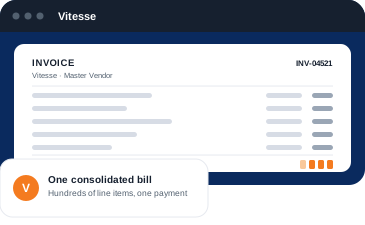
Consolidated invoicing. If you’re still processing thousands of individual invoices for small MRO purchases, your AP team is spending time on low-value work. A good managed service consolidates everything into a single invoice, dramatically reducing processing workload.
Category visibility. You can’t manage what you can’t see. The provider should auto-classify every routed purchase so you can see what’s being bought, from whom, at what price, and whether a preferred vendor already exists for that category.
Fast onboarding. This is a dealbreaker in manufacturing. If a new vendor takes six to eight weeks to onboard, your plant teams will continue to work around the system. The best managed services can have suppliers active in days.
How to Evaluate Providers: The Questions That Matter
Once you’ve identified potential providers, the evaluation comes down to a few key questions:
How fast can they onboard a new supplier? Urgency is the reality of MRO. If the provider can’t onboard a vendor quickly enough to meet plant-floor timelines, adoption will fail. Look for providers that measure onboarding in business days, not weeks.
How many procurement categories do they cover? MRO is broad. You need a provider that can handle purchases across the full range of maintenance, repair, and operations categories without requiring you to carve out exceptions.
Can they handle multi-country complexity? If your manufacturing footprint spans multiple countries, your managed service needs to manage downstream vendor payments, taxes, tariffs, and reconciliation across jurisdictions. This is where many providers fall short.
What visibility will you actually get? Ask to see the analytics. Can they show you real-time spend by category, by vendor, by site? Can they identify where a preferred supplier already exists for a given category? Visibility without actionable classification is just data.
What does adoption look like for your plant teams? The best procurement management process in the world fails if nobody uses it. Evaluate how the provider handles the employee experience. Routing purchases through the service should be simple enough that plant managers actually do it, even under time pressure.
Where Simfoni’s Vitesse Fits
Vitesse is Simfoni’s managed master-vendor service for tail spend, and MRO in manufacturing is one of its core use cases. Employees route small purchases through Vitesse, which vets the vendor and purchase before payment, handles onboarding, and consolidates everything into one invoice. Downstream vendor payments, taxes, tariffs, and reconciliation are managed across countries.
A few specifics that matter for manufacturing procurement teams:
Onboarding speed. Most suppliers are active within 1 to 3 business days, compared to the 6 to 8 weeks that’s typical in many enterprise environments. That’s the difference between a system plant teams will actually use and one they’ll route around.
Category coverage. Every routed purchase is auto-classified across 200+ procurement categories, giving you real-time visibility into what’s being bought and from whom.
AP workload reduction. Vitesse clients see an average 70% lower invoice processing workload. For manufacturing organizations processing thousands of small MRO invoices per month, that’s a meaningful operational improvement.
Vendor reduction. On average, clients reduce their small vendor count by 30%, with one case study showing a 62% reduction. Fewer vendors means less administrative overhead, better compliance, and more negotiating leverage.
Vitesse is trusted by 250+ finance and procurement teams, including organizations like Sodexo, IKEA, and Glencore.
Making the Decision
MRO procurement will always be fragmented. That’s the nature of the category. The question is whether you continue absorbing the administrative cost of managing thousands of small vendor relationships in-house, or whether you consolidate through a managed service that gives you visibility, compliance, and speed.
If you’re a procurement director or CPO evaluating managed procurement services for MRO, start with the criteria above. The right provider should make tail spend visible, compliant, and operationally simple, without requiring your plant teams to change the way they work in any dramatic way.
The savings are real. So is the time your team gets back.