Most procurement leaders arrive at the outsourcing conversation after months of wrestling with fragmented data across multiple ERPs, a backlog of savings opportunities nobody has time to pursue, and a growing pile of unclassified tail spend that finance keeps flagging but nobody owns.
Spend management outsourcing is increasingly the answer, and it’s a different conversation than traditional procurement outsourcing. Understanding the distinction is critical to making the right investment.
Spend Management Outsourcing vs. Full Procurement Outsourcing
Full procurement outsourcing, sometimes called procurement as a service, typically means handing over entire procurement operations to a third party: sourcing, supplier management, contract administration, even transactional buying. It’s a big move with big implications for internal capability and control.
Spend management outsourcing is narrower and, for many organizations, more practical. You’re outsourcing the data layer: aggregation, classification, analytics, and ongoing insight delivery. You may also outsource specific execution layers like tail-spend management. Strategic sourcing decisions, supplier relationships, and category strategy stay with your team.
Full procurement outsourcing replaces your function. Spend management outsourcing augments it. You keep the judgment. You outsource the grunt work and the infrastructure that makes good judgment possible.
When Spend Management Outsourcing Makes Sense
There’s no single trigger. But if you recognize two or more of the following scenarios, the case for outsourcing becomes hard to ignore.
Your analytics capability doesn’t match your data complexity. Organizations running multiple ERPs, operating across regions, or growing through acquisition often have spend data scattered across systems with inconsistent taxonomies. Building an internal analytics function that can aggregate, normalize, and classify all of that data is expensive and slow. Outsourcing it to a provider with purpose-built AI classification can collapse months of work into weeks.
Your procurement team is lean and strategic. A team of five category managers shouldn’t be spending 40% of their time cleaning spreadsheets. If your headcount is optimized for strategic work but your data infrastructure demands operational effort, outsourcing the analytics layer frees your team to do what they were hired to do.
You need speed. Internal analytics builds take quarters. A strong procurement service provider with the right architecture can deliver first dashboards in days, not months. When the CFO wants visibility into $500 million of addressable spend by the next board meeting, speed matters.
Tail spend is consuming disproportionate resources. If your AP team is processing thousands of invoices from hundreds of small vendors, each requiring onboarding, vetting, and payment, that’s a management burden with almost no strategic value. It’s a natural outsourcing candidate.
You need ongoing insight, not a one-time data cleanse. Many organizations have tried the “big data project” approach: hire a consultancy, classify historical spend, get a report, watch it go stale. Spend management outsourcing, done right, delivers continuous, real-time intelligence that evolves with your spend.
What to Outsource vs. What to Keep In-House
Getting this boundary right is the difference between a successful engagement and a frustrating one. Here’s a practical framework.
Outsource: data aggregation and classification. This is high-volume, technically demanding work that benefits enormously from AI and scale. A provider classifying thousands of records per minute with continuously improving models will outperform most internal teams.
Outsource: tail-spend execution. The fragmented, low-value, high-volume purchases that clog your AP process and create vendor sprawl. A managed service for tail spend can consolidate thousands of small vendors into a single relationship, handling vetting, onboarding, invoicing, and payment.
Keep in-house: strategic sourcing decisions. Category strategy, supplier selection for critical categories, negotiation on high-value contracts. These require institutional knowledge, relationship context, and strategic judgment. No outsourcing model should remove your team from these decisions.
Keep in-house: stakeholder alignment. Internal change management, executive reporting narratives, and cross-functional alignment are yours to own. A good provider gives you the data and dashboards; your team gives them meaning inside the organization.
Keep in-house: award decisions. Even when you outsource sourcing execution or analytics, the final call on who gets the business stays with your team. Tools and providers should score, rank, and optimize. Humans decide.
How to Evaluate a Spend Management Outsourcing Provider
The quality of managed procurement services varies widely. Here’s what to look for.
Data integration speed. How fast can the provider connect to your systems and deliver initial insights? If the answer involves a six-month implementation, the value proposition erodes quickly. Best-in-class providers can deliver first dashboards within roughly seven days.
Classification accuracy and methodology. Ask whether classification is AI-driven, manual, or hybrid. Ask whether the model improves over time. One-time classification degrades as your spend evolves. You need supervised and unsupervised learning that continuously refines.
Ongoing insight delivery. Dashboards are table stakes. What you really need is proactive intelligence: alerts on maverick spend, commodity price shifts, tariff exposure, supplier consolidation opportunities. The provider should surface what matters before you ask.
Pricing alignment. This is where many engagements go sideways. Avoid large upfront license fees for capabilities you haven’t validated yet. Consumption-based pricing, where you pay based on actual usage, aligns the provider’s incentives with your outcomes. For tail-spend management, a pay-as-you-save model ensures the provider only earns when you do.
Guaranteed outcomes. Any provider confident in their approach should be willing to commit to measurable results. Ask about guaranteed ROI, timeline to value, and what happens if targets aren’t met.
Where Simfoni Fits
Simfoni’s approach to spend management outsourcing operates on two layers.
Strategic Spend Hub (SSH) functions as an outsourced analytics and intelligence layer. It’s Snowflake-native, meaning it sits on infrastructure your IT team likely already trusts, and runs on consumption-based pricing with no upfront license fees. AI-driven classification, real-time dashboards, proactive alerts, and the Virgil AI conversational agent let your team ask questions of their own data in natural language across analytics, sourcing pipeline, eSourcing, and contracts. First dashboards can be live within roughly seven days. SSH also carries a guaranteed ROI.
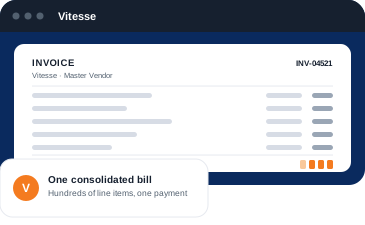
Vitesse is a managed master-vendor service for tail spend. It consolidates thousands of small purchases through a single relationship, vetting vendors and purchases before payment, handling onboarding (most suppliers active within one to three business days), and delivering one consolidated invoice. The results are concrete: an average of 70% lower invoice processing workload, $1.5 million in average vendor management costs saved per year, and 30% fewer small vendors cluttering your tail spend. Trusted by 250+ finance and procurement teams, Vitesse is purpose-built for the fragmented purchases that consume disproportionate operational effort.
Together, they cover the two layers of spend management outsourcing that deliver the most immediate value: intelligence and tail-spend execution. Your team keeps strategic control. The data and operational burden shifts to infrastructure and services designed for exactly that purpose.
Measuring Success
Once you’ve outsourced, track three things. First, time to insight: how quickly did you move from contract signature to actionable dashboards? Second, operational load reduction: measure AP headcount hours, invoice volumes, and vendor onboarding timelines before and after. Third, savings realized, not projected, but realized. Any provider worth engaging should help you track the delta between identified opportunities and captured value.
Spend management outsourcing works when the scope is right, the pricing is aligned, and the outcomes are measurable. Define what you’re outsourcing, keep what matters in-house, and hold your provider accountable to real numbers.