Every retail organization with more than a handful of locations faces the same structural problem. Stores, regional offices, and distribution centers all generate their own purchasing activity, much of it small, fragmented, and largely invisible to central procurement. Multiply that by hundreds or thousands of locations, and you have a sprawling tail of vendors, invoices, and compliance gaps that no amount of staffing can keep up with.
This is where retail procurement managed services become essential. The question is what “managed” should actually mean for a retail business, and how to evaluate providers so that you solve the problem rather than add another layer of complexity.
The Multi-Location Procurement Problem
Retail procurement teams are built to manage strategic categories: merchandise, logistics, facilities, marketing. The sourcing decisions that drive competitive advantage rightly receive the most attention. But underneath those strategic categories sits a long tail of indirect spend: maintenance supplies, local signage, janitorial services, one-off equipment purchases, temporary staffing, and thousands of similar transactions that happen at the store level every week.
The aggregate volume of these purchases is enormous, the vendor base is sprawling, and the purchasing behavior is decentralized by design. Store managers need to buy what they need quickly. They do not have time to navigate a sourcing process, and most are not trained to vet vendors for compliance, insurance, or tax documentation.
The consequences are predictable. Accounts payable teams process thousands of small invoices with limited automation. Finance lacks visibility into what is being purchased, from whom, and at what price. Compliance gaps accumulate quietly. Preferred vendors are bypassed because nobody at the store level knows they exist. And procurement leaders cannot report on tail-spend patterns because the data is fragmented across locations, ERPs, and P-card systems.
What Managed Procurement Services Should Actually Deliver for Retail
The phrase “managed procurement services” covers a wide range of offerings, from staff augmentation to full outsourcing. For retail organizations dealing with multi-location tail spend, the most impactful model is one that acts as a consolidation layer between your locations and the thousands of small vendors they use.
Specifically, effective procurement services for retail should address four things simultaneously.
Vendor consolidation and onboarding. Rather than requiring every location to find, vet, and onboard its own vendors, a managed service should handle vendor qualification centrally. This includes insurance verification, tax documentation, sanctions screening, and compliance checks, completed before any payment is made. Onboarding should be measured in days, not weeks.
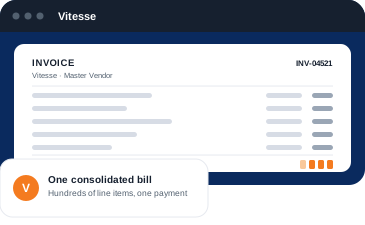
Invoice and payment consolidation. The managed service should aggregate all small-vendor transactions into a single invoice stream. This is one of the highest-impact changes a retail finance team can make. When thousands of individual invoices collapse into a consolidated view, AP workload drops dramatically and reconciliation becomes manageable.
Real-time spend visibility by category and location. Every purchase routed through the managed service should be auto-classified and made visible in analytics dashboards. Procurement directors and CFOs need to see what each location is buying, identify category patterns, detect whether preferred vendors are being used, and flag outliers. Without this visibility, tail spend remains a blind spot regardless of how well the rest of the procurement function operates.
Compliance controls that work at the point of purchase. Compliance in a decentralized retail environment must be enforced at the moment of transaction. The managed service must vet both the vendor and the purchase before payment is released. This is the only way to ensure that every transaction, even a $200 local services purchase at a single store, meets your organization’s standards.
How to Evaluate Retail Procurement Managed Services Providers
When assessing digital procurement services for multi-location retail, the evaluation criteria should reflect the specific complexity of your environment.
Coverage breadth. Can the provider handle purchases across all of your tail-spend categories, not just a narrow slice? Retail tail spend spans everything from equipment repair to event services to specialty printing. A provider limited to a few categories will leave gaps.
Onboarding speed. Ask for specific timelines. If a store manager needs a new vendor, how quickly can that vendor be vetted and activated? Best-in-class providers complete onboarding in one to three business days. If the answer is weeks, the service will be bypassed.
Compliance rigor. Understand exactly what checks happen before payment. Sanctions screening, e-invoicing compliance, insurance verification, and tax documentation should all be standard. For retailers operating across countries, the provider must handle local tax, tariff, and regulatory requirements.
Analytics depth. The provider should auto-classify every purchase across a broad taxonomy (200 or more procurement categories is a reasonable benchmark) and surface that data in real-time dashboards. You should be able to answer questions like “How much did we spend on facility maintenance vendors in the Southeast last quarter?” without manual data pulls.
Multi-location scalability. This is the filter that eliminates most general-purpose procurement services providers. A retail chain with 500 locations generates a volume and variety of small transactions that requires purpose-built infrastructure, not a generic consulting model.
A Dual-Approach: Tail Spend Consolidation Plus Enterprise Spend Visibility
Retail organizations that solve this problem well tend to address it at two levels simultaneously.
At the tail-spend level, Vitesse acts as a managed master-vendor service for all fragmented, low-value purchases across locations. Employees route small purchases through Vitesse, which vets the vendor and purchase before payment, handles onboarding, and consolidates everything into a single invoice. Downstream, Vitesse manages vendor payments, taxes, tariffs, and reconciliation across countries. The result is measurable: an average 70% reduction in AP invoice processing workload, 80% faster supplier onboarding, and $1.5M in average vendor management cost savings per year. Every routed purchase is auto-classified across 200+ procurement categories, giving procurement and finance teams the real-time visibility that tail spend has always lacked.
At the enterprise level, Strategic Spend Hub provides AI-powered spend analytics, sourcing pipeline management, and savings tracking across all categories. For retail procurement directors managing both strategic and indirect spend, SSH surfaces opportunities that would otherwise stay hidden: maverick spend patterns, supplier consolidation candidates, contract compliance gaps, and category trends across the full spend portfolio. Its Snowflake-native architecture means dashboards can be live within days, and the Virgil AI agent lets users ask natural-language questions across their spend, sourcing, and contract data.
Together, these two solutions close the loop. Vitesse handles the high-volume, low-value transactions that overwhelm AP and create compliance risk. SSH provides the strategic visibility and sourcing execution capability that turns spend data into measurable savings. Trusted by 250+ finance and procurement teams, including major retail and consumer brands, this dual approach addresses the full spectrum of the multi-location retail procurement challenge.
Moving from Reactive to Proactive
The shift from reactive tail-spend management to proactive, data-driven procurement services does not require a multi-year transformation program. It requires the right consolidation layer at the point of purchase and the right analytics layer at the enterprise level. For retail procurement leaders, CFOs, and CPOs looking to scale indirect spend management across locations, the path forward starts with understanding exactly where fragmented spend is creating cost, risk, and inefficiency, and then routing it through a system designed to handle that complexity.