Your procurement suite handles strategic categories well. It runs RFx events for high-value contracts, manages supplier relationships with your top 50 vendors, and gives leadership the dashboards they need. But when it comes to the thousands of small, fragmented purchases that make up your tail spend, that same suite creates more friction than value.
This is the core tension procurement directors and CFOs face when evaluating tail spend management software. The tools built for strategic sourcing were never designed for the high-volume, low-value purchasing that defines the tail. Trying to force-fit them creates onboarding bottlenecks, compliance blind spots, and an AP workload that scales in the wrong direction.
If you’re evaluating tail spend management solutions, this guide covers what the software actually needs to do, why general procurement suites fall short, and how to compare tail spend management providers on the criteria that matter.
What Tail Spend Management Software Actually Needs to Do
Tail spend is a specific problem. It involves hundreds or thousands of suppliers, each handling relatively small purchase volumes. These transactions are often unmanaged, meaning they sit outside contract coverage, bypass preferred vendors, and generate a disproportionate number of invoices relative to their value.
Effective tail end spend management software needs to solve five problems simultaneously:
Vendor consolidation. The primary job is reducing the number of suppliers your team touches directly. Instead of managing 3,000 small vendors, you route purchases through a single master vendor that handles downstream supplier relationships, payments, and compliance on your behalf.
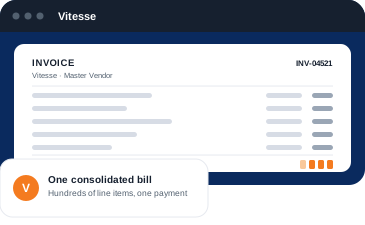
One-invoice processing. Every small vendor creates its own invoice, payment terms, and reconciliation burden. Tail spend management software should collapse that into a single consolidated invoice, dramatically reducing the AP workload per transaction.
Compliance vetting before payment. With strategic suppliers, your team has time to run thorough due diligence. With tail vendors, the pressure to “just get it done” often wins. The right solution vets vendors and purchases before payment, applying configurable controls, e-invoicing checks, and real-time sanctions screening automatically.
Rapid supplier onboarding. If it takes six to eight weeks to onboard a new small vendor, employees will find workarounds. Tail spend software should compress onboarding to days, removing the incentive to go around the system.
Real-time category visibility. Most organizations cannot answer basic questions about their tail spend: What are we buying? From whom? Is there a preferred vendor for this category? Tail spend management software should auto-classify every routed purchase across procurement categories and surface that data in real time.
Why General Procurement Suites Fall Short for Tail Spend
General procurement suites are engineered for a fundamentally different problem. They excel at managing high-value, low-volume strategic sourcing, where the cost of running a structured process (RFx, evaluation, negotiation, contract execution) is justified by the size of the spend.
Tail spend inverts that equation. The individual transactions are small, the vendor count is enormous, and the cost of applying a full procurement process to each purchase exceeds the value of the purchase itself.
Here is where the mismatch shows up in practice:
Onboarding economics. Strategic suites treat supplier onboarding as a thorough, multi-step process. That’s appropriate for a vendor you’ll spend $5M with annually. It’s a barrier when you need a $2,000 part from a specialty fabricator next week.
Invoice volume. These platforms are built to manage hundreds of supplier relationships efficiently. Tail spend can involve thousands of vendors generating tens of thousands of low-value invoices. The administrative cost per invoice stays high because the system was designed for fewer, larger transactions.
Compliance coverage. Strategic suites apply robust compliance to managed suppliers. Tail vendors, by definition, often sit outside that managed population. The result is a compliance gap precisely where risk is hardest to see.
Category visibility. Without purchases flowing through a managed channel, tail spend remains a black box. You see the aggregate number on your P&L, but you cannot drill into categories, identify consolidation opportunities, or detect maverick purchasing patterns.
General procurement suites solve their intended problem well. They simply were not designed for the fragmented, high-transaction-count reality of tail spend.
Evaluation Criteria: How to Compare Tail Spend Management Providers
When evaluating tail spend management solutions, the criteria differ meaningfully from a traditional procurement software evaluation. Here is what to prioritize:
Onboarding speed. Ask providers for their average time-to-active for new suppliers. Best-in-class providers activate most suppliers within one to three business days. If a provider cannot give you a concrete number, that is a signal.
Category coverage. How many procurement categories does the solution classify across? Broader coverage means better analytics and more accurate identification of consolidation opportunities. Look for solutions covering 200 or more categories.
Compliance controls. Understand exactly what gets vetted and when. The strongest solutions vet both the vendor and the purchase before payment. Ask about sanctions screening, e-invoicing compliance, and how controls are configured for different geographies.
AP workload reduction. This is one of the most measurable ROI drivers. Consolidating thousands of vendor invoices into one invoice should produce a significant, quantifiable reduction in invoice processing effort. Ask for benchmarks from existing customers.
Pricing model. This is where tail spend management providers diverge sharply. Traditional software charges license fees regardless of outcomes. Some providers use a pay-as-you-save model, aligning their revenue with measurable cost reductions. For a CFO evaluating the business case, the pricing model is as important as the capability set.
Analytics depth. Can the solution show you what was bought, from whom, whether a preferred vendor exists, and how spend patterns change over time? Or does it simply process transactions? The analytics layer is what turns tail spend management from a cost center into a source of strategic insight.
Software vs. Managed Service vs. Hybrid: Understanding the Spectrum
This is the most important architectural decision in your evaluation, and the one most often overlooked.
Pure software gives you a platform and expects your team to run the process. This works when you have dedicated staff for tail spend, which most organizations do not.
Pure managed service outsources everything but offers limited visibility. You reduce workload, but you lose insight into what is happening with your spend.
Hybrid models combine a managed master-vendor service with built-in analytics. Your team gets the workload reduction of outsourcing and the visibility of a software platform. Purchases are routed, vetted, consolidated, and paid through the service, while real-time dashboards give procurement and finance teams continuous insight into categories, vendors, and compliance.
Vitesse is an example of this hybrid approach. It operates as a managed master-vendor service, consolidating thousands of small purchases into one invoice and handling vendor vetting, onboarding, and downstream payments, including taxes, tariffs, and reconciliation across countries. At the same time, every routed purchase is auto-classified across 200+ procurement categories, giving teams real-time visibility they never had before. Trusted by 250+ finance and procurement teams, including organizations like Sodexo, IKEA, and DocuSign, Vitesse has demonstrated measurable impact: an average of 70% lower invoice processing workload, supplier onboarding that is 80% faster, and $1.5M in average vendor management costs saved per year.
Making the Right Choice
The decision comes down to whether your current tools can realistically manage the volume, fragmentation, and compliance demands of your tail spend. If they cannot, and for most organizations they cannot, a purpose-built tail spend management solution will deliver faster, more measurable results than trying to extend a strategic procurement suite into territory it was never designed for.
Start your evaluation with the criteria above. Ask providers for specific, quantifiable benchmarks. And pay close attention to whether their model aligns cost with outcomes, because in tail spend, that alignment is what separates a line item from a value driver.