Every procurement organization has a version of the same problem. Strategic categories get attention, competitive sourcing events, negotiated contracts, quarterly business reviews. Then there is everything else: the thousands of small purchases flowing through the organization with no owner, no process, and no visibility. That is tail spend, and it has a way of quietly draining resources while everyone focuses on the big-ticket items.
The challenge is that building a credible business case to justify action is harder than recognizing the issue. Most procurement leaders know that tail spend exists and that it creates risk. The spend itself is fragmented, the vendors are numerous, and the savings per transaction look small in isolation. If you are a CPO, Procurement Director, or CFO trying to move from awareness to action, this article provides a framework for doing exactly that.
Why Tail Spend Needs a Strategy, a Sustained Operating Model
Tail spend is a recurring cycle, and it regenerates. Every quarter, new vendors enter the system, employees find new suppliers for one-off needs, and small purchases accumulate outside of contracts. A project-based approach, running a spend analysis, consolidating a few categories, then moving on, addresses the symptom without fixing the underlying dynamic.
A genuine tail spend strategy accounts for this cycle. It establishes ongoing governance, defines how small purchases are routed and controlled, and creates a sustainable operating model rather than a point-in-time intervention. Without that strategic foundation, you will find yourself revisiting the same problem 12 months later with the same fragmented vendor base and the same compliance gaps.
Building the Business Case: Quantify What Unmanaged Tail Spend Actually Costs
The reason tail spend stays unmanaged is often that no one has done the math. When you do, the numbers tend to get executive attention quickly.
AP processing cost. Industry estimates put the cost of processing a single invoice between $15 and $40, depending on the level of automation. Multiply that by the number of tail spend suppliers, many of whom send a handful of invoices per year, and you get a substantial cost that delivers no strategic value.
Vendor management overhead. Every supplier in your system carries an administrative burden: onboarding, master data maintenance, tax documentation, payment inquiries. When thousands of those vendors account for a small fraction of total spend, the cost-to-value ratio is inverted.
Compliance and risk exposure. Tail spend suppliers are the least likely to have been vetted against sanctions lists, insurance requirements, or data-privacy standards. Every unvetted vendor is a potential audit finding or regulatory exposure.
Missed savings. Fragmentation means no leverage. When the same category of spend is spread across dozens of suppliers with no coordination, you are paying list price repeatedly instead of consolidating volume.
A straightforward business case model multiplies these cost drivers across your actual tail spend volume. For most enterprises, the result is a seven-figure annual cost that is largely invisible until someone quantifies it.
Three Strategic Approaches to Managing Tail Spend
Once the business case establishes the “why,” the next question is “how.” There are three primary approaches, and understanding when each applies is critical to selecting the right path.
Vendor consolidation. Reduce the number of tail spend suppliers by directing volume toward preferred vendors in common categories. This works well when tail spend is concentrated in a few categories where alternatives already exist under contract. It requires category management capacity and employee compliance, both of which can be difficult to sustain for low-value purchases.
Process automation. Implement catalog-based purchasing, automated approvals, and streamlined onboarding to reduce the transactional cost of each tail purchase. Automation lowers the per-transaction burden but does not solve the problem of vendor proliferation or compliance gaps. It makes the existing process cheaper without necessarily making it better.
Managed service. Outsource the operational management of tail spend to a master-vendor model. Employees route small purchases through a single provider that handles vendor vetting, onboarding, payment, and consolidation. This approach addresses all four cost drivers simultaneously: it reduces vendor count, lowers AP workload, enforces compliance before payment, and creates consolidated visibility.
Decision Framework: When to Use Which Approach
These approaches are not mutually exclusive. The right tail spend strategy often combines elements of all three, applied to different segments of the tail.
Consolidation is most effective for repeat-purchase categories where preferred suppliers already exist and the challenge is simply directing spend. Office supplies, standard MRO, and common professional services are typical examples.
Automation makes sense when transaction volume is high but the vendor base is relatively stable. If the same suppliers are used repeatedly for low-value purchases, reducing the processing cost per transaction delivers clear ROI.
A managed service is the right choice when the tail is truly fragmented, meaning high vendor count, low repeat rates, diverse categories, and multinational complexity. This is the segment where internal resources cannot economically scale, and where compliance risk is highest because purchases are ad hoc and vendors are unfamiliar.
For most enterprises, the managed-service approach addresses the largest and most problematic portion of the tail, while consolidation and automation handle the more structured edges.
From Strategy to Execution
Building the business case is the first step. Executing the strategy requires two things: visibility into where the tail spend actually sits, and an operating model to manage it.
On the visibility side, Spend Analytics provides the foundation. AI-driven classification can process thousands of spend records per minute, identifying which categories, suppliers, and business units contribute to the tail. The Strategic Spend Hub extends this with opportunity identification and ongoing tracking, so you can quantify the tail spend problem with real data and monitor outcomes after you act.
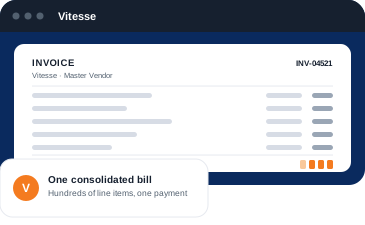
On the execution side, Vitesse is Simfoni’s managed master-vendor service purpose-built for tail spend. It consolidates thousands of small purchases through one master vendor, vetting suppliers and purchases before payment, handling onboarding, and delivering a single consolidated invoice. The results are measurable: an average of 70% lower invoice processing workload, 30% fewer small vendors, supplier onboarding reduced from weeks to 1 to 3 business days, and an average of $1.5M in vendor management costs saved per year. More than 250 finance and procurement teams, including Sodexo, IKEA, VISA, and DocuSign, use Vitesse to manage their tail.
The combination matters. Analytics quantifies the opportunity and builds the business case. A managed service executes on it. Savings tracking closes the loop by showing the CFO exactly what the initiative delivered.
The Real Risk Is Inaction
Tail spend will grow, fragment further, and continue to absorb resources that could be deployed against strategic priorities. The organizations that treat tail spend management as a strategic initiative consistently recover more value and reduce more risk than those that wait.
The business case is straightforward to build once you have the data. The question is whether your organization is ready to move from knowing the problem exists to owning the solution.