Five years ago, if you searched for tail spend management providers, you would have found almost nothing. A few consultancies offered one-off projects. A handful of niche firms were experimenting with managed services. There was no established market, no standard feature set, and no consensus on what “tail spend management” even meant.
Today, the category is real, but it is still maturing. And that creates a specific challenge for CPOs and procurement directors evaluating their options: how do you compare tail spend management companies when there is no universally accepted framework for what good looks like?
This article gives you one.
Why the Tail Spend Market Still Feels Unstructured
Most procurement technology categories have had decades to consolidate around shared definitions. Source-to-pay suites, spend analytics platforms, and contract management tools all follow recognizable patterns. Buyers know what to expect.
Tail spend management services are different. The category emerged from a gap that traditional procurement ignored: the high-volume, low-value purchases, often thousands of transactions across hundreds or thousands of suppliers, that fall below strategic sourcing thresholds. Because no single legacy system was designed for this problem, providers have approached it from very different directions.
That means the vendor you evaluate might be a consulting firm running a one-time cleanup, a software company selling a self-service platform, or a managed-service provider handling operations on your behalf. These are fundamentally different offerings, and comparing them requires understanding which model fits your problem.
Three Provider Models You Will Encounter
When evaluating tail spend management companies, the first step is to classify the type of provider you are talking to.
Consulting-led (one-time project). A tail spend management consulting company in this model will analyze your spend, identify consolidation opportunities, and deliver a set of recommendations. The engagement typically lasts a few months. Once the project ends, execution is your responsibility. This model works if you have internal capacity to act on findings, but it does not solve the ongoing operational burden of managing thousands of small vendors.
Technology-led (software platform). These providers sell a platform that gives your team tools to manage tail spend in-house. The value depends heavily on whether your team has the bandwidth and expertise to use the platform effectively. If tail spend is a low priority for your sourcing team (and for most organizations, it is), a software license alone rarely moves the needle.
Managed-service-led (ongoing outsourced operation). In this model, the provider takes on the operational work: vendor vetting, onboarding, payment, compliance, and reporting. Your team routes purchases through the provider, who acts as a master vendor. This approach addresses both the visibility gap and the execution gap, which is why it has gained traction with enterprise finance and procurement teams that need results without adding headcount.
Most buyers evaluating tail spend management providers today are looking at some version of the managed-service model, either pure-play or hybrid. It is worth understanding where each provider falls on that spectrum before diving into feature comparisons.
An Evaluation Framework for Tail Spend Management Providers
Once you know the model, apply these six criteria to compare providers side by side.
Coverage breadth. How many procurement categories does the provider support, and in how many geographies? Tail spend is inherently diverse. A provider that only covers a few categories or a single region will leave significant gaps. Look for coverage across 200 or more procurement categories and multi-country operations.
Onboarding speed. One of the biggest pain points in tail spend is the time it takes to onboard new vendors. If your current process takes six to eight weeks, a provider that can get suppliers active in one to three business days is delivering immediate operational value.
Compliance rigor. Ask specifically how the provider vets vendors and purchases. Do they screen before or after payment? Do they handle e-invoicing checks, sanctions screening, and tax compliance across jurisdictions? If a provider cannot articulate their compliance process in detail, treat that as a disqualifying gap.
Analytics and reporting. Tail spend is a visibility problem as much as an operational one. The provider should auto-classify every routed purchase and give you real-time reporting on what was bought, from whom, and whether a preferred vendor already exists. Without this, you are outsourcing operations without gaining intelligence.
Pricing model. Pay attention to how the provider charges. License fees with no tie to measurable outcomes put the financial risk on you. Providers that align pricing with demonstrated savings (such as a pay-as-you-save model) share the risk and have a built-in incentive to perform.
Scalability. Your tail spend profile will change. Acquisitions, new geographies, and category expansions should not require renegotiating the entire engagement. Ask how the provider handles growth.
Red Flags to Watch For
In a market this young, some providers have yet to earn the right to call themselves a tail spend management solution. Watch for these warning signs:
- No clear compliance process. If the provider cannot explain exactly how they vet vendors and purchases before payment, they are managing invoices, not risk.
- License fees without AP savings evidence. If you are paying for software but your accounts payable workload does not measurably decrease, the provider is adding cost without removing it.
- One-time cleanup framing. Tail spend regenerates continuously. Providers who frame their offering as a one-time fix are solving last quarter’s problem while next quarter’s grows unchecked.
- No category classification. If the provider cannot tell you what you bought, organized by category, they are a payment intermediary, not a management solution.
Where Vitesse Fits
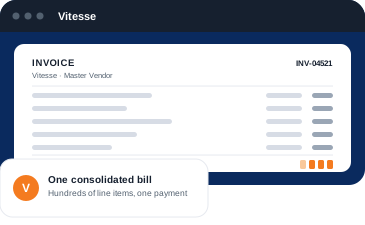
Simfoni’s Vitesse is a managed master-vendor service for tail spend. Employees route small purchases through Vitesse, which vets the vendor and purchase before payment, handles onboarding, and consolidates everything into a single invoice. Downstream, Vitesse manages vendor payments, taxes, tariffs, and reconciliation across countries.
Every routed purchase is auto-classified across 200+ procurement categories, giving procurement and finance teams real-time visibility into tail spend patterns, including whether a preferred vendor already exists. Supplier onboarding drops from six to eight weeks to one to three business days. AP workload decreases by an average of 70%. And the pricing model is pay-as-you-save, meaning Simfoni’s incentives are aligned with yours.
Vitesse is trusted by 250+ finance and procurement teams, including organizations like Sodexo, IKEA, VISA, and DocuSign. For enterprise finance leaders and CPOs who need to bring tail spend under control without building a new internal team, it is a model worth evaluating against the framework above.
Making the Comparison Work
The tail spend management market is still young enough that providers define themselves differently. That is why a structured evaluation framework matters more here than in mature categories. Know the model you need, apply the criteria consistently, and hold providers to specific, measurable commitments on compliance, onboarding, and savings.
The providers who can answer your hardest questions with specifics are the ones worth shortlisting.