You have budget approval, a shortlist of four or five vendors, and a steering committee that includes your CFO. The demos are scheduled. Now comes the part most procurement leaders dread: building an evaluation framework rigorous enough to survive finance scrutiny and flexible enough to reflect what your team actually needs.
Choosing the best procurement software for an enterprise is rarely a technology decision alone. It is a business-case decision, a change-management decision, and, increasingly, a data-architecture decision. This article gives you a structured framework for shortlisting, a set of demo questions you can use with any vendor, and a clear picture of what to prioritize when the field narrows.
What Enterprise Buyers Are Really Choosing Between
Before you score features, step back and identify the structural choices that will shape every conversation on your shortlist.
Suite vs. modular. Some platforms bundle analytics, sourcing, contracts, and supplier management into a single monolithic suite. Others let you start with one capability and expand. The right answer depends on your current maturity, your integration landscape, and how quickly you need value. A modular approach with a unified data layer often delivers faster wins without forcing a multi-year, all-or-nothing rollout.
Data architecture. Where does your spend data live, and who controls it? Legacy procurement management software typically copies data into a proprietary warehouse, creating lag and governance risk. Newer architectures run natively on cloud data platforms, keeping your data in an environment your IT and finance teams already trust.
Depth of AI. Every vendor claims AI. The question is whether it classifies spend, surfaces opportunities, or actually lets users interact with data conversationally. There is a meaningful gap between a static dashboard and an AI agent that answers “What’s our maverick spend in EMEA this quarter?” in plain language.
Pricing model. Upfront license fees vs. consumption-based pricing vs. transaction fees. Finance cares about this more than procurement sometimes realizes. A consumption model tied to actual usage lowers adoption risk and aligns cost with value.
A Shortlisting Framework in Seven Dimensions
Use this framework to score every vendor on your list. Weight each dimension according to your organization’s priorities, but do not skip any of them. Finance will ask about the ones you leave blank.
1. Data foundation. Can the platform aggregate spend from ERPs, P-cards, AP systems, and contract tools? How fast is classification, and how accurate? Look for AI-driven classification that improves continuously, not a one-time data load that goes stale.
2. Analytics depth. Go beyond basic spend cubes. Does the platform offer price variance analysis, tail spend analysis, supplier consolidation insights, commonality analysis, ESG and supplier diversity reporting, and trend analysis with seasonality and outlier detection? These capabilities determine whether you can move from reporting to action.
3. Sourcing execution. Can you launch an eRFx or eAuction from within the same environment where you identified the opportunity? Multi-round bidding, configurable scoring with section and question-level weighting, and structured supplier Q&A forums are table stakes for enterprise complexity. Decision optimization, where the platform scores, ranks, and compares bids while leaving the award decision with your team, is what separates mature tools from basic ones.
4. Savings tracking. Projected savings mean little if you cannot track them through to realized impact. The best procurement software closes the loop: from opportunity identification through sourcing execution to verified P&L impact. If savings tracking lives in a separate spreadsheet, you have a reporting gap that finance will exploit.
5. AI capability. Ask specifically: can users ask natural-language questions across analytics, sourcing pipeline, and contracts in one conversational interface? Can the AI generate proactive alerts on tariff shifts, commodity price changes, or off-contract spend? A conversational AI layer that works across modules is materially different from a chatbot bolted onto a single screen.
6. Pricing model. Map each vendor’s pricing to your CFO’s preferred risk profile. Consumption-based models with no upfront license fee are easier to defend in a business case because cost scales with usage. Ask every vendor to show you what Year 1 and Year 3 look like under realistic adoption scenarios.
7. Time to value. Enterprise procurement software implementations that take 12 to 18 months carry significant risk. Ask for specific timelines: when will you see your first dashboard? When will your first sourcing event run through the platform? Weeks matter more than months.
Questions to Put to Every Vendor in the Demo
Bring these to every shortlist demo. They are designed to surface real capability gaps without creating adversarial dynamics.
- “Show me how spend data from our three ERPs would be classified. What accuracy rate do you guarantee, and how does the model improve over time?”
- “Walk me through the workflow from identifying a sourcing opportunity in analytics to launching an RFQ. How many clicks or handoffs does that require?”
- “How does your platform track savings from projected opportunity through to realized impact on the P&L?”
- “Can a user ask a natural-language question that spans analytics and sourcing data in a single query?”
- “What does your pricing look like if our usage doubles in Year 2? Show me the model.”
- “What is the fastest a customer has gone from contract signature to first live dashboard?”
- “How do you handle supplier discovery? What dimensions can I search on?”
- “Show me how the platform handles maverick spend detection and alerts.”
Document answers side by side. Finance will want to see a normalized comparison, not a stack of slide decks.
Where Simfoni Fits in This Framework
Strategic Spend Hub (SSH) was built around the closed-loop model this framework describes: spend insight, sourcing execution, measurable savings. It unifies Spend Analytics, Sourcing Pipeline, eSourcing Execution, and Savings Tracking in a single Snowflake-native environment. You do not need to already use Snowflake to adopt it.
A few specifics worth noting against the framework dimensions above. On data foundation, SSH uses AI-driven classification that processes thousands of records per minute and improves continuously. On AI capability, Virgil, Simfoni’s conversational AI agent, lets users talk to their data across analytics, sourcing, and contracts in one interface. On pricing, SSH runs on consumption-based Snowflake credits with no upfront license fee, a model that aligns naturally with CFO expectations. On time to value, customers typically see first dashboards within about 7 days.
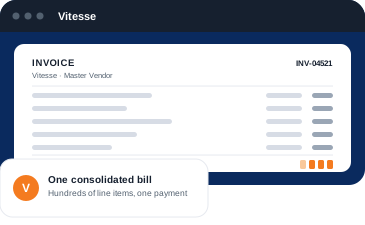
For organizations that also need to address fragmented tail spend, Vitesse operates as a managed master-vendor service, consolidating thousands of small purchases into one invoice and reducing AP workload by an average of 70%.
Making the Decision Stick
The best procurement software evaluation is the one your CFO co-signs. Build your shortlist around a framework that speaks finance’s language: data integrity, measurable ROI, pricing predictability, and time to value. Score rigorously, document demo answers consistently, and keep the conversation anchored in outcomes rather than features.
Your steering committee does not need to become procurement experts. They need a structured comparison they can trust. Give them that, and the decision will hold.