Every enterprise finance leader knows the feeling. You look at your accounts payable data and see hundreds, sometimes thousands, of small vendors generating a fraction of total spend but consuming a disproportionate share of your team’s time. Each one needs onboarding, vetting, invoicing, and payment. Each one introduces risk. And yet, individually, none of them is large enough to justify a formal sourcing process.
That is the tail. And until you address it deliberately, it will quietly drain resources from every corner of finance and procurement.
What Is Tail Spend?
Tail spend is the high-volume, low-value slice of an organization’s purchasing. It typically represents around 20% of total spend by dollar value, but it can account for 80% or more of suppliers and transactions. These are the one-off purchases, the emergency buys, the niche services that don’t fit neatly into a negotiated contract.
It is important to distinguish tail spend from indirect spend more broadly. Indirect spend covers everything a company buys that does not go directly into a finished product: software licenses, consulting, facilities management, office supplies, travel, professional services. Some of that indirect spend is large, concentrated, and well-managed through strategic sourcing. Tail spend is the fragmented, often unmanaged remainder. Think of it as the long, thin end of the spend distribution curve, where transaction counts are high but individual purchase values are low.
Why the Tail Resists Control
If tail spend management were straightforward, every organization would have solved it years ago. The challenge is structural.
Sheer volume of vendors. A midsize enterprise might have 3,000 to 5,000 active suppliers in the tail. Each needs to be vetted for compliance, set up in the ERP, issued a purchase order, invoiced, and paid. The administrative cost per transaction can exceed the value of the purchase itself.
Decentralized buying. Tail purchases happen across departments, geographies, and business units. The marketing team orders signage from a local printer. A plant manager sources a replacement part from a specialist. An HR team engages a freelance trainer. No single category manager owns the tail, so no single person can fix it.
Low visibility. Because these purchases are small, they often bypass procurement entirely. They show up as P-card charges, expense reimbursements, or one-time invoices. Without classification and aggregation, finance has no clear picture of what is being bought, from whom, or whether better options exist.
Compliance and risk gaps. When vendors are not formally vetted, the organization absorbs risk: sanctions exposure, tax reporting errors, missed e-invoicing requirements, and inconsistent payment terms across countries.
The result is a paradox. Tail spend is individually trivial and collectively expensive to ignore.
How a Master-Vendor Model Works
A master-vendor approach addresses the structural problems of tail spend by consolidating thousands of supplier relationships into one. Here is the core logic.
Routing. Employees route their small purchases through a single master vendor instead of engaging suppliers directly. The request goes to the master vendor, not to AP.
Vetting. Before any payment is made, the master vendor vets both the supplier and the purchase. This closes the compliance gap that opens when purchases bypass procurement.
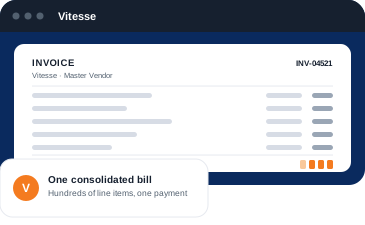
Consolidation. Instead of processing thousands of individual invoices, finance receives one consolidated invoice from the master vendor. The master vendor handles downstream payments, taxes, tariffs, and reconciliation across countries.
Classification. Every routed purchase is automatically classified, giving finance and procurement real-time visibility into what was bought, from whom, and whether a preferred vendor already exists.
The model does not replace strategic sourcing for high-value indirect categories. It handles the fragmented, low-value tail that strategic sourcing was never designed to address.
What Finance Gains
For CFOs and finance leaders, tail spend management through a master-vendor model delivers measurable operational improvement.
Reduced invoice processing workload. Consolidating thousands of small invoices into one changes the economics of AP. Organizations using Vitesse, Simfoni’s managed master-vendor service for tail spend, see a 70% lower average invoice processing workload.
Lower vendor management costs. Vetting, onboarding, paying, and reconciling thousands of small suppliers is expensive. Vitesse customers save an average of $1.5M per year in vendor management costs.
Fewer suppliers to manage. Consolidation reduces the number of active small vendors by an average of 30%, simplifying the supplier base without limiting what employees can buy.
Compliance built in. Every purchase is vetted before payment, with configurable controls, e-invoicing checks, and real-time sanctions screening. Finance does not have to choose between speed and compliance.
These are not hypothetical projections. They reflect outcomes across more than 250 finance and procurement teams, including organizations like Sodexo, IKEA, VISA, and DocuSign.
Frequently Asked Questions
Who owns tail spend, finance or procurement?
In practice, both. Procurement sets the policies and often identifies the tail as a problem, but finance feels the operational burden most acutely: the invoice volume, the payment complexity, the reconciliation across entities and countries. That is why enterprise finance is increasingly the primary buyer of tail spend management solutions. The most effective programs treat it as a shared initiative with finance as the operational owner and procurement as the strategic partner.
How is tail spend different from indirect spend?
Indirect spend is the broad category of non-production purchases. It typically represents 20% to 40% of total organizational spend and includes everything from large SaaS contracts to consulting engagements to facilities management. Tail spend is the fragmented, low-value portion within indirect spend. It is characterized by high transaction volumes, many small suppliers, and limited procurement oversight. A large facilities management contract is indirect spend. A one-time purchase of replacement light fixtures from a local supplier is tail spend.
How can procurement manage the tail without adding headcount?
This is the central tension. Traditional procurement approaches (running RFPs, negotiating contracts, managing supplier relationships) do not scale to thousands of low-value transactions. The cost of managing each purchase would exceed its value. A master-vendor model solves this by shifting the operational work (vetting, onboarding, invoicing, payment, reconciliation) to the master vendor. Procurement retains visibility and control through analytics and configurable compliance rules without needing to add staff. The tail gets managed. The team stays focused on strategic categories where their expertise delivers the greatest return.
Moving Forward
Tail spend management is a finance efficiency problem that procurement can help solve. If your AP team is processing thousands of small invoices, if your compliance team is chasing vendor documentation, and if your procurement leaders cannot see what the organization is buying in the tail, the master-vendor model offers a proven path to control.
Vitesse was built for exactly this challenge. It consolidates thousands of small purchases with one master vendor, giving finance the visibility, compliance, and workload reduction the tail has always resisted.