Most procurement teams know their indirect spend is a problem. The challenge is that it’s rarely one problem. It’s two very different ones, and treating them with a single tool almost always leaves gaps.
A Procurement Director managing $500M in indirect categories faces a portfolio that ranges from multi-million-dollar consulting engagements to $800 office supply orders. These two extremes behave nothing alike. They have different risk profiles, different stakeholder dynamics, and different failure modes. Yet many organizations evaluate indirect procurement software as though one platform should handle both equally well.
That assumption is where most indirect procurement strategies start to break down.
The Indirect Procurement Definition That Actually Matters for Software Selection
The textbook indirect procurement definition covers any goods or services not directly incorporated into a finished product: IT, facilities, professional services, travel, MRO, marketing, office supplies, and dozens of other categories. Useful as a starting point, but not useful for choosing software.
What matters more is the shape of the spend. Indirect breaks into two distinct patterns, and each one demands a fundamentally different approach.
Concentrated indirect includes your high-value, strategically significant categories. Large SaaS contracts, consulting engagements, facilities management, fleet services, logistics. These categories involve fewer suppliers, higher contract values, longer negotiation cycles, and significant savings potential per event. They reward structured sourcing, competitive bidding, and active category management.
Fragmented tail spend is the opposite. It consists of thousands of low-value, high-volume transactions spread across hundreds or even thousands of small vendors. Office supplies, ad hoc services, one-time purchases, specialized parts. No single transaction justifies a full sourcing event, but collectively this tail can represent 20% or more of your indirect spend and consume a disproportionate share of AP and procurement resources.
A sound indirect procurement strategy treats these two shapes differently. Your software should, too.
What Concentrated Indirect Spend Needs
For your high-value indirect categories, the core requirements are visibility, structured sourcing, and measurable savings tracking.
Spend visibility and classification. You cannot manage categories you cannot see. Indirect data is notoriously messy, spread across ERPs, P-cards, AP systems, and contract tools. Effective indirect procurement software must aggregate and classify this data accurately across hundreds of categories, normalize supplier names, and surface patterns like maverick spend or off-contract purchases.
A sourcing pipeline and competitive events. Concentrated indirect categories benefit from structured RFx processes, multi-round bidding, and eAuctions. The ability to move from opportunity identification through sourcing execution to award in one workflow eliminates the handoff gaps where savings leak.
Savings tracking. Identifying a savings opportunity is only half the job. Tracking whether projected savings actually reach the P&L, with visibility into realized versus projected numbers, is what turns procurement from a cost center narrative into a value-creation story the CFO trusts.
Strategic Spend Hub (SSH) was built for this shape of indirect spend. As a Snowflake-native solution, it unifies spend analytics, sourcing pipeline management, eSourcing execution, and savings tracking in a single environment. AI-driven classification handles thousands of records per minute. Virgil, Simfoni’s conversational AI agent, lets users query their own connected data in natural language across analytics, sourcing, and contracts. And capabilities like Push-to-Source let teams launch competitive events directly from identified opportunities, closing the loop between insight and action.
What the Fragmented Tail Needs
The tail demands an entirely different approach. Running a formal sourcing event for every $1,200 purchase is impractical; it costs more in labor than it saves.
What the tail needs is consolidation: fewer vendors, fewer invoices, less onboarding friction, and better compliance controls on the purchases that are most likely to slip through the cracks.
The core requirements here are:
Vendor consolidation and managed onboarding. Instead of maintaining relationships with hundreds of small suppliers, route purchases through a single managed channel that handles vetting, onboarding, and payment.
Compliance before payment. Small purchases are where policy violations, duplicate payments, and sanctions risks hide. Vetting each purchase and vendor before payment, rather than after, changes the risk profile entirely.
AP workload reduction. Processing thousands of small invoices is expensive. Consolidating them into a single invoice stream frees finance resources for higher-value work.
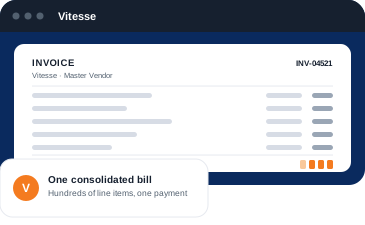
Vitesse addresses the tail as a managed master-vendor service. Employees route small purchases through Vitesse, which vets the vendor and purchase, handles onboarding (most suppliers are active within 1 to 3 business days), and consolidates everything into one invoice. The results are measurable: an average 70% reduction in invoice processing workload, 30% fewer small vendors in the tail, and $1.5M in average vendor management costs saved per year. Over 250 finance and procurement teams, including organizations like Sodexo, IKEA, and VISA, rely on it.
The distinction matters. Vitesse is scoped to the fragmented, low-value tail. High-value concentrated indirect, your large SaaS contracts and consulting engagements, belongs in a structured sourcing workflow.
Evaluation Criteria Specific to Indirect
When assessing indirect procurement software, four criteria deserve particular attention.
Classification depth across indirect categories. Generic classification that works well for direct materials often fails on indirect, where categories range from legal services to janitorial supplies. Look for AI-driven classification that handles 200+ procurement categories and improves continuously.
Maverick and off-contract spend detection. Indirect is where maverick spend thrives. Your software should flag purchases that bypass preferred suppliers or existing contracts automatically, rather than through quarterly manual audits.
Sourcing integration. Analytics without execution is a report. Execution without analytics is guesswork. The ability to move from spend insight to sourcing event to tracked savings in one workflow is what separates effective indirect procurement software from expensive dashboards.
Finance alignment. Indirect spend touches finance as much as procurement. Consumption-based pricing models, AP integration, and clear savings attribution help both teams work from the same numbers.
How the Two Tools Cover Both Shapes Together
The most effective indirect procurement strategy acknowledges that concentrated and fragmented spend are different problems and applies the right tool to each.
SSH provides the visibility, sourcing execution, and savings tracking that high-value indirect categories require. Vitesse provides the consolidation, compliance, and AP efficiency that the fragmented tail demands. Together, they cover the full spectrum of indirect spend without forcing either shape into a workflow designed for the other.
For Procurement Directors and CPOs building or refining an indirect procurement strategy, the first step is understanding how your indirect spend actually breaks down. The second is choosing software that respects that breakdown rather than pretending it does not exist.