Every healthcare organization has a spend category that absorbs disproportionate risk relative to its dollar value. The thousands of small, fragmented purchases scattered across clinical supplies, lab consumables, facilities maintenance, consulting services, and one-off equipment repairs often receive far less attention than the large imaging equipment contracts or the pharmaceutical agreements negotiated through GPOs. This is healthcare tail spend, and in regulated environments, it is one of the most overlooked sources of compliance exposure.
For procurement directors and CFOs in healthcare and pharma, the challenge goes beyond awareness. Most leaders know tail spend exists. The challenge is that traditional procurement infrastructure was never designed to manage it, and the consequences of leaving it unmanaged are amplified in an industry where vendor compliance is essential.
The Scale of the Problem
Tail spend in healthcare typically represents 20 to 30% of a system’s supplier base while accounting for only 5 to 10% of total spend value. That ratio creates a structural problem: a large volume of vendors, each processing relatively small transactions, with minimal oversight per transaction.
In most organizations, these purchases flow through P-cards, one-off purchase orders, or informal departmental processes. Each transaction individually seems low-risk. Collectively, though, they represent thousands of vendor relationships where basic compliance checks, such as sanctions screening, tax documentation, insurance verification, and regulatory credentialing, may not happen consistently or at all.
In healthcare specifically, this matters more than in most industries. A facilities vendor servicing a hospital wing may need specific insurance coverage. A lab supplier may be subject to export controls. A clinical staffing agency may need credentialing verification. When these purchases bypass the structured procurement process, compliance gaps accumulate quietly until an audit or incident surfaces them.
Why Traditional Approaches Fall Short in Healthcare
Healthcare procurement teams generally rely on a few mechanisms to manage purchasing: GPO contracts for strategic categories, preferred supplier lists, P-card programs, and manual onboarding for new vendors. Each of these has clear limitations when it comes to the long tail.
GPO contracts cover strategic, high-volume categories. They are effective for pharmaceuticals, med-surg supplies, and capital equipment. They rarely extend to the fragmented tail: the niche service providers, local maintenance firms, specialty lab suppliers, or one-time purchases that don’t fit neatly into a contract template.
P-card programs enable fast purchasing but lack pre-purchase controls. A P-card transaction is approved after the fact, if it’s reviewed at all. There is no mechanism to vet a vendor for sanctions compliance or verify insurance before payment is made. In a regulated environment, this is a meaningful gap.
Manual vendor onboarding is thorough but slow. Healthcare organizations often require 6 to 8 weeks to fully onboard a new supplier through standard processes. For a $2,000 lab supply order or an urgent facilities repair, that timeline is impractical. The result is predictable: departments find workarounds, purchases bypass procurement entirely, and compliance visibility drops.
The question facing healthcare procurement leaders is how to manage tail spend in procurement without building a parallel bureaucracy that slows down the very purchases it’s trying to control.
What Effective Tail Spend Management Looks Like in Regulated Industries
Solving this problem requires a different model than what works for strategic spend. The volume is too high and the individual transaction value too low for traditional sourcing processes. At the same time, the compliance requirements in healthcare are too serious for a hands-off approach.
Effective tail spend management in healthcare shares a few characteristics:
Pre-payment vetting as a default. Every vendor and every purchase should be screened before payment is processed. This includes real-time sanctions screening, tax and insurance verification, and configurable compliance checks that reflect the organization’s specific regulatory requirements. The vetting needs to happen automatically, without requiring procurement staff to manually review each small transaction.
Rapid supplier onboarding. If onboarding a new tail-spend vendor takes 6 to 8 weeks, the process will be bypassed. Reducing that to days rather than weeks is essential for adoption. Clinical and facilities teams need supplies and services on operational timelines, and any tail spend management approach that cannot match those timelines will be ignored in practice.
Consolidated visibility. One of the core problems with fragmented tail spend is that no one can see the full picture. Purchases are spread across departments, cost centers, and payment methods. Effective management requires aggregating and classifying every routed purchase so procurement and finance can see what was bought, from whom, at what cost, and whether a preferred or contracted vendor already exists for that category.
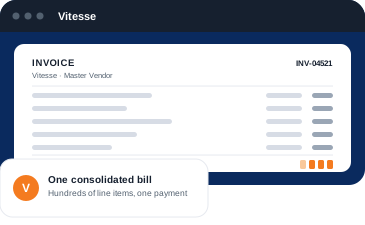
Reduced administrative burden. Healthcare finance teams are already stretched. If a tail spend program adds invoice volume or reconciliation complexity, it creates resistance. Consolidating thousands of small vendor invoices into a single consolidated invoice, with downstream vendor payments, tax handling, and reconciliation managed externally, removes friction rather than adding it.
How Simfoni Addresses Healthcare Tail Spend
Vitesse, Simfoni’s managed master-vendor service for tail spend, was built around exactly this model. Employees route small purchases through Vitesse, which vets the vendor and purchase before payment, handles onboarding, and consolidates everything into one invoice. Simfoni then manages downstream vendor payments, taxes, tariffs, and reconciliation across countries.
For healthcare organizations, several capabilities are particularly relevant:
Compliance controls are built into the workflow. Every routed purchase passes through configurable controls, including e-invoicing checks and real-time sanctions screening. In a sector where vendor compliance failures carry regulatory consequences, this pre-payment layer addresses a gap that P-cards and manual processes cannot fill.
Supplier onboarding drops from weeks to days. Vitesse activates most suppliers within 1 to 3 business days, compared to the 6 to 8 week timelines common in healthcare procurement. This means clinical and facilities teams get what they need on schedule, through a compliant channel, rather than routing around procurement.
Operational results are measurable. Organizations using Vitesse see an average 70% reduction in invoice processing workload, a 30% reduction in small vendors on their tail spend, and an average of $1.5M in vendor management costs saved per year. For healthcare CFOs evaluating where to focus process improvement, those numbers represent meaningful AP and finance capacity recovered.
Every purchase routed through Vitesse is auto-classified across 200+ procurement categories, giving procurement leaders real-time visibility into tail spend patterns. That visibility often surfaces consolidation opportunities, preferred-vendor compliance gaps, and category-level trends that were previously invisible.
Moving From Risk Exposure to Controlled Spend
Healthcare procurement teams operate under a unique set of pressures: regulatory scrutiny, budget constraints, clinical urgency, and organizational complexity. Tail spend sits at the intersection of all four. It is too fragmented for strategic sourcing, too risky for unmanaged purchasing, and too high-volume for manual oversight.
The organizations that manage it well treat it as a distinct operational challenge, with purpose-built controls, fast onboarding, and consolidated visibility. Those that don’t will continue to absorb compliance risk on every small purchase that slips through the cracks.
If your team is evaluating how to bring tail spend under control in a regulated environment, the starting point is understanding what you’re spending, with whom, and whether basic compliance checks are happening before payment. Everything else follows from there.