A chemistry lab orders specialized glassware from a local supplier. The athletics department buys custom printing from a vendor across town. Facilities management contracts a one-time HVAC repair. The English department purchases software licenses for a digital humanities project. None of these purchases are large enough to trigger formal sourcing, and none of the buyers are coordinating with each other.
Multiply this across dozens of departments, hundreds of cost centers, and thousands of transactions per semester, and you have the higher education tail spend problem in full view. It is a visibility, compliance, and vendor management problem that quietly consumes institutional resources while flying under the radar of strategic procurement.
Why Higher Education Tail Spend Is Uniquely Difficult
Most organizations struggle with tail spend. Universities struggle more, for structural reasons.
Decentralization is the operating model. Unlike corporations, where procurement can set policy and expect compliance, universities operate as federations of semi-autonomous units. Academic departments, research labs, athletics programs, administrative offices, and auxiliary services all maintain their own budgets and, in practice, their own purchasing habits. Faculty members often view purchasing autonomy as inseparable from academic freedom.
The vendor universe is enormous and constantly shifting. A mid-size university might maintain active relationships with 3,000 to 5,000 small vendors in a given year. Many of these vendors serve a single department, fulfill a handful of orders, and then go dormant. New ones appear every semester as research projects launch, courses change, and departmental needs evolve.
Compliance requirements apply to every single one. Each vendor, regardless of spend volume, needs W-9 collection, insurance verification, tax reporting, and payment processing. For universities receiving federal research funding, the compliance bar is even higher: cost allowability reviews, conflict-of-interest checks, and audit trail documentation are all required, down to the smallest purchase.
The result is a paradox: the purchases that matter least strategically create the most administrative work per dollar spent.
The Hidden Costs Nobody Budgets For
When finance leaders look at tail spend in higher education, the direct purchase costs are rarely the concern. A $400 lab supply order or a $1,200 printing job is not going to move the institutional budget. The costs that accumulate are operational.
Accounts payable workload. Processing a $400 invoice costs roughly the same in staff time as processing a $40,000 invoice. When thousands of small invoices flow through AP every month, often with inconsistent formats, missing PO references, or incomplete vendor records, the processing burden is disproportionate to the spend.
Vendor onboarding delays. Setting up a new vendor in most university ERP systems takes weeks. Paperwork moves between the requesting department, procurement, risk management, and AP. For time-sensitive purchases (a replacement part for lab equipment, materials for an event next week), those weeks are unacceptable. So departments find workarounds: P-cards with limited controls, personal reimbursements, or simply pressuring AP to expedite outside the normal process.
Audit exposure. Every workaround creates a gap in the audit trail. For institutions subject to federal single audits, state reporting requirements, or accreditation reviews, those gaps represent real risk. And the risk is not hypothetical. Audit findings related to purchasing controls and vendor documentation are among the most common in higher education.
Why Top-Down Mandates Fall Short
The instinctive response is to centralize. Require all purchases above $500 to go through procurement. Mandate use of the institutional P2P system. Restrict P-card spending categories.
These policies look clean on paper. In practice, they fail for a predictable reason: they add friction to purchases that faculty and department heads consider routine and low-risk. When a researcher needs a $300 component to keep an experiment running, a multi-day approval workflow feels like institutional bureaucracy interfering with academic work. The result is creative avoidance, and the tail spend problem moves further from visibility rather than closer to it.
The real opportunity is managing tail spend in a way that preserves the purchasing flexibility departments need while giving finance and procurement the visibility, compliance, and cost control they require.
A Different Model: Centralize the Back Office, Preserve the Decision
This is where tail spend management solutions have evolved. The most effective approach separates the purchasing decision (what to buy, from whom) from the operational burden (vetting, onboarding, payment, compliance documentation, and reporting).
Vitesse, Simfoni’s managed master-vendor service for tail spend, is built on exactly this principle. Employees still choose what to buy and from which supplier. The difference is that purchases route through a single master vendor that handles the administrative complexity downstream.
Here is what that looks like in a university context:
Vendor vetting happens before payment, every time. Each purchase is reviewed against configurable controls, including real-time sanctions screening and e-invoicing checks, before any payment is issued. Departments do not need to manage compliance documentation themselves, and finance does not need to worry about unvetted vendors entering the payment stream.
Supplier onboarding drops from weeks to days. Most suppliers are active within 1 to 3 business days, compared to the 6 to 8 weeks typical of traditional university onboarding. That speed eliminates the pressure to create workarounds and keeps purchases inside the managed process.
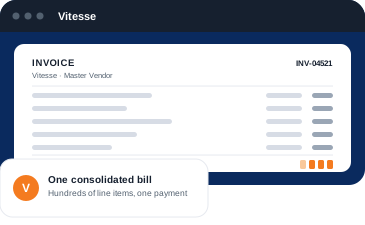
One consolidated invoice replaces thousands. Instead of processing invoices from every small vendor individually, AP receives a single invoice from Vitesse. Downstream vendor payments, tax reporting, tariffs, and reconciliation are handled on the university’s behalf. The impact is significant: organizations using Vitesse see an average 70% reduction in invoice processing workload.
Every purchase is auto-classified and visible. Spend is automatically categorized across 200+ procurement categories, giving finance and procurement leaders real-time visibility into what departments are buying, from whom, and whether preferred or contracted vendors already exist for those categories.
The Institutional Case for Tail Spend Management
For procurement directors and CFOs in higher education, the value of getting tail spend under control extends beyond operational efficiency.
Audit readiness improves. When every small purchase is vetted, documented, and tracked through a single channel, the audit trail is complete by default rather than assembled retroactively.
Vendor proliferation decreases. Organizations using Vitesse reduce their small-vendor base by an average of 30%, which simplifies institutional reporting and reduces risk surface area.
Real cost savings emerge. Average vendor management cost savings reach $1.5M per year, and supplier onboarding timelines improve by 80%. Those are resources that can be redirected to strategic procurement initiatives or other institutional priorities.
Departments stay autonomous. Faculty and department heads retain the flexibility to purchase what they need without navigating a centralized approval process. The institutional controls happen in the background, which means compliance increases without friction increasing alongside it.
Getting Started
Higher education tail spend will never be eliminated. Departments will always need to make small, varied, time-sensitive purchases from a rotating cast of suppliers. The goal is to route that activity through a process that protects the institution without burdening the people making the purchases.
For procurement directors and finance leaders exploring how to manage tail spend more effectively, the first step is understanding what you are currently spending, with how many vendors, and at what administrative cost. That baseline makes the path forward clear.