Most procurement teams know they have a tail spend problem. The data tells them so: hundreds or thousands of suppliers, scattered across dozens of categories, each representing a small fraction of total spend. What most teams can’t answer is the harder question: where exactly are the savings hiding within that long tail, and how much is actually recoverable?
Tail spend analysis is the systematic process of breaking down an organization's unmanaged or lightly managed spend to identify which segments offer real, recoverable savings and which are not worth the effort. This analysis answers three critical questions: where value is leaking, how much is realistically recoverable after accounting for constraints, and what actions procurement teams should prioritize first. Ultimately, tail spend analysis provides a prioritized, quantified action plan, moving beyond mere data classification to drive tangible savings for procurement teams.
That gap between awareness and action is where value gets left on the table. And it’s why tail spend analysis, done with the right methodology, is one of the highest-leverage exercises a procurement team can undertake.
Why Knowing You Have Tail Spend Isn’t Enough
Here’s a scenario that plays out in procurement organizations every quarter. Leadership acknowledges that 20-30% of their indirect spend sits in the tail. Someone pulls a report. The team looks at it, agrees it’s messy, and moves on to the next strategic sourcing event because there’s no clear path from “we see the problem” to “here’s where to act first.”
The issue isn’t visibility. It’s analytical rigor. Without a structured approach to segmenting, quantifying, and prioritizing tail spend, procurement teams default to either ignoring it entirely or applying broad-stroke strategies that don’t account for the nuance within the long tail.
Tail spend isn’t one problem. It’s hundreds of micro-problems, each with different root causes, different savings levers, and different levels of effort to address. Treating it as a monolith is the first mistake.
What Is Tail Spend Analysis?
Tail spend analysis is the systematic process of breaking down your unmanaged or lightly managed spend to identify which segments offer real, recoverable savings and which ones aren’t worth the effort. It goes beyond categorization. It answers three questions:
- Where is value leaking? Which suppliers, categories, or transaction patterns are costing you more than they should?
- How much is recoverable? What’s the realistic savings potential after accounting for switching costs, compliance requirements, and operational constraints?
- What should you act on first? Where does the effort-to-impact ratio make sense for your team’s capacity?
This is distinct from spend classification or supplier rationalization, though it draws on both. The goal is a prioritized, quantified action plan, not just a cleaner dataset.
A Practical Methodology for Tail Spend Analysis
How Can You Get Your Tail Spend Data Right (Or Right Enough)?
Tail spend data is inherently messy. Transactions come from P-cards, one-off POs, expense reports, and systems that don’t talk to each other. Waiting for perfect data means waiting forever.
Start with what you have. Pull AP data, P-card feeds, and any catalog or contract data you can access. The goal at this stage is coverage, not perfection. You need enough data to see patterns, even if some records are incomplete.
Common pitfall: spending months cleaning data before doing any analysis. Clean as you go. The analysis itself will reveal where data quality matters most.
How Should You Classify and Segment Tail Spend Beyond Simple Tiers?
Most organizations define tail spend with an arbitrary threshold: the bottom 20% of spend, or anything under $50K per supplier. These thresholds create blind spots.
A better approach segments tail spend along multiple dimensions:
- Category type: Is this a commodity with market pricing, a service with negotiation leverage, or a niche purchase with limited alternatives?
- Supplier fragmentation: How many suppliers are serving the same category? High fragmentation often signals consolidation opportunity.
- Transaction frequency: Are these one-time purchases or recurring needs being fulfilled through ad hoc buying?
- Contract coverage: Is this spend covered by any agreement, or is it completely unmanaged?
This multi-dimensional view reveals clusters of opportunity that a simple spend ranking would miss.
How Can You Score Tail Spend Savings Potential Realistically?
Not every dollar of tail spend has the same savings potential. A rigorous analysis applies different savings estimates based on category dynamics, not a flat percentage across the board.
Consider these factors:
- Market competitiveness: Categories with multiple capable suppliers typically yield higher savings through competitive bidding.
- Current pricing vs. benchmarks: Where are you paying significantly above market? That’s your low-hanging fruit.
- Switching costs: Some categories have high switching friction (specialized services, integrated software). Factor that into your net savings estimate.
- Transaction costs: If it costs $200 in process effort to save $150 on a purchase, that’s not a real savings opportunity. Include the cost of managing the change.
How Should You Prioritize Tail Spend Opportunities for Action, Not Just Savings Size?
The final step is building a prioritized roadmap. Rank opportunities not just by total savings potential, but by feasibility, speed to value, and resource requirements.
A useful framework:
- Quick wins: High savings potential, low complexity, minimal change management. Act now.
- Strategic plays: Significant savings but requires supplier negotiation, contract work, or stakeholder alignment. Plan for next quarter.
- Monitor: Low savings potential or high complexity. Flag for future review, don’t invest resources today.
Common Pitfalls That Undermine Tail Spend Analysis
Even well-intentioned analysis efforts go sideways. Watch for these:
- Treating all tail categories the same. Office supplies and specialized lab equipment don’t respond to the same sourcing strategy. Your analysis should reflect that.
- Ignoring demand management. Sometimes the savings lever isn’t better pricing, it’s reducing unnecessary purchases altogether. Analysis should flag categories where demand reduction is the real opportunity.
- One-and-done analysis. Tail spend is dynamic. New suppliers creep in, maverick buying resurfaces, contracts expire. Analysis needs to be continuous, not annual.
- Manual-only approaches. Spreadsheet-based tail spend analysis can work for a first pass, but it doesn’t scale, and it can’t keep up with the pace at which tail spend shifts.
How to Manage Tail Spend in Procurement Without Burning Out Your Team
This is where most teams hit a wall. The analysis reveals real opportunities, but executing against hundreds of small-value categories with a team already stretched thin on strategic sourcing isn’t realistic.
Long tail spend management requires a different operating model than strategic category management. It needs automation, standardized processes, and technology purpose-built for high-volume, lower-value transactions.
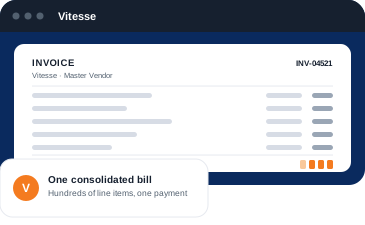
This is exactly what Simfoni’s Vitesse platform is designed to address. Vitesse routes employee purchases through one controlled workflow, then acts as your single master vendor: it handles vetting, onboarding, compliance checks, and payment for any staff vendor purchase, anywhere. Your strategic team stays focused on higher-value categories instead of chasing hundreds of small suppliers.
Real-time analytics auto-classify every transaction across 200+ categories, so you can see what employees are buying, which vendors they are using, and where a preferred vendor could leverage spend better. Compliance controls vet the vendor and purchase details before payment, catching out-of-policy or unauthorized spend before it happens.
The result is that the savings hiding in your tail spend become visible and actionable, with finance making a single consolidated payment to Vitesse instead of reconciling a flood of invoices from a long vendor list.
Start With the Analysis. Then Automate the Execution.
Tail spend analysis is the foundation. Without it, you’re guessing at where the savings are. With it, you have a clear, prioritized map of where to focus.
But analysis without execution is just an expensive spreadsheet. The organizations that consistently capture savings from their indirect spend tail are the ones that pair rigorous analysis with a scalable execution model.
If your team has been staring at tail spend data without a clear path to action, start with the methodology above. And when you’re ready to move from insight to savings, explore how Simfoni’s Enterprise Tail Spend platform can help.