Most procurement teams can draw the process flow for direct spend from memory. Raw materials, components, finished goods: the steps are well-defined, the stakeholders are known, and the systems are mature.
Indirect procurement is a different story. Hundreds of requesters across dozens of departments buy everything from IT licenses to janitorial supplies to consulting services. Categories are wildly diverse, approval paths vary by location and business unit, and individual transaction values are often too low to justify the same rigor applied to strategic spend. The result? A process flow that exists on paper (maybe) but rarely plays out the same way twice.
If you’re a procurement manager or director trying to bring structure to this chaos, the first step is understanding what makes the indirect procurement process flow unique, then mapping it clearly enough to spot where it breaks down and how to fix it.
What Is Indirect Procurement, and Why Does Its Process Flow Differ?
So what is indirect procurement? It covers the goods and services a company needs to operate but that don’t become part of a finished product sold to customers. Think office supplies, facilities management, professional services, travel, marketing, software subscriptions, and MRO (maintenance, repair, and operations).
Three characteristics make the indirect procurement process flow fundamentally different from its direct counterpart:
- Decentralized requesters. In direct procurement, a small group of planners and buyers drives demand. In indirect, virtually anyone in the organization can initiate a purchase. That means more variation, more exceptions, and more potential for spend to bypass procurement entirely.
- Diverse and fragmented categories. A single company might manage 200 or more indirect categories, each with its own supplier base, pricing model, and compliance requirements.
- Lower individual transaction values. Many indirect purchases fall below formal sourcing thresholds, which often means they receive little scrutiny, even though they add up to 20 to 40% of total organizational spend.
These traits make standardization harder but also more valuable. Every improvement in process consistency translates directly into better visibility, fewer compliance gaps, and measurable savings.
Mapping the End-to-End Indirect Procurement Process Flow
A complete indirect procurement process flow typically follows eight stages. Not every purchase touches all eight with equal formality, but mapping them gives you a baseline you can optimize against.
1. Need identification. A business user recognizes a requirement: a new software tool, a facilities repair, a marketing agency engagement. In many organizations, this step is invisible to procurement until a purchase order or invoice surfaces weeks later.
2. Sourcing and vendor selection. The requester (or a procurement team member) identifies potential suppliers, gathers quotes, and evaluates options. For higher-value indirect spend, this may involve a formal RFx process. For lower-value purchases, it often happens informally, if it happens at all.
3. Approval. The purchase request moves through an approval workflow that may vary by category, dollar threshold, department, or geography. Inconsistent or manual approval paths are one of the most common sources of delay and maverick spending.
4. Purchase order creation. A formal PO is issued to the selected vendor. In practice, a significant share of indirect purchases skip this step entirely, creating downstream reconciliation problems.
5. Receipt and delivery confirmation. The goods or services are delivered and acknowledged. For services and digital goods, confirming receipt can be ambiguous, leading to disputes and payment delays.
6. Invoice processing. The supplier submits an invoice, which must be matched against the PO and receipt before payment. Manual invoice processing is time-intensive and error-prone, especially when POs were never created.
7. Payment. The approved invoice is paid according to agreed terms. When vendors are numerous and invoice formats vary, payment processing becomes a bottleneck.
8. Spend classification and analysis. The completed transaction is categorized, aggregated, and analyzed to inform future sourcing decisions, compliance monitoring, and savings tracking.
Where the Process Typically Breaks Down
Knowing the steps is easy. The hard part is acknowledging where your organization’s version of them falls apart. Four breakpoints appear consistently across indirect procurement teams:
- Fragmented sourcing. When every department sources independently, you lose leverage. The same category gets purchased from dozens of vendors at different prices with no negotiated terms.
- No spend visibility. If transactions aren’t classified until months after the fact (or at all), procurement can’t identify savings opportunities, consolidation targets, or compliance risks in time to act on them.
- Maverick purchasing. Without clear, accessible approval paths, employees buy what they need through whatever channel is fastest. Off-contract spend erodes negotiated savings and introduces vendor risk.
- Manual invoice processing. Paper invoices, email-based approvals, and spreadsheet tracking consume hours of AP time per transaction, especially when hundreds or thousands of small vendors are involved.
These are the norm for most organizations that haven’t deliberately designed and enforced their indirect procurement process flow.
How Technology Addresses Each Breakpoint
Applying indirect procurement best practices starts with the right tools at the right points in the workflow. Here’s how modern technology maps to the breakpoints above.
Spend classification and visibility. AI-powered Spend Analytics can aggregate data from ERPs, P-cards, AP systems, and contracts, then classify thousands of records per minute. Instead of waiting for a quarterly report, procurement teams get real-time dashboards that surface maverick spend, consolidation opportunities, and category-level trends as they emerge.
Competitive sourcing for mid-value indirect. eSourcing platforms bring structure to the vendor selection stage. Templated RFx events, multi-round bidding, automated scoring of objective criteria, and centralized supplier Q&A make it practical to run competitive events even for categories that historically went unsourced. Teams that adopt structured eSourcing typically see 10 to 15% savings per event.
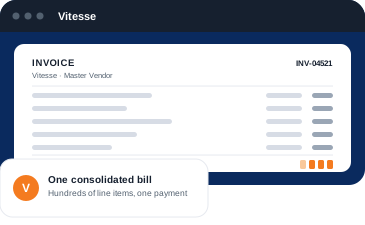
Tail-spend management for high-volume, low-value purchases. The long tail of indirect spend, thousands of small transactions across hundreds of vendors, is where process discipline is hardest to maintain. Vitesse, a managed master-vendor service, addresses this by consolidating small purchases through a single master vendor. Employees route purchases through Vitesse, which vets vendors and purchases before payment, handles onboarding (typically within 1 to 3 business days), and consolidates everything into one invoice. Organizations using Vitesse see an average 70% reduction in invoice processing workload and 30% fewer small vendors in their tail spend.
Ongoing insight across the workflow. Conversational AI, like the Virgil agent inside the Strategic Spend Hub, lets procurement teams ask natural-language questions across analytics, sourcing pipelines, events, and contracts in a single interface. Rather than building a new report every time a stakeholder asks “What are we spending with Supplier X?”, the answer is a conversation away.
Start with the Map, Then Close the Gaps
Improving your indirect procurement process flow doesn’t require a complete transformation on day one. Start by mapping the eight stages as they actually happen in your organization, not how they’re documented in a policy manual. Identify which breakpoints are costing you the most in time, savings leakage, or risk exposure. Then address them in order of impact.
The organizations that get indirect procurement right treat the process flow as a living system: continuously measured, continuously improved, and supported by technology that matches the complexity of the spend it manages.