Every organization buys things. Raw materials, office supplies, consulting services, software licenses. The distance between “we need this” and “we paid for this” is where millions of dollars in value are either captured or quietly lost.
If you’ve ever dealt with duplicate invoices, maverick purchases that bypass approved vendors, or month-end reconciliation nightmares, you already know the procure-to-pay process deserves more attention than it usually gets. The question is where to focus.
This guide breaks down the full P2P process, step by step, for both procurement and finance stakeholders. Whether you’re a CFO looking for tighter controls and cleaner reporting, or a procurement manager trying to reduce cycle times and improve compliance, the same process underpins everything.
What Is Procure to Pay?
The procure to pay meaning is straightforward: it’s the end-to-end business process that covers every step from identifying a purchasing need through paying the supplier and reconciling the transaction. You’ll also see it called the P2P process or simply P2P.
It’s worth distinguishing procure-to-pay from source-to-pay. Source-to-pay starts earlier, at supplier identification, category strategy, and contract negotiation. Procure-to-pay picks up once the sourcing decisions have been made and focuses on the transactional execution: requisition, ordering, receiving, invoicing, and payment.
For finance teams, the P2P process is where cash flow commitments are made, where controls either hold or break, and where AP workload concentrates. For procurement, it’s where sourcing strategies either get followed or get ignored.
The Eight Steps of the Procure-to-Pay Process
Every organization’s version looks slightly different, but the core sequence is consistent.
1. Need Identification
A department or employee identifies a purchasing need. This could be a project requirement, a stock replenishment trigger, or a one-off request. The key question at this stage is whether the need is legitimate and whether an approved contract or catalog already covers it.
Where value is lost: When employees bypass procurement entirely and purchase directly, creating maverick spend that’s invisible until the invoice arrives.
2. Purchase Requisition
The requester submits a formal requisition describing what they need, the estimated cost, the suggested supplier, and the business justification. This is the first control point.
Where value is lost: Incomplete or vague requisitions slow down approvals, create back-and-forth, and delay fulfillment.
3. Approval
The requisition routes through one or more approval layers based on spend thresholds, budget ownership, or category policies. Approvals are where organizational policy meets individual purchasing behavior.
Where value is lost: Overly complex approval chains create bottlenecks. Too few controls create compliance gaps. Neither extreme serves finance or procurement well.
4. Purchase Order Creation
Once approved, the requisition converts into a purchase order (PO) sent to the supplier. The PO is the binding commitment: it specifies quantities, prices, delivery terms, and payment terms.
Where value is lost: When POs aren’t created at all. A significant share of invoices in many organizations arrive without a matching PO, making three-way matching impossible and audit trails incomplete.
5. Goods or Service Receipt
The buyer confirms that what was ordered has been delivered, in the right quantity and quality. For physical goods, this is a receiving dock process. For services, it may be a sign-off from the project owner.
Where value is lost: When receipt isn’t recorded promptly, invoices stack up in a holding pattern. Payment delays follow, supplier relationships suffer, and early payment discounts expire.
6. Invoice Matching
The supplier’s invoice is matched against the PO and the goods receipt. This three-way match confirms that what was ordered, what was received, and what was billed all align. Discrepancies trigger exception handling.
Where value is lost: Manual matching is slow and error-prone. Exceptions that should take minutes can take days when they require email chains between AP, procurement, and the requesting department.
7. Payment
Once the invoice is validated, payment is scheduled and executed according to the agreed terms. This step sits squarely in finance’s domain and directly impacts cash flow management, supplier terms, and working capital.
Where value is lost: Late payments damage supplier relationships and forfeit discount opportunities. Duplicate payments, a more common problem than most CFOs would like to admit, erode margins directly.
8. Reporting and Reconciliation
After payment, the transaction data flows into reporting. This final step closes the loop: spend is categorized, budget consumption is updated, and the data becomes available for analysis.
Where value is lost: When transaction data is fragmented across systems, reporting gaps emerge. Finance can’t reconcile cleanly, procurement can’t identify savings opportunities, and nobody has a reliable picture of actual spend.
Where Technology Addresses Each Stage
The P2P process is sequential, but the problems at each stage are solved by connecting visibility, execution, and control across the full cycle.
Spend visibility is the foundation. Without accurate, classified spend data, you can’t identify maverick purchases at the requisition stage, you can’t enforce contract compliance at the PO stage, and you can’t spot duplicate payments at the invoice stage. Spend Analytics solutions use AI-driven classification to aggregate data from ERPs, P-cards, and AP systems into a unified view, turning raw transaction records into actionable insight.
Sourcing execution determines what happens before the PO. When sourcing events are structured, competitive, and documented, the POs that follow carry better pricing and clearer terms. eSourcing platforms handle RFx distribution, bid evaluation, and award optimization, so the commitments made at step four reflect real market value.
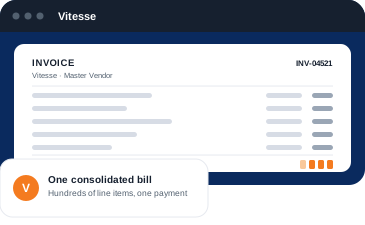
Tail-spend management addresses a specific and often overlooked segment of the P2P cycle. In most organizations, a large share of suppliers account for a small share of total spend. These thousands of low-value transactions create disproportionate AP workload: onboarding, invoicing, payment, tax handling, reconciliation. Vitesse, a managed master-vendor service for tail spend, consolidates these purchases through a single master vendor, reducing AP invoice processing workload by an average of 70% and getting suppliers onboarded in 1 to 3 business days instead of the typical 6 to 8 weeks.
Making the P2P Process Work for Both Procurement and Finance
The procure-to-pay process sits at the intersection of procurement operations and financial controls. When it works well, procurement gets compliance and contract adherence. Finance gets clean data, predictable cash flow, and audit-ready records.
When it breaks down, both sides pay. Procurement loses visibility into what’s being bought and from whom. Finance absorbs the downstream consequences: reconciliation delays, duplicate payments, budget overruns, and reporting gaps.
The path forward is connecting the steps so that data flows from requisition through reconciliation without manual hand-offs, re-keying, or blind spots.
Start by understanding where your current process creates the most friction. For many organizations, the answer lies in the volume of small, fragmented transactions that consume far more administrative effort than their dollar value warrants. For others, it’s the lack of visibility into what’s already been spent. In both cases, the first step is the same: see the problem clearly, then address it systematically.
Frequently Asked Questions
What is procure to pay?
Procure to pay is the complete business process that spans from identifying a purchasing need through paying the supplier and reconciling the transaction. It includes requisition, approval, purchase order creation, goods receipt, invoice matching, payment, and reporting.
What does procure to pay meaning refer to in a business context?
In business, procure to pay refers to the operational and financial workflow that governs how an organization buys goods and services and processes supplier payments. It is distinct from source-to-pay, which also includes upstream activities like supplier identification and contract negotiation.
What are the main steps in the P2P process?
The core steps are: need identification, purchase requisition, approval, PO creation, goods or service receipt, invoice matching, payment, and reporting/reconciliation. Each step represents both a control point and a potential source of inefficiency.