You have a source-to-pay process mapped out. You may even have software in place. Yet savings targets keep slipping, sourcing events take longer than they should, and your team spends more time wrangling data and vendors than driving strategy. The issue often is a lack of capacity to use technology well, rather than a lack of technology itself.
That gap is where source-to-pay services come in. Understanding the difference between buying a tool and buying an outcome is one of the most consequential decisions a procurement leader can make.
What Is Source-to-Pay Software, and Where Does It Stop?
If you’ve researched what is source to pay software, you already know the basics. S2P platforms digitize the process from identifying sourcing opportunities through supplier payment. They give your team dashboards, workflow automation, RFx templates, contract repositories, and analytics.
What they don’t give you is the people, expertise, and operational bandwidth to run the process end to end. Software assumes your team has the headcount, category knowledge, and data maturity to extract value from the platform. For organizations with large, experienced procurement teams, that assumption holds. For everyone else, it creates a gap between the platform’s potential and the results you actually achieve.
This is the core distinction: source-to-pay software gives you tools, while source-to-pay services give you outcomes with technology embedded underneath.
What Source-to-Pay Services Typically Include
The source-to-pay process spans a wide set of activities, from spend analysis through payment reconciliation. A services model wraps technology with human expertise across some or all of these stages.
Spend analysis and classification. Before you can source strategically, you need clean, classified spend data. Services providers handle the ingestion, normalization, and categorization of data from ERPs, P-cards, AP systems, and other sources, delivering dashboards and opportunity assessments rather than asking your team to build them.
Sourcing execution (managed events). Running a competitive sourcing event well requires supplier discovery, document preparation, bid management, evaluation, and award support. Managed sourcing services handle event execution on your behalf, using your strategy and approval authority while removing the operational burden from your team.
Contract management. Centralizing contracts, extracting key terms and obligations, tracking renewals, and linking purchase orders back to agreements. In a services model, this is an active process with alerts and oversight built in, going beyond a repository you simply maintain.
Tail-spend management. The long tail of small, fragmented purchases is notoriously difficult to manage with software alone. There are too many vendors, too many one-off transactions, and too little spend per supplier to justify a traditional sourcing approach. Managed tail-spend services consolidate these purchases through a master vendor, handling vetting, onboarding, payment, and compliance on your behalf.
Ongoing analytics and optimization. Services don’t end at implementation. Continuous classification, trend monitoring, and proactive identification of new savings opportunities keep the value compounding over time.
When Services Beat Software-Only
Every organization’s needs are different. But several conditions make services the stronger choice.
Lean procurement teams. If your team is small relative to your spend portfolio, software alone will sit underutilized. Managed services extend your capacity without adding headcount.
Limited category expertise. Sourcing complex or unfamiliar categories requires market knowledge your team may not have. Services providers bring category depth and supplier networks that accelerate results.
Need for speed. When leadership expects measurable savings within months, a services model compresses timelines. You’re buying execution readiness, a platform your team needs to learn and configure takes longer to deliver results.
Multi-ERP complexity. Organizations running multiple ERPs, often from acquisitions, face a data normalization challenge that delays analytics and sourcing. Services providers absorb that complexity, delivering clean output regardless of how messy the inputs are.
High-volume, low-value transactions. The tail-spend problem is a capacity problem. No amount of software will make it economical for your team to run sourcing events on thousands of small purchases. A managed service is the only practical model for this spend segment.
How a Combined Model Works in Practice
The strongest approach for most mid-market and enterprise organizations is a combination: technology for visibility, control, and strategic execution, paired with services for the operational workload your team can’t or shouldn’t absorb.
Simfoni’s model is built around this principle. Strategic Spend Hub provides the Snowflake-native analytics and sourcing technology layer. AI-driven spend classification, real-time dashboards, opportunity identification, and the Virgil conversational AI agent give procurement leaders direct access to their data and sourcing pipeline. eSourcing handles RFx creation, multi-round bidding, eAuctions, and decision optimization, with Managed Events available for teams that want sourcing execution handled on their behalf.
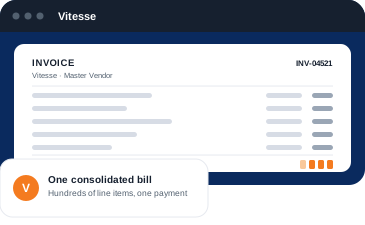
For tail spend, Vitesse operates as a managed master-vendor service. Employees route small purchases through Vitesse, which vets the vendor and purchase, handles onboarding (most suppliers active within one to three business days), consolidates everything into a single invoice, and manages downstream payments, taxes, and compliance. The result: AP workload drops by an average of 70%, and organizations save an average of $1.5M per year in vendor management costs.
The pricing reflects the model’s flexibility. Strategic Spend Hub runs on consumption-based Snowflake credits with no upfront license fee. Vitesse operates on a pay-as-you-save basis. You pay for outcomes, not shelf-ware.
Choosing the Right Mix
The real question is where in the source-to-pay process your team adds strategic value and where managed services would deliver faster, more consistent results.
Start by mapping your team’s bandwidth against your spend portfolio. Where are sourcing events stalling? Where is spend going unmanaged? Where does data quality prevent action? The answers point to where services will have the most impact.
For most procurement leaders, the highest-value configuration is direct control over strategic categories through a strong technology platform, combined with managed services for sourcing execution support and tail-spend management. That combination maximizes both reach and results without requiring proportional headcount growth.
Source-to-pay services are how you scale procurement capability, extending your team’s reach and accelerating results.