Growth is good. But growth without spending discipline is expensive.
When a company scales, the P&L spotlight stays on revenue, headcount, and direct costs. Meanwhile, indirect spend quietly compounds. New offices need furniture, IT equipment, cleaning services, and local suppliers. New product lines trigger consulting engagements, testing services, and packaging vendors. New departments spin up SaaS subscriptions, staffing contracts, and travel programs that no one centrally approved.
By the time procurement or finance notices, the company is managing hundreds (sometimes thousands) more vendors than it was 18 months ago, with little visibility into what it’s actually spending or whether any of it is competitive.
This article lays out a practical framework for getting indirect procurement under control during periods of rapid growth, and for keeping procurement and finance aligned while doing it.
Why Indirect Spend Spirals During Growth
Indirect spend typically represents 20 to 40% of a company’s total expenditure. It covers everything from office supplies and professional services to facilities maintenance and IT peripherals. Unlike direct spend, which is tied to production and closely managed by default, indirect spend is distributed across dozens of cost centers with no single owner.
Growth amplifies every weakness in that structure:
- Category fragmentation. Each new office or business unit introduces its own preferred vendors, often duplicating suppliers already in use elsewhere.
- Decentralized purchasing. Hiring managers, department heads, and regional teams make buying decisions independently. There is no malicious intent, just no easy path to compliance.
- AP cost accumulation. Every new vendor means another onboarding process, another invoice stream, another tax profile to manage. The administrative cost per transaction stays flat or rises, even as the value per transaction drops.
- Compliance gaps. When purchasing is fragmented, contract coverage drops. More purchases happen off-contract, outside negotiated terms, and without proper vetting.
The result is a compounding problem. Each quarter of unchecked growth adds cost, risk, and complexity that becomes harder to unwind later.
The Real Cost of Inaction
For CPOs and CFOs, the danger goes beyond overspending on individual purchases. It is the loss of strategic leverage. When indirect spend is scattered across hundreds of small vendors with no consolidated view, you cannot negotiate volume discounts, enforce preferred supplier agreements, or demonstrate procurement’s value to the board.
Finance teams feel this acutely. Invoice volumes climb, reconciliation becomes manual, and audit readiness deteriorates. Procurement teams feel it differently: they spend their time firefighting low-value requests instead of running strategic sourcing events that actually move the savings needle.
Alignment between the two functions is essential during growth. It is the prerequisite for control.
A Four-Step Framework for Controlling Indirect Spend
The following framework reflects indirect procurement best practices adapted for companies in active growth. It is sequential, but steps three and four should run in parallel once the foundation is set.
Step 1: Classify and Visualize Current Indirect Spend
You cannot manage what you cannot see. The first step is aggregating spend data from every source, including ERP, accounts payable, purchase cards, and contract systems, then classifying it into a consistent taxonomy.
AI-driven classification tools can process thousands of records per minute, normalizing supplier names and mapping transactions to procurement categories. The goal is a single, accurate view of where money is going, by category, by supplier, and by business unit.
Simfoni’s Spend Analytics is built for exactly this stage, using AI/ML classification to turn fragmented data into real-time dashboards, with initial insights available in weeks rather than months.
Step 2: Identify Categories Where Consolidation Is Possible
With clean data in hand, the next step is opportunity identification. Where are multiple business units buying the same category from different vendors at different prices? Where is maverick spend highest? Which supplier relationships have enough combined volume to justify a formal sourcing event?
This is where procurement and finance alignment becomes tangible. Finance brings the cost-center perspective. Procurement brings the category expertise. Together, they prioritize the consolidation opportunities with the highest savings potential and the lowest organizational friction.
The Strategic Spend Hub supports this step by surfacing AI-generated opportunities from internal and third-party data, then connecting them directly to a sourcing pipeline. When an opportunity is validated, teams can push it to an eRFx event without switching platforms.
Step 3: Route Tail Spend Through a Managed Channel
Every indirect category does not warrant a full sourcing event. Tail spend, the high-volume, low-value purchases that collectively represent a significant share of indirect spend, requires a different approach. Running a competitive bid for a $2,000 purchase does not make economic sense. But ignoring thousands of those purchases does not either.
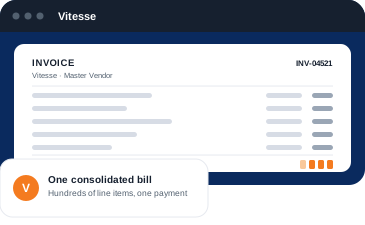
The solution is a managed master-vendor service that consolidates small purchases through a single provider. Employees route their purchases through the service. The provider vets the vendor and purchase before payment, handles onboarding, and consolidates everything into one invoice.
Vitesse operates as this managed master-vendor service for enterprise finance and procurement teams. Most suppliers are active within 1 to 3 business days (compared to the typical 6 to 8 weeks), AP workload drops by an average of 70%, and every routed purchase is auto-classified across 200+ procurement categories for full visibility. Trusted by 250+ finance and procurement teams, Vitesse addresses the fragmented, low-value tail that traditional sourcing tools are not designed to reach.
Step 4: Implement Ongoing Monitoring and Proactive Alerting
Control is a continuous discipline, not a one-time project. Growth continues, new categories emerge, and spending patterns shift. The framework only works if monitoring is continuous.
This means tracking projected versus realized savings, flagging anomalies in spending trends, and detecting maverick or off-contract purchases as they happen. Proactive alerts on tariff shifts, commodity price changes, and seasonal outliers allow procurement to intervene before costs escalate.
Virgil AI, Simfoni’s conversational agent within the Strategic Spend Hub, lets users ask natural-language questions across analytics, sourcing pipeline, eSourcing, and contracts in one interface. Instead of building a report, a procurement director can ask, “Which categories saw the biggest increase in vendor count this quarter?” and get an immediate, visual answer drawn from the customer’s own connected data.
Getting Procurement and Finance on the Same Page
The framework above works best when procurement and finance share ownership of indirect spend outcomes. In practice, that means agreeing on three things:
- A common data source. Both teams need the same view of spend. Separate spreadsheets and shadow reports undermine trust and slow decision-making.
- Clear routing rules. Define which purchases go through strategic sourcing, which go through a managed tail-spend channel, and which require no intervention. Make the path of least resistance the compliant one.
- Shared success metrics. Cost savings matter, but so do AP efficiency, supplier consolidation ratios, and contract coverage rates. Align on metrics that reflect both teams’ priorities.
Start With Visibility, Scale With Discipline
Controlling indirect spend in a growing company means building the visibility, processes, and automation that let the organization scale without proportionally scaling its procurement complexity.
Classify first. Consolidate where it matters. Route the tail through a managed channel. Monitor continuously. And keep procurement and finance working from the same data.
The companies that get this right do more than save money. They turn procurement into a function that actively supports growth, rather than scrambling to keep up with it.