You have already decided to invest in procurement automation. The harder question is what to prioritize first. Most procurement automation software platforms list dozens of capabilities, from AI-driven classification to reverse auctions to contract lifecycle management. The teams that succeed rarely try to deploy everything at once. They focus on the five to ten features that will generate measurable impact within the first year, then expand deliberately.
If you are a Procurement Director, VP, or Manager evaluating platforms right now, the real question is: what features are important in procurement automation software for a team like mine, at this stage of maturity?
This guide breaks that down.
Why Feature Prioritization Matters More Than Feature Count
A long feature list can actually slow adoption. When a team tries to roll out spend analytics, sourcing automation, contract management, and savings tracking simultaneously, each module gets partial attention, data quality suffers, and users revert to spreadsheets within weeks.
The procurement teams that drive real ROI tend to follow a sequenced approach: get foundational capabilities live first, prove value quickly, and then layer on more advanced functionality. This is true whether you are a three-person team at a mid-market company or a 30-person global procurement organization.
The two variables that matter most when deciding how to prioritize are team size and operational maturity.
Feature Prioritization by Team Size
Small teams (1 to 5 procurement professionals)
Small teams are stretched thin. They need features that deliver visibility without heavy configuration or ongoing maintenance.
- AI-driven spend classification. This is the foundation. If your team cannot see what the organization is spending, with whom, and across which categories, every other initiative is guesswork. Look for platforms that classify thousands of records per minute and normalize supplier names automatically. Simfoni’s Spend Analytics uses AI/ML classification, both supervised and unsupervised, that continuously improves over time and can deliver initial insights in weeks.
- Real-time dashboards. Small teams do not have the bandwidth to build reports manually. Pre-built dashboards covering spend distribution, tail spend analysis, and maverick spend detection let a lean team answer executive questions on the same day they are asked.
- Supplier normalization. Without it, “Acme Corp,” “ACME,” and “Acme Corporation” look like three different vendors. Normalization is a prerequisite for every downstream analysis.
At this stage, sourcing execution tools and contract repositories are valuable but secondary. Get spend visibility right first.
Mid-size teams (6 to 15 procurement professionals)
Once visibility is in place, mid-size teams are ready to automate sourcing execution and begin tracking savings.
- RFx creation and distribution. Templated sourcing events with automated supplier notifications eliminate manual email coordination. Category templates and a sourcing library let your team reuse what works instead of starting from scratch every time.
- Bid evaluation and scoring. Automatic scoring of objective question types, section-level weighting, and side-by-side bid comparison accelerate award timelines. Simfoni’s eSourcing platform includes Decision Optimization to rank suppliers, while the award decision stays with your team.
- Centralized Q&A. A public forum where all bidding suppliers see the same questions and answers reduces back-channel emails and ensures a fair, auditable process.
- Contract repository. Centralized storage with OCR-based clause extraction, renewal alerts, and PO-to-contract linkage prevents value leakage after award.
Mid-size teams should also start tracking realized savings against projected savings to build credibility with finance.
Large teams (15+ procurement professionals, often global)
Large teams need cross-module intelligence, proactive alerts, and pipeline management to coordinate activity across categories, regions, and business units.
- Cross-module conversational AI. Natural-language queries that span analytics, sourcing pipeline, active events, and contracts in one interface reduce the time category managers spend hunting for information. Simfoni’s Virgil AI, the “Talk With Your Data” agent inside the Strategic Spend Hub, lets users ask questions like “What’s our spend with Supplier X across all regions?” and get text and visual answers from their own connected data immediately.
- Sourcing pipeline management. At scale, knowing which categories are in which stage of the sourcing cycle is as important as running individual events well. Pipeline visibility helps leadership allocate resources and sequence waves of activity.
- Proactive market and risk alerts. Tariff shifts, commodity price movements, and supply-market concentration risks should surface automatically through the analytics layer, informing sourcing strategy before events are launched.
- Savings tracking (projected vs. realized). Large organizations need to demonstrate procurement’s value to the CFO and the board. Tracking savings from opportunity identification through contract execution closes the loop.
Feature Prioritization by Maturity: Crawl, Walk, Run
Team size is one axis. The other is operational maturity, which does not always correlate with headcount.
Crawl: Spend visibility. Your organization has fragmented data across multiple ERPs, P-card systems, and AP tools. The priority is aggregating, classifying, and normalizing that data into a single view. Maverick spend detection and tail spend analysis belong here too. This is where most teams should start, regardless of size.
Walk: Sourcing automation. You have clean spend data and can identify savings opportunities. Now you need to act on them efficiently. RFx execution, eAuctions (reverse, forward, or multi-round), and structured bid evaluation move sourcing from ad hoc to repeatable. Integration between analytics and sourcing, such as the ability to push an identified opportunity directly into a sourcing event, accelerates cycle time.
Run: Proactive AI and closed-loop tracking. Your team is operating with a mature category management framework. AI-generated opportunity identification, proactive alerts on market shifts, supplier diversity and ESG tracking, and end-to-end savings tracking (projected through realized) let you move from reactive to strategic. Cross-module AI queries become essential here because your data set is rich enough to generate meaningful, actionable answers.
A Modular Adoption Path
One of the most important criteria when choosing procurement automation software is whether the platform supports phased adoption. If a vendor requires you to deploy everything or nothing, the risk of a stalled implementation increases.
Simfoni’s architecture is built around this principle. Teams can start with Spend Analytics for classification and visibility, add eSourcing when they are ready to automate sourcing execution, and move to the full Strategic Spend Hub for pipeline management, proactive intelligence, and savings tracking. Virgil AI layers across all of these modules, so the conversational interface grows richer as more data flows into the system. The Strategic Spend Hub is Snowflake-native, with consumption-based pricing via Snowflake credits that scales with usage rather than requiring a large upfront license commitment.
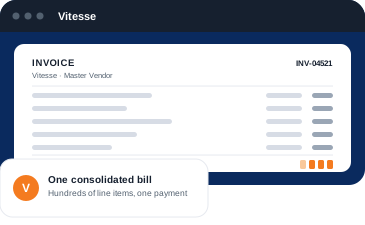
For organizations that also need to address high-volume, low-value tail-spend purchases, Vitesse operates as a managed master-vendor service, consolidating thousands of small vendor transactions into a single invoice and reducing AP workload by an average of 70%.
Start With What Moves the Needle
How do you choose the right procurement automation software? Start by being honest about where your team is today. If you lack spend visibility, do not jump to sourcing automation. If you have strong analytics but your sourcing process is still email-driven, that is your bottleneck. If you are running hundreds of events a year but cannot track whether savings are hitting the P&L, close the loop.
Feature prioritization is about sequencing capabilities so each layer builds on the last, adoption sticks, and value compounds over time.