eProcurement software is an electronic procurement system that digitizes how organizations request, source, approve, and pay for goods and services. If your team still relies on emailed quotes, spreadsheet trackers, and manual approvals, an e procurement software platform replaces those fragmented steps with a single digital workflow, giving you speed, visibility, and control over every dollar spent.
This guide breaks down what modern eProcurement looks like, what capabilities matter most, and how to evaluate your first procurement platform without getting lost in vendor jargon.
How Does eProcurement Differ from Generic Procurement Software?
The terms overlap, but they signal different things. “Procurement software” is a broad umbrella that can include anything from basic purchase-order tools to heavyweight ERP modules. “eProcurement software” implies something more specific: a digital-first, self-service purchasing experience designed for everyday users across the organization, not just the procurement team.
In practice, a modern procurement system built around eProcurement principles should let a marketing manager submit a purchase request, route it through the right approvals, match it against preferred suppliers, and track the spend, all without picking up the phone or forwarding a PDF. The emphasis is on electronic workflows end to end: requisition, sourcing, purchasing, invoicing, and reporting.
If your organization is evaluating its first platform, this distinction matters. You want a system that people across the business will actually use, not one that only procurement specialists can navigate.
What Core Capabilities Should You Expect?
Every procurement platform pitches a long feature list. Here are the capabilities that genuinely move the needle for first-time buyers.
Spend visibility and classification. Before you can save money, you need to see where it goes. Look for AI-driven classification that can process thousands of records quickly and normalize supplier names so “Acme Corp,” “ACME Corporation,” and “Acme” all resolve to one entity. Without clean, categorized data, every other capability sits on a shaky foundation.
Sourcing and competitive bidding. The ability to create RFPs, RFQs, and run multi-round bidding or eAuctions from within the platform. This turns sourcing from a manual, email-heavy process into a structured, auditable event.
Approval workflows. Configurable routing so the right stakeholders review and approve purchases before money leaves the building. This is where compliance lives.
Catalog and supplier management. Pre-approved vendor catalogs and supplier discovery tools help end users buy from the right sources, reducing maverick spend.
Reporting and savings tracking. Real-time dashboards that show projected versus realized savings. If your CFO asks “What did procurement deliver this quarter?” you should be able to answer in minutes, not weeks.
Contract management. Centralized storage for agreements, with renewal and expiration alerts and the ability to link purchase orders back to contract terms.
These capabilities work together. Classification feeds spend visibility. Spend visibility reveals sourcing opportunities. Sourcing events generate savings. Savings tracking proves the value. The best eProcurement software creates this closed loop rather than handling each step in isolation.
What Separates Modern eProcurement from Legacy Systems?
If you have used older procurement tools (or inherited one that nobody likes), you already know the pain: rigid interfaces, slow implementations, manual data entry, and licensing costs that hit the budget before you see any return. Modern platforms have moved past those constraints in a few key ways.
AI-driven intelligence. Instead of static reports, modern systems use AI to classify spend data, identify savings opportunities, detect off-contract purchasing, and surface proactive alerts on market shifts like commodity price swings or tariff changes.
Natural-language interaction. Conversational AI agents let users ask questions in plain English, such as “What did we spend on packaging suppliers in Q1?” and get immediate, visual answers. This lowers the barrier for non-technical users and accelerates decision-making.
Faster time to value. Legacy implementations measured in quarters or years are giving way to platforms that deliver initial dashboards in days. Cloud-native architecture and consumption-based pricing, where you pay for what you use rather than committing to a large upfront license, reduce the financial risk of getting started.
Proactive savings identification. Rather than waiting for someone to run a report, modern eProcurement software flags consolidation opportunities, supplier overlaps, and price variances automatically.
How Simfoni’s Products Map to the eProcurement Landscape
For teams building their first procurement technology stack, the challenge is often figuring out which pieces you need first. Simfoni’s portfolio is organized around the closed-loop model of insight, execution, and measurable savings.
Strategic Spend Hub (SSH) is Simfoni’s Snowflake-native solution that unifies spend analytics, sourcing pipeline management, sourcing execution, and savings tracking. It includes Virgil AI, a conversational agent that lets users query their connected data across modules in natural language. SSH is consumption-based, with no upfront license fee, so teams can start small and expand as they prove value. First dashboards are typically live within about seven days.
eSourcing handles competitive bidding from supplier discovery by category and region through award. It supports RFP/RFQ distribution, multi-round bidding, reverse and forward eAuctions, automated scoring of objective questions, and a Contract Repository with OCR-based metadata extraction and renewal alerts. The tool scores, ranks, and optimizes bids, while the award decision stays with your team. Teams using eSourcing typically see 10 to 15% savings per event.
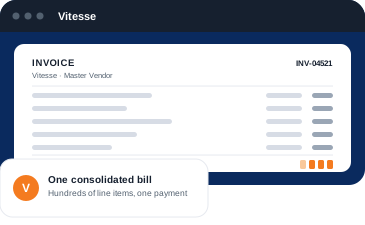
Vitesse addresses a problem most procurement platforms ignore entirely: tail spend. These are the thousands of low-value, high-volume purchases that fall outside formal sourcing processes. Vitesse is a managed master-vendor service that consolidates small purchases into one invoice, vets vendors and purchases before payment, and reduces AP workload by an average of 70%. It is trusted by over 250 finance and procurement teams, including Sodexo, IKEA, VISA, and DocuSign.
For Spend Analytics as a standalone need, Simfoni’s AI-powered classification processes thousands of records per minute and integrates data from ERP, P-card, AP, contract tools, and third-party market intelligence sources. Implementation typically takes four to six weeks, with earlier initial insights along the way.
How to Start Evaluating Your First Procurement Platform
If you are early in this process, keep three principles in mind.
Start with visibility. You cannot optimize what you cannot see. Spend analytics is the foundation, and it delivers value on its own while informing every sourcing and compliance decision you make next.
Prioritize adoption over features. The best procurement system is the one your team actually uses. Self-service interfaces, conversational AI, and intuitive workflows matter more than a long feature checklist that only power users will touch.
Align with finance early. eProcurement software touches budgets, invoices, and compliance, all things your CFO cares about. Frame the business case around measurable outcomes: savings delivered, AP workload reduced, maverick spend eliminated. A platform that tracks projected versus realized savings makes this conversation straightforward.
The right eProcurement software gives your team the intelligence and the tools to manage spend more effectively, with proof that it is working.