There’s a reason tail spend stays unmanaged year after year. It’s not that procurement teams don’t know it exists. It’s that nobody can agree on what’s actually in it.
When 20% of your spend is scattered across hundreds or thousands of suppliers, with no clear category ownership and inconsistent coding in your ERP, the problem isn’t motivation. It’s visibility. And visibility starts with categorization.
Most procurement organizations have a solid grip on their strategic categories. The top suppliers, the big contracts, the negotiated agreements. But below that line, tail spend sits in a gray zone: miscategorized, uncategorized, or lumped into catch-all buckets like “miscellaneous” or “other services.” That’s not a data problem. It’s a management problem. If you can’t see what’s in the tail, you can’t prioritize it. And if you can’t prioritize it, it stays unowned.
This piece walks through how to identify your tail spend categories, rank them by impact, and build a practical plan to bring them under management, starting with the data you already have.
What Makes Tail Spend So Hard to Categorize
Tail spend, broadly defined as the high-volume, low-value transactions that fall outside strategic sourcing, typically represents 20% of total spend but can involve 80% of suppliers and transactions. That volume-to-value mismatch is exactly what makes categorization difficult.
Here’s what’s usually happening beneath the surface:
- Transactions are coded inconsistently across business units, ERPs, or P2P systems
- Spend descriptions are vague or free-text, making automated classification unreliable without enrichment
- Categories that exist in your taxonomy may not reflect how tail spend actually behaves (e.g., “professional services” can mean anything from consulting to pest control)
- Many purchases bypass procurement entirely, meaning there’s no category assignment at all
The result is that a significant portion of your indirect spend is essentially invisible. Not because the data doesn’t exist, but because it hasn’t been cleaned, classified, and organized in a way that makes it actionable.
Common Tail Spend Categories
While every organization’s tail is different, certain categories show up repeatedly. Understanding these gives you a starting framework for your own tail spend analysis.
Facilities and maintenance: Janitorial services, HVAC repair, pest control, landscaping, security services. Often managed locally with no central contracts.
Office supplies and equipment: Printers, toner, breakroom supplies, furniture. Frequently purchased through multiple suppliers with no volume leverage.
IT peripherals and accessories: Cables, adapters, keyboards, monitors, small software licenses. Scattered across departments with little coordination.
Professional services (non-strategic): Translation, notarization, training providers, temporary staffing for non-core roles. Hard to consolidate because requestors choose vendors independently.
Marketing services: Print production, promotional items, event materials, local advertising. Often purchased by marketing teams outside procurement’s view.
Travel and expenses: Ground transportation, hotel bookings outside managed programs, meal and entertainment spend. High transaction volume, low per-transaction value.
MRO (maintenance, repair, and operations): Replacement parts, safety equipment, tools. Common in manufacturing and facilities-heavy organizations.
These categories share a pattern: decentralized purchasing, fragmented supplier bases, and little to no strategic oversight. That’s what makes them tail spend, and that’s what makes categorization the essential first step.
How to Prioritize Tail Spend Categories
Not all tail spend categories are equally worth pursuing. The goal isn’t to manage everything at once. It’s to focus on the categories where consolidation, renegotiation, or process improvement will deliver the most value with the least effort.
A simple prioritization framework uses three dimensions:
Addressable spend volume: How much total spend sits in this category? Categories with higher spend offer more savings potential, even at modest percentage improvements.
Supplier fragmentation: How many suppliers are serving this category? High supplier counts signal consolidation opportunities. If you’re buying office supplies from 40 vendors, that’s a quick win.
Ease of consolidation: Can this category be consolidated without significant business disruption? Some categories, like promotional items, are easy to consolidate. Others, like specialized maintenance services, may have geographic or technical constraints.
Score each category across these three factors. The categories that score high on all three are your starting points. You don’t need a perfect taxonomy to begin. You need enough clarity to act.
Why Manual Categorization Doesn’t Scale
Here’s where most tail spend initiatives stall. The procurement team knows categorization matters, but the manual effort required to clean, classify, and enrich thousands of transactions across multiple data sources is overwhelming. Analysts spend weeks in spreadsheets, mapping free-text descriptions to category codes, reconciling inconsistencies between systems, and still end up with gaps.
This is where AI-powered spend classification changes the equation. Automated taxonomy tools can ingest raw transaction data, normalize supplier names, and classify spend into a consistent category hierarchy at a pace and accuracy level that manual work simply can’t match.
Simfoni, for example, uses AI-driven classification to automatically categorize spend data, including the messy, uncoded transactions that typically define the tail. Instead of spending weeks building a baseline, procurement teams get a categorized view of their tail spend in days, not months. That speed matters because the longer categorization takes, the longer the tail stays unmanaged.
The point isn’t to eliminate human judgment. It’s to eliminate the manual bottleneck that keeps procurement teams from ever reaching the analysis stage.
What Getting Started with Tail Spend Management Actually Looks Like
For most procurement teams, the barrier to tackling tail spend isn’t motivation. It’s capacity. Cleaning and classifying spend data, onboarding suppliers, consolidating invoices, and building category programs are all high-value activities that also happen to be enormously time-consuming when done manually.
Simfoni’s Enterprise Tail Spend platform is built around that reality. Rather than handing you a tool and a methodology, Simfoni operates as a managed program. Here’s how the first quarter typically unfolds:
The engagement starts with launch, communicating the new process to your existing suppliers and running a live onboarding session for employees. From there, purchasing starts flowing through the platform: employees route purchases through Enterprise Tail Spend, and suppliers invoice against those orders directly.
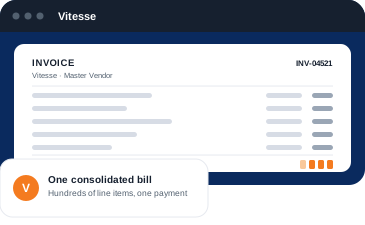
Within the first quarter, Finance receives one consolidated invoice instead of managing payment relationships with dozens of tail spend suppliers. Simfoni handles payment distribution on the back end. By the end of the quarter, the platform is screening for repeat purchases and building catalogs to automate future demand, turning one-off tail spend transactions into a managed, repeatable buying program.
The result is tail spend that’s visible, controlled, and continuously improving, without consuming your team’s capacity to get there.
The Bottom Line
Tail spend stays unmanaged because it stays uncategorized. The suppliers are too many, the transactions are too small, and the data is too messy for anyone to take ownership. But that’s exactly why categorization is the highest-leverage first step a procurement team can take.
You don’t need perfect data. You need a consistent framework for classifying what you have, a clear method for prioritizing where to focus, and the right tools to accelerate the process. Get the categories right, and the savings follow.