Every procurement leader knows where their direct spend goes. Raw materials, components, packaging, logistics: these categories get the lion’s share of strategic attention because they’re tied directly to revenue and production. They’re visible, well-negotiated, and closely managed.
Indirect spend is a different story.
In most enterprises, indirect represents 20 to 40 percent of total spend, yet it receives less than 10 percent of procurement’s time and resources. That gap has always existed. But over the past several years, it’s been growing, and the consequences are becoming harder to ignore.
The Indirect Spend Problem Keeps Growing
Several forces are pushing indirect spend upward while simultaneously making it harder to manage.
First, the categories themselves are expanding. SaaS subscriptions, professional services, contingent labor, facilities management, marketing technology, cybersecurity tools: these are all growing line items that didn’t exist or barely registered a decade ago. Each one introduces new suppliers, new buying patterns, and new stakeholders who control purchasing decisions outside of procurement’s influence.
Second, the buying authority for indirect categories is increasingly distributed. Business units, department heads, and individual contributors are making purchasing decisions independently, often through corporate cards, self-service portals, or direct vendor relationships. Procurement may not even see these transactions until they show up in accounts payable.
Third, the sheer volume of suppliers involved in indirect procurement makes consolidation and negotiation difficult. It’s not uncommon for mid-sized enterprises to have thousands of suppliers across indirect categories, many of them engaged for a single transaction or a handful of low-value purchases per year.
The result is a large, growing pool of spend that’s fragmented, poorly visible, and largely unmanaged.
Why Traditional Procurement Models Struggle with the Tail
Here’s the uncomfortable truth: most procurement operating models were designed for direct materials, and they extend reasonably well to the high-value end of indirect. Strategic sourcing methodologies, category management frameworks, and supplier relationship programs work when you’re dealing with a concentrated supplier base, high-value contracts, and categories central to operations. A major enterprise software agreement or a large facilities contract is indirect, but it can be sourced and managed with the same discipline as a direct category.
The difficulty sits in the tail: the fragmented, low-value, high-volume portion of indirect that no strategic sourcing cycle can economically reach. The characteristics that define tail spend are the same ones that make traditional tools ineffective against it:
- High supplier count, low spend per supplier. Running a full strategic sourcing cycle for a $15,000 MRO supplier doesn’t make economic sense, but multiply that by hundreds of similar suppliers and the aggregate is significant.
- Fragmented categories with unclear ownership. Who owns office supplies? IT peripherals? Employee wellness programs? These sit in a gray zone between procurement, finance, and the business.
- Low transaction value, high transaction volume. The individual purchase orders are small enough to fly under the radar, but they add up quickly. This is the heart of tail spend.
- Inconsistent data. Tail purchases are often coded inconsistently, described in free text, or processed through systems that don’t connect to procurement’s analytics. Without clean data, you can’t see the problem clearly, let alone solve it.
The net effect is that procurement teams know the tail is a problem, but they don’t have the bandwidth, the tools, or the organizational mandate to address it with the same approaches they apply to strategic categories.
The Organizational Trap
This creates an organizational trap. Leadership expects procurement to deliver savings across all spend. But the operating model, team structure, and technology stack are optimized for one part of it: the strategic, high-value, well-structured categories.
The tail requires a different approach. It calls for automation where strategic sourcing calls for expertise, and breadth of coverage where strategic categories call for depth. It needs technology that can handle thousands of low-value transactions efficiently, which is a different design problem from the one platforms built for complex, high-stakes negotiations were solving.
When teams try to stretch their existing tools and people to cover the tail, two things typically happen. Either they burn out chasing diminishing returns, or the tail gets deprioritized in favor of categories where the return on effort is more obvious.
Neither outcome is acceptable when indirect represents a third or more of total organizational spend, and the tail is where much of it slips out of view.
What High-Performing Procurement Teams Do Differently
The organizations that manage indirect spend well, tail included, tend to share a few traits.
They build a dedicated operating model for the tail. Rather than forcing low-value, fragmented categories into a strategic sourcing framework, they create separate workflows, governance, and success metrics suited to high-volume, low-value transactions.
They invest in purpose-built technology. Generic procurement suites can handle the tail in theory, but they weren’t designed for it. The user experience, automation, and category intelligence needed for tail spend are different from what it takes to manage a $50 million raw materials contract.
They favor automation over manual intervention. The economics of the tail don’t support putting a senior category manager on every purchase. High-performing teams automate supplier selection, compliance checks, and spend categorization, freeing their strategic resources for the categories where human judgment adds the most value.
They treat visibility as the first step toward action. Knowing what you spend on the tail is necessary but not sufficient on its own. The value comes from acting on it: consolidating suppliers, enforcing preferred agreements, and capturing savings that would otherwise leak through the cracks.
Purpose-Built for the Tail
Many procurement platforms offer indirect spend visibility as a feature within a broader suite. But visibility alone doesn’t solve the tail if nothing acts on what it reveals across thousands of low-value, high-volume transactions.
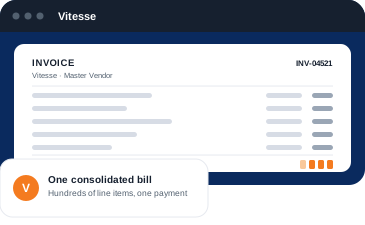
Simfoni’s Vitesse takes a different approach to that last mile. Rather than asking a stretched team to source and manage thousands of small suppliers, Vitesse becomes the single master vendor for that spend. Employees route their small purchases through Vitesse, which vets the vendor and the purchase before payment, handles onboarding, and consolidates everything into one invoice. Vitesse manages the downstream vendor payments, taxes, and reconciliation across markets.
The effect is to collapse the operational load that makes the tail so hard to manage. Onboarding that used to take six to eight weeks drops to days. Out-of-policy purchases and unapproved vendors get caught before money leaves the building. And every routed purchase generates analytics on what’s being bought, from whom, and at what price, turning a blind spot into a managed, measurable stream. As that spend flows, the same data supports pre-approved catalogs for repeat purchases and on-request sourcing for harder-to-find items.
For finance and procurement leaders who recognize that the tail is growing faster than their ability to manage it, the real question is whether today’s tools and operating models can address a problem that looks fundamentally different from the one they were built to solve. For most organizations, the honest answer is that they can’t, and that gap is the starting point for a better approach.