If you are reading this, you have already made the decision to outsource tail spend management. That puts you ahead of most organizations. But having a provider and having the right provider are two different things. When the service you are paying for still leaves your AP team buried in invoices, your compliance team guessing, and your category coverage full of gaps, the real question becomes how to switch tail spend management providers without creating chaos in the process.
The good news: a well-planned transition is far less disruptive than living with a provider that fails to deliver. Here is how to approach it.
Recognizing the Signs It Is Time to Move On
Switching providers is a significant decision, especially for enterprise finance leaders who need continuity above all else. But certain patterns make it clear that staying put costs more than moving.
Your AP workload has not meaningfully dropped. The whole point of consolidating tail spend through a managed service is fewer invoices and less reconciliation work. If your team is still processing high volumes of small-vendor invoices, the provider is failing to absorb enough of the transactional burden.
Category coverage has gaps. Tail spend spans dozens, sometimes hundreds, of procurement categories. If your current provider handles only a narrow slice, your employees are routing purchases outside the system. That means unvetted vendors, fragmented data, and the same visibility problems you started with.
You lack compliance visibility before payment. Some tail spend management services only provide reporting after the fact. If your provider is not vetting vendors and purchases before payment goes out, you are exposed to sanctions risk, tax errors, and policy violations that show up as surprises in the next audit.
Spend data is shallow or delayed. If you cannot see, in real time, what was bought, from whom, and whether a preferred vendor existed for that purchase, your provider is not giving you the analytics foundation that tail spend management should deliver.
Any one of these is a reason to evaluate alternatives. Two or more together make a compelling case to start planning.
Planning the Move: Protect Your Data, Understand Your Commitments
A smooth transition starts well before you notify your current provider. The planning phase is where you protect continuity and set up the replacement for success.
Inventory your current vendors and categories. Export a full list of suppliers your current provider manages, along with the categories they cover. This becomes the baseline for your new provider’s onboarding scope. It also reveals any vendors that were never properly captured.
Preserve your spend history. Classified spend data is an asset. Make sure your contract with the current provider gives you full access to historical transaction data, category classifications, and any compliance records. If it does not, negotiate that access before you initiate the exit.
Review exit terms carefully. Look at notice periods, data portability clauses, and any fees tied to early termination. Knowing these details early prevents timeline surprises and gives you room to negotiate a transition period that works for both sides.
Align your stakeholders. Finance, procurement, and the business units that use the system most frequently should all understand the timeline and what will change for them. A switching decision made in isolation creates resistance. A switching decision made collaboratively builds momentum.
Running the Transition: Phase It, Communicate It, Monitor It
The biggest risk during any provider switch is the gap between old and new. Eliminate that gap by phasing the transition instead of attempting a hard cutover.
Phase by category or business unit. Start with a manageable segment, perhaps one business unit or a cluster of related categories. Let the new provider demonstrate its process, work through edge cases, and prove the model before you expand. This also gives employees a chance to adjust without being overwhelmed.
Communicate clearly with employees and vendors. Employees need to know where to route purchases and when the change takes effect for their group. Vendors need to understand who their new point of contact is for payments and onboarding. Simple, direct communication at each phase prevents confusion and keeps purchases flowing.
Run a brief parallel period if possible. For the first phase, consider a short overlap where both providers are active. This gives you a fallback and a direct comparison of service quality, speed, and data accuracy.
Track early performance signals. Within the first few weeks of each phase, monitor invoice volumes hitting your AP team, time to vendor activation, and spend classification accuracy. These early signals tell you whether the new provider is delivering on its promises.
What to Look for in the Replacement Provider
When you are evaluating the best tail spend management providers for your organization, focus on the operational model. The right replacement should structurally eliminate the problems that prompted the switch.
Vetting before payment. The provider should screen every vendor and purchase before payment is processed. This is the compliance standard that separates managed tail spend services from simple payment consolidation.
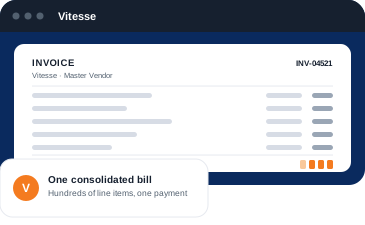
One consolidated invoice. Your AP team should receive a single invoice from the provider, regardless of how many vendors and purchases flow through the system. The provider handles downstream payments, taxes, tariffs, and reconciliation.
Broad category coverage. The best tail spend management services cover the full breadth of tail spend, not just a handful of common categories. Look for coverage across 200 or more procurement categories to ensure employees can route virtually any small purchase through the system.
A pricing model that aligns incentives. Ask whether the provider’s pricing ties their compensation to measurable outcomes. A pay-as-you-save model, where the provider earns based on savings delivered, means their success depends on yours.
Auto-classification and real-time analytics. Every routed purchase should be automatically classified so you can see spending patterns, identify preferred-vendor opportunities, and track compliance in real time. If the replacement provider cannot offer this from day one, you will end up in the same data gap you are leaving behind.
Where Vitesse Fits
Vitesse operates as a managed master-vendor service built specifically for the kind of transition described above. It consolidates thousands of small purchases through a single point of contact, vetting each vendor and purchase before payment. Spend is auto-classified across 200+ procurement categories, giving finance and procurement teams real-time visibility without manual tagging. The output is one consolidated invoice, which on average reduces AP invoice processing workload by 70%.
For organizations evaluating tail spend management services as a replacement for an underperforming provider, Vitesse’s model is designed to absorb the complexity of the transition: broad category coverage, configurable compliance controls, real-time sanctions screening, and a Pay-as-You-Save pricing structure that ties cost directly to value delivered.
Trusted by 250+ finance and procurement teams, including Sodexo, IKEA, VISA, and DocuSign, Vitesse addresses the specific operational gaps that most often trigger a provider switch.
The Cost of Staying Is Usually Higher Than the Cost of Switching
Switching tail spend management providers feels like a big move. It involves contracts, data migration, change management, and organizational buy-in. But the math almost always favors action. Every month with a provider that leaves compliance gaps, delivers incomplete data, or fails to reduce AP workload is a month of value left on the table.
Plan the move carefully, phase it intelligently, and choose a replacement based on operational substance. The disruption you are worried about is far smaller than the drag of staying where you are.