Every procurement team knows the feeling. You have strategic sourcing priorities, supplier negotiations to run, and stakeholder relationships to maintain. Then there’s tail spend: the sprawling mass of low-value purchases, one-off vendors, and fragmented transactions that nobody has time to manage but everybody agrees needs attention.
The challenge is real. Tail spend typically accounts for roughly 80% of your supplier base but only about 20% of total spend value. That ratio means each dollar of tail spend consumes far more administrative effort per unit of value than your strategic categories. For lean teams already stretched thin, dedicating headcount to chase down hundreds or thousands of small vendor relationships simply isn’t an option.
So how do you manage tail spend in procurement without hiring more people? This playbook lays out a practical, four-step approach.
The Resource Paradox: Why Tail Spend Resists Traditional Management
Before diving into solutions, it helps to understand why tail spend is so stubbornly difficult to address. Each small purchase seems harmless on its own: a $500 order here, a $2,000 service there. But aggregate those transactions across dozens of departments, hundreds of suppliers, and multiple countries, and you get a significant operational burden.
Think about what each vendor relationship requires: onboarding paperwork, compliance checks, purchase orders, invoice processing, payment reconciliation, and ongoing vendor management. Multiply that by hundreds of suppliers, and your AP team and procurement coordinators are spending a disproportionate share of their time on transactions that barely move the needle on total spend.
This is the resource paradox. The tail is too dispersed to ignore, too labor-intensive to manage with existing staff, and too low-value to justify hiring dedicated resources. The solution is a fundamentally different operating model.
Step 1: Classify and Quantify Your Tail Spend
You cannot manage what you cannot see. The first step is getting a clear, data-driven picture of your tail spend landscape.
Use your spend analytics to answer a few foundational questions:
- How much tail spend do you actually have? Pull a total figure and express it as a percentage of overall spend.
- How many suppliers are involved? This number is often eye-opening. Organizations routinely discover they have thousands of vendors supplying less than 20% of total value.
- Which categories does it span? Tail spend tends to scatter across dozens or even hundreds of procurement categories, from office supplies and maintenance services to one-time consulting engagements and specialty equipment.
- Where is it geographically distributed? Multi-country operations add layers of tax, compliance, and payment complexity.
If your classification is manual or incomplete, AI-driven Spend Analytics can accelerate this dramatically, classifying thousands of records per minute and normalizing supplier names so you get an accurate baseline.
The goal here is a simple but honest picture: total tail spend, supplier count, category spread, and geographic footprint. That picture becomes the foundation for every decision that follows.
Step 2: Segment by Action Type
Not all tail spend is the same. Once you have visibility, segment your tail transactions into three buckets:
- Consolidate. Identify categories where multiple suppliers do essentially the same thing. Can you reduce five office-supply vendors to one? Three regional maintenance providers to a single contract? Consolidation reduces vendor management overhead and often unlocks better pricing.
- Automate. Some tail spend is repetitive and predictable: recurring orders, standard services, refills. These are candidates for catalogs, pre-approved vendor lists, or automated routing so purchases happen without manual procurement involvement.
- Eliminate. Some purchases shouldn’t be happening at all. Duplicate subscriptions, redundant services, or spend with non-compliant vendors. Flag these for removal or policy enforcement.
This segmentation exercise doesn’t require weeks of analysis. A focused review of your top tail-spend categories, informed by good data, can usually be completed in a few working sessions. The point is to move from “we have a tail spend problem” to “here’s exactly what we’re going to do about each piece of it.”
Step 3: Route Purchases Through a Single Managed Channel
This is the mindset shift that makes tail spend management viable for lean teams. Stop trying to manage thousands of individual vendor relationships. Instead, route purchases through a single managed channel.
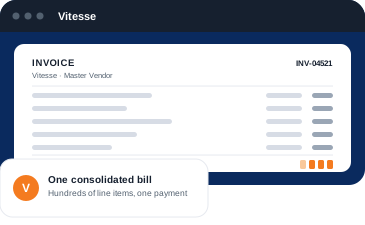
The concept is straightforward. Employees submit their purchase needs to one central point. That channel handles vendor vetting, compliance checks, onboarding, purchase execution, invoicing, and payment. Your team gets one consolidated invoice instead of hundreds. Your AP workload drops. Your supplier count shrinks. And every routed purchase is automatically classified, giving you ongoing visibility without manual effort.
This is exactly the model behind Vitesse, Simfoni’s managed master-vendor service for tail spend. Employees route small purchases through Vitesse, which vets the vendor and purchase before payment, handles onboarding (most suppliers are active within 1 to 3 business days, compared to the typical 6 to 8 weeks), and consolidates everything into a single invoice. Downstream vendor payments, taxes, tariffs, and reconciliation are all managed on your behalf.
The result is that your procurement team doesn’t need to add headcount. The operational burden shifts to a purpose-built service, and your team focuses on strategic work.
Step 4: Measure Impact
Any tail spend management approach is only as good as its measurable outcomes. Define your baseline metrics before you start and track them consistently.
Four metrics matter most:
- AP workload reduction. How many fewer invoices is your team processing? Vitesse customers see an average 70% reduction in invoice processing workload.
- Supplier count reduction. How many fewer small vendors are you actively managing? The confirmed average is 30% fewer small vendors on tail spend, with one case study showing a 62% reduction.
- Spend visibility improvement. What percentage of tail spend is now classified and visible? With every routed purchase auto-classified across 200+ procurement categories, you move from guesswork to real-time insight.
- Cost savings. What are you saving on vendor management overhead? The average is $1.5M in vendor management costs saved per year, a figure driven by reduced onboarding effort, consolidated payments, and fewer administrative touchpoints.
Track these quarterly. Share results with your CFO and stakeholders. Tail spend management is one of the few areas where procurement can demonstrate clear, quantifiable value without a multi-year transformation program.
Making It Work With the Team You Have
The question of how to manage tail spend comes up in nearly every procurement organization, and the answer almost never involves hiring more analysts. The teams that solve this problem share a common approach: they get visibility through data, segment their tail into actionable categories, shift from managing to routing, and measure the results.
Tail spend management works precisely because this problem doesn’t respond well to manual effort. The economics don’t support it. What works is a structured operating model that removes the administrative burden from your team entirely.
If your team is lean and your tail spend is growing, start with Step 1. Quantify the problem. The rest follows from there.