Procurement as a service is an operating model where companies access procurement technology, expertise, and execution capacity on a consumption-based or outcome-aligned basis, rather than building and staffing every capability internally. For procurement leaders facing growing mandates with flat headcount, it offers a way to scale impact without scaling fixed costs.
Why the “As a Service” Model Is Gaining Traction
The pressure is familiar: deliver more savings, manage more risk, improve compliance, and demonstrate measurable value to the CFO. The budget to do it? Flat at best. Headcount approvals? Slower than ever.
Traditional responses to this gap (outsourcing the function entirely, hiring consultants for discrete projects, or investing in large platform implementations) each carry trade-offs. Full outsourcing sacrifices control. Consulting engagements end. Enterprise platforms require dedicated teams to operate and years to show returns.
Procurement as a service sits in a different space. It combines technology and people in a delivery model that scales with your actual consumption, not your org chart. You pay for outcomes or usage, not licenses and headcount.
What Are Procurement Managed Services, and How Is “As a Service” Different?
The terms overlap, so the distinctions matter, especially when a CFO is evaluating total cost of ownership.
Traditional outsourcing (BPO) transfers operational procurement tasks to a third party. The provider runs the process, often with their own systems. You gain efficiency but lose visibility and control.
Managed procurement services sit a step closer. A provider manages specific procurement functions on your behalf, typically using a blend of their technology and expertise, while you retain strategic oversight. This is the broad category.
Procurement as a service is the evolution of managed services toward a consumption-based, outcome-aligned model. The defining characteristics:
- Variable cost structure. You pay based on usage, transactions, or savings delivered, not a fixed annual fee or per-seat license.
- Technology-plus-people delivery. The service layer includes both the platform and the expertise to operate it, so you don’t need to hire specialists to run the tool.
- Modular adoption. You can start with one capability (analytics, sourcing, tail spend) and expand as needs evolve, without re-platforming.
For CFOs, the shift from fixed to variable matters. Procurement moves from a cost center with unpredictable ROI to an investment with measurable, outcome-linked returns.
When Should a Company Use Procurement Managed Services?
Three scenarios consistently push organizations toward an as-a-service model:
Scaling without headcount. Your spend is growing or becoming more complex, but you can’t add people fast enough. An as-a-service model gives you execution capacity on demand. A company running 200 sourcing events a year doesn’t necessarily need 10 more sourcing managers. It needs a model that absorbs volume elastically.
Accessing capabilities you can’t hire for. Spend analytics, category intelligence, and AI-driven classification require specialized talent that is expensive and scarce. When the capability is delivered as a service, you get the output without competing for the hire.
Bridging technology gaps. Many procurement teams are stuck between a legacy ERP and the analytics or sourcing tools they actually need. An as-a-service model can layer modern capability on top of existing systems without a multi-year implementation.
Three Delivery Models, Mapped to Real Procurement Needs
Procurement as a service breaks into distinct delivery models, each addressing a different gap.
Analytics as a Service
The problem: your spend data sits across ERPs, P-card systems, AP tools, and spreadsheets. You lack the classified, normalized view needed to find opportunities.
The service model: a provider ingests, classifies, and visualizes your spend data, then delivers real-time dashboards and opportunity assessments. You get spend visibility without building an analytics team.
Simfoni’s Strategic Spend Hub operates this way. It runs natively on Snowflake with consumption-based pricing (you pay via Snowflake credits, not upfront license fees), aggregates spend data from any source, and delivers AI-driven classification and dashboards. First insights can arrive within roughly seven days. The Virgil AI agent lets users ask questions in natural language across analytics, sourcing pipeline, eSourcing, and contracts, lowering the expertise barrier further.
Sourcing Execution as a Service
The problem: you have strategic categories that need competitive events, but your sourcing team is at capacity. Events get delayed, savings targets slip.
The service model: managed sourcing events where a provider handles event design, supplier outreach, bid evaluation support, and award optimization, using a platform purpose-built for the workflow.
Simfoni’s eSourcing product supports this through managed events. The platform handles RFx creation, multi-round bidding, eAuctions, and decision optimization, scoring, ranking, and comparing bids so your team can make faster award decisions. Organizations have seen 10 to 15% savings per event and measurable results within the first three months.
Tail Spend as a Service
The problem: thousands of small, one-off purchases create disproportionate vendor management costs, AP workload, and compliance risk. Nobody wants to own it, and it’s too fragmented for traditional sourcing.
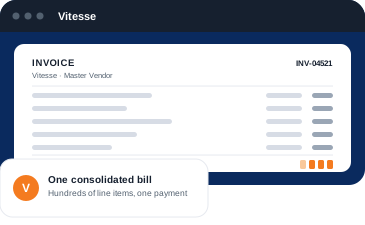
The service model: a managed master-vendor service that consolidates small purchases into one relationship, one invoice, and one compliance process.
Vitesse is built for this. Employees route small purchases through Vitesse, which vets the vendor and purchase before payment, handles onboarding (typically one to three business days vs. six to eight weeks), and consolidates everything into a single invoice. The result: an average 70% reduction in AP invoice processing workload, $1.5M in average vendor management cost savings per year, and 30% fewer small vendors cluttering the supply base. Pricing follows a pay-as-you-save model, aligning the provider’s incentive with yours.
Industry Fit: Where Procurement as a Service Delivers the Most Value
The model works across sectors, but three stand out:
Manufacturing companies with complex, multi-tier supply chains benefit from analytics as a service for commodity trend monitoring and sourcing execution for high-volume indirect categories.
Food and beverage organizations with seasonal demand spikes and large tail-spend footprints use the model to flex sourcing capacity and manage vendor fragmentation without permanent headcount.
Retail procurement teams managing hundreds of indirect suppliers across locations find that tail-spend-as-a-service reduces per-store complexity while improving compliance and spend visibility.
The Decision Framework
Procurement as a service is about matching your operating model to your actual resources and ambitions. If you have the team, the technology, and the bandwidth, build in-house. If you have gaps in any of those three, an as-a-service model lets you close them without the lag of hiring, implementing, and training.
The questions worth asking: Where are we losing value because we lack capacity? Where are we paying fixed costs for variable needs? And where would outcome-aligned pricing change the ROI conversation with our CFO?