Most enterprise procurement teams are living with some version of the same problem. Spend analytics sits in one tool (or a spreadsheet). Sourcing execution happens in another. And tail spend, the thousands of low-value purchases that quietly drain AP resources, isn’t managed at all.
Each of these gaps has its own cost. But the real damage is what happens between them: data that doesn’t connect, savings that get claimed but never tracked, and leadership that can’t see a clear picture of procurement’s impact on the P&L.
If you’re a CPO or CFO evaluating what is the best procurement software for enterprise, the question worth asking is whether the platform you choose can connect insight to action to measurable outcomes, across analytics, sourcing, and tail spend, without forcing your team to manually bridge the gaps.
The Real Cost of Fragmented Procurement Tools
Enterprise procurement has historically been built in silos. One team runs spend analytics. Another manages sourcing events. Finance deals with the flood of small invoices from hundreds of tail-spend vendors. Each function may have its own tool, its own data model, and its own definition of “savings.”
The consequences compound quickly:
- Duplicated effort. Analysts pull spend data, clean it, and identify opportunities. Then someone manually re-enters that information to launch a sourcing event. Context is lost. Time is wasted.
- Untracked savings. A sourcing event delivers negotiated savings, but there’s no closed loop back to analytics. Six months later, no one can confirm whether those savings materialized in actual spend.
- Invisible tail spend. Small purchases bypass procurement entirely. Finance processes thousands of invoices from one-time vendors, with no visibility into what’s being bought, from whom, or whether a preferred supplier already exists.
When you evaluate procurement software, start here. If a platform can’t solve the integration problem, the individual capabilities matter less than you’d think.
What to Look for in Spend Analytics
Spend analytics is the foundation. Without clean, classified, cross-source spend data, every downstream decision is built on assumptions.
When evaluating the analytics capability in any procurement platform, focus on:
- AI-driven classification that handles thousands of records per minute across supervised and unsupervised models. Manual classification doesn’t scale, and one-time classification gets stale.
- Cross-ERP aggregation. Enterprise spend data lives in multiple ERPs, P-card systems, AP platforms, and contract tools. The analytics layer must normalize and unify all of it.
- Opportunity identification. Beyond dashboards, can the system proactively surface consolidation opportunities, maverick spend, price variances, and supplier risk? Can it alert you to commodity or tariff shifts before they hit your budget?
- Time to value. If implementation takes six months, you’re paying for insight you don’t have yet. Look for platforms that deliver initial dashboards within days, not quarters.
Simfoni’s Spend Analytics is built on this model: Snowflake-native, AI-classified, with implementation timelines of four to six weeks and earlier initial insights. But regardless of which vendor you evaluate, these are the criteria that separate real analytics from glorified dashboards.
What to Look for in eSourcing
Sourcing execution is where insight becomes action. The best procurement software connects analytics directly to sourcing events, so your team doesn’t lose momentum between identifying an opportunity and launching an RFx.
Key evaluation criteria:
- RFx flexibility. Can you run RFPs, RFQs, and multi-round bidding with BAFOs from the same platform? Are there category templates to accelerate setup?
- Auction formats. Reverse, forward, English, Dutch, Japanese. Different categories need different approaches.
- Decision optimization. The platform should score objective questions automatically, apply your weightings, and rank offers for comparison. The award decision stays with your team, but the analysis shouldn’t take days.
- Supplier discovery. Can you find qualified suppliers by category and region directly within the platform?
- Audit trail. Every response, revision, and communication should be tracked. Centralized Q&A forums keep the process fair and defensible.
Simfoni’s eSourcing delivers confirmed savings of 10 to 15% per event, with measurable results within the first three months. It also includes a Contract Repository with OCR-based clause extraction and renewal alerts, closing the gap between award and contract compliance.
What to Look for in Tail Spend Management
Tail spend is where most enterprise procurement tools stop paying attention. These are the high-volume, low-value purchases that represent a small share of total spend but consume a disproportionate share of AP resources, vendor management time, and compliance risk.
Evaluate tail spend solutions on:
- Vendor consolidation. Can you route thousands of small purchases through a single master vendor, reducing your supplier base and invoice volume simultaneously?
- Compliance controls. Is every vendor and purchase vetted before payment? Are there sanctions screening, e-invoicing checks, and configurable approval controls?
- Onboarding speed. If it takes six to eight weeks to onboard a new small vendor, your employees will work around the system. Look for onboarding in days.
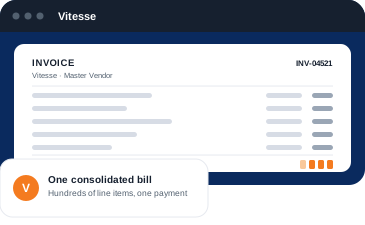
- AP workload reduction. One consolidated invoice should replace hundreds of individual ones.
Vitesse, Simfoni’s managed master-vendor service for tail spend, consolidates small purchases into one master vendor relationship. The confirmed impact: $1.5M in average vendor management costs saved per year, 70% lower invoice processing workload, 30% fewer small vendors, and 80% faster supplier onboarding. It’s trusted by 250+ finance and procurement teams, including Sodexo, IKEA, VISA, and DocuSign.
The Integration Question That Most Evaluations Miss
Here’s where most procurement software evaluations fall short. They assess each capability in isolation. The more important question: can insights flow to sourcing events without manual re-entry? Can tail spend data feed back into analytics? Can a stakeholder ask a question that spans all three domains in a single interface?
Simfoni’s Strategic Spend Hub is designed around this exact problem. It’s a Snowflake-native solution that unifies Spend Analytics, Sourcing Pipeline, eSourcing Execution, and Savings Tracking. Virgil AI, Simfoni’s conversational agent, lets users talk to their data across all modules in one interface: “What’s our spend with Supplier X?” or “Which categories have the highest maverick spend?”
Architecture matters here. A Snowflake-native platform means your procurement data lives where your enterprise data already does (or can), with consumption-based pricing through Snowflake credits instead of traditional upfront license fees. First dashboards can be live within roughly seven days.
The result is a closed loop: spend insight feeds sourcing execution, sourcing outcomes feed savings tracking, and tail spend data enriches the overall analytics picture.
A Comparison Rubric You Can Use Today
When evaluating any procurement platform for enterprise, score each vendor against these questions:
- Analytics depth. Does it classify spend with AI, aggregate across ERPs, and proactively identify opportunities?
- Sourcing execution. Does it support multi-format RFx, auctions, and decision optimization with a full audit trail?
- Tail spend coverage. Does it consolidate vendors, reduce AP workload, and enforce compliance on small purchases?
- Integration. Can you move from insight to sourcing event without manual re-entry? Does savings tracking close the loop?
- Conversational access. Can non-technical stakeholders query across modules in natural language?
- Time to value. Days and weeks, or months and quarters?
- Pricing transparency. Consumption-based or locked into multi-year licenses before you’ve seen results?
The best procurement software for enterprise is the one that connects analytics, sourcing, and tail spend into a single, measurable workflow, so your team spends less time bridging tools and more time delivering value.