Every procurement leader eventually faces the same question: where should we invest in building our own team’s capability, and where does it make more sense to bring in outside expertise?
The answer is rarely all or nothing. Most enterprises that get this right don’t choose between internal procurement and outsourced execution. They do both, deliberately, category by category. The challenge is knowing which side of the line each spend category falls on.
The Procurement Operating Model Spectrum
Before diving into the build-vs-buy decision, it helps to understand the range of options available. Think of it as a spectrum with four zones.
Fully in-house. Your team owns strategy, sourcing execution, supplier management, and contract administration. You control everything and bear the full cost of staffing, tooling, and process development.
Technology-only (SaaS). You add procurement software to make your internal team faster. Analytics, sourcing platforms, and contract repositories reduce manual work, but your people still run every process.
Procurement managed services. An external partner executes specific procurement activities on your behalf. This might cover sourcing events, supplier onboarding, tail-spend purchasing, or invoice processing. You retain strategic oversight while the partner handles operational volume.
Hybrid models. Software and selective managed services layered together. Your team focuses on high-value strategic work. Managed services absorb the operational categories that consume disproportionate time relative to their value. A shared technology layer gives everyone visibility.
Most enterprises doing procurement well today land somewhere in the hybrid zone. The question is really which categories deserve internal investment and which ones benefit from managed expertise.
When to Build Internal Capability
Some categories belong in-house. The common thread is strategic importance, deep institutional knowledge, or regulatory exposure that makes external handoff impractical.
Strategic categories with high spend concentration. When a small number of suppliers represent significant spend and those relationships directly affect your product, service quality, or competitive position, you want your own people managing them. These negotiations require continuity, context, and long-term relationship investment that doesn’t transfer well to an outside partner.
High-value negotiations requiring relationship continuity. Categories where switching costs are high and supplier performance is tightly linked to business outcomes (think contract manufacturing, primary logistics, or core IT infrastructure) benefit from dedicated internal expertise. Your team knows the history, the leverage points, and the business priorities.
Regulatory complexity requiring internal accountability. In industries like pharmaceuticals, financial services, or food and beverage, certain categories carry compliance obligations that demand direct organizational control. When audit trails, certifications, and regulatory reporting are on the line, you need internal ownership.
When to Buy Managed Expertise
Other categories are strong candidates for procurement managed services. These tend to share a different profile: high transaction volume, low individual transaction value, limited strategic impact, or gaps in internal team bandwidth.
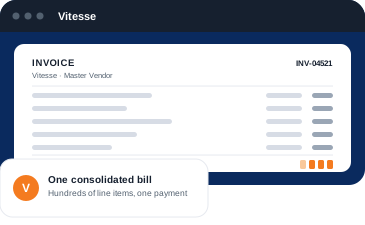
Tail spend with high transaction volume but low strategic value. This is the most common entry point. Tail spend, the long tail of small, fragmented purchases across hundreds or thousands of suppliers, consumes a disproportionate share of procurement and AP team time. Each transaction is low-value, but collectively the volume creates real cost and compliance risk. A managed master-vendor approach consolidates these purchases, handles vendor vetting and onboarding, and reduces invoice volume dramatically.
Sourcing events in categories outside core team expertise. When your team needs to run an event in an unfamiliar category (specialized packaging, niche professional services, regional logistics), managed sourcing events bring category knowledge and supplier market access without hiring for it permanently.
Rapid capacity scaling during M&A or organizational change. Mergers, integrations, and restructurings create temporary surges in sourcing and supplier management workload. Selective managed support lets you scale capacity without permanent headcount commitments.
A Decision Framework: Three Variables per Category
When deciding whether to build or buy for a given spend category, assess three variables.
Strategic importance. How directly does this category affect your product, customer experience, or competitive position? High strategic importance favors internal ownership.
Internal expertise availability. Does your team have (or can it reasonably develop) deep knowledge in this category? If the answer is no, and the category doesn’t justify a full-time hire, managed services fill the gap more efficiently.
Transaction volume-to-value ratio. Categories with many low-value transactions are natural candidates for managed services. The cost of processing each transaction internally often exceeds the value of the purchase itself. Categories with fewer, higher-value transactions justify dedicated internal attention.
When a category scores low on all three, the case for external execution is strong. When it scores high on strategic importance, keep it in-house and invest in the tools your team needs.
How Hybrid Models Work in Practice
The most effective procurement organizations use a shared technology layer as the connective tissue between internal teams and managed services. Analytics, sourcing pipelines, and savings tracking need to live in one place regardless of who executes the work.
For tail spend, Vitesse operates as a managed master-vendor service. Employees route small purchases through Vitesse, which vets the vendor and purchase before payment, handles onboarding (most suppliers active within 1 to 3 business days), and consolidates everything into one invoice. The result is real visibility into fragmented spend: every routed purchase is auto-classified across 200+ procurement categories, and AP workload drops by an average of 70%. Finance teams, the primary buyers of this service, get compliance controls and cost reduction without adding headcount.
For strategic sourcing, eSourcing managed events provide execution capacity when your team needs it. A managed sourcing event delivers the same structured process (RFx creation, supplier discovery by category and region, bid evaluation, award optimization) without pulling your team away from their highest-priority categories. Organizations typically see 10 to 15% savings per event.
Underneath both, the Strategic Spend Hub provides the analytics and pipeline visibility that connects internal strategy with managed execution. Category managers see the full picture: what’s being spent, where savings are being realized, and which categories need attention, whether the work is done internally or through a managed service.
Making the Decision
The question of when a company should use procurement managed services doesn’t have a universal answer. It depends on your team’s capacity, your category mix, and where your organization’s time creates the most value.
Start with a spend analysis. Identify the categories where your team’s expertise and relationships drive differentiated outcomes. Those stay in-house. Then look at the categories consuming disproportionate time relative to their strategic value. Those are your candidates for managed services.
The goal is to make sure every hour your team spends is focused on work that only they can do, while proven managed services handle the rest.