For years, “procurement best practices” meant standardized processes, policy compliance, and negotiating harder. That playbook still matters, but it’s no longer enough. The procurement teams pulling ahead in 2026 aren’t just following a checklist. They’re building data-driven operating models that connect insight to action, and they’re doing it faster than their peers thought possible.
High-performing procurement teams in 2026 move beyond traditional compliance, building data-driven operating models that connect insight to action faster than their peers. These teams prioritize achieving true spend visibility, using platforms like Simfoni’s Strategic Spend Hub to gain a reliable view of purchasing data. They also rationalize their supplier base to consolidate volume and foster deeper relationships with strategic partners. Ultimately, these practices enable procurement to shift from transactional to strategic, aligning with broader business objectives.
Foundational procurement best practices for high-performing teams involve ensuring your current practices deliver strategic value and keep pace with modern requirements. This section outlines the key practices that differentiate top-tier procurement teams, organized by maturity level to help assess your organization's standing.
Here are the practices that separate high-performing procurement teams from the rest, organized by maturity level so you can see where your organization stands.
What are the foundational procurement best practices for high-performing teams?
1. Achieve True Spend Visibility
You can’t manage what you can’t see. Yet many procurement organizations still operate with incomplete, fragmented, or stale spend data. A foundational procurement best practice is having a single, reliable view of who is buying what, from whom, and at what cost.
This isn’t just a data project. It’s the prerequisite for every strategic decision your procurement team will make. Without it, category strategies are guesswork, savings claims are soft, and supplier consolidation efforts stall.
Self-assessment: Can your team answer, within minutes, how much you spent with a given supplier across all business units last quarter?
Simfoni’s Strategic Spend Hub is built for exactly this challenge. As a Snowflake-native analytics platform, it gives procurement leaders full, clean visibility into their spend data without months of implementation drag.
2. Rationalize Your Supplier Base
Supplier proliferation is one of the most common (and most expensive) inefficiencies in procurement management. When every business unit can onboard vendors independently, you end up with dozens of suppliers providing the same goods or services, often at wildly different price points.
High-performing teams take a disciplined approach to supplier rationalization: identifying overlap, consolidating volume, and building deeper relationships with fewer, more strategic partners.
Self-assessment: Do you know how many active suppliers you have, and what percentage of them account for less than 1% of total spend?
Intermediate: Move from Reactive to Proactive
3. Build Real Category Management Capability
Category management is where procurement shifts from transactional to strategic. But too many organizations treat it as an org chart exercise rather than an analytical discipline. Effective category management means understanding market dynamics, total cost of ownership, demand patterns, and supplier performance at a granular level.
The best procurement teams build category strategies rooted in data and revisit them regularly, not just at contract renewal time.
Self-assessment: Do your category managers have current, data-backed strategies, or are they primarily focused on processing requisitions?
4. Align Procurement with the Business
A procurement process that operates in isolation from finance, operations, and the business units it serves will always underperform. Cross-functional alignment means procurement has a seat at the table when demand is being shaped, not just when a purchase order needs to be placed.
This is a leadership challenge as much as a process one. CPOs who invest in stakeholder relationships and communicate procurement’s value in business terms (cost avoidance, risk reduction, speed to market) earn the mandate to operate strategically.
Self-assessment: Does your CFO view procurement as a cost center, or as a function that directly contributes to margin improvement?
5. Bring Tail Spend Under Control
Most procurement leaders focus their energy on the top 80% of spend. That makes sense, but ignoring the long tail creates real exposure: rogue spending, compliance gaps, and thousands of transactions that never benefit from procurement oversight.
High-performing teams treat tail spend as a distinct management challenge with its own processes and tools, not an afterthought.
Self-assessment: What percentage of your total spend is truly unmanaged, with no procurement involvement whatsoever?
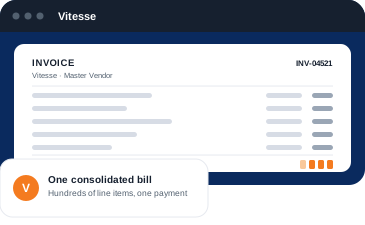
Simfoni’s Vitesse platform is purpose-built to solve this problem, bringing structure and savings to the spend categories that traditional procurement processes don’t reach.
Advanced: Operate at the Speed of Insight
6. Use AI to Accelerate Sourcing Execution
The procurement teams gaining the most ground in 2026 are using AI not to replace human judgment, but to eliminate the manual work that slows it down. AI-assisted sourcing can automate RFP creation, normalize supplier responses, score bids against weighted criteria, and compress sourcing cycle times from weeks to days.
This isn’t a future-state vision. It’s happening now, and teams that delay adoption are falling behind on both speed and savings.
Self-assessment: How long does it take your team to go from identifying a sourcing opportunity to awarding a contract?
Simfoni’s eRFX platform, powered by its AI layer Virgil, automates the most time-consuming parts of the sourcing process so your procurement team can focus on strategy and supplier relationships instead of spreadsheets.
7. Close the Loop Between Visibility and Savings
Here’s where most procurement organizations break down. They invest in analytics. They run sourcing events. But they can’t draw a clean line from insight to execution to realized savings. The data lives in one system, the sourcing activity happens in another, and savings tracking is a manual reconciliation exercise that nobody trusts.
The most advanced procurement best practice in 2026 is closing that loop: building an operating model where spend visibility surfaces opportunities, sourcing execution captures them, and savings are tracked and verified automatically.
Self-assessment: Can you demonstrate, with data, the dollar impact of your procurement team’s work over the last 12 months?
This is the core of Simfoni’s approach. The platform connects spend insight to sourcing execution to measurable savings in a single closed-loop model, so procurement leaders can show the board exactly what their function delivers.
8. Proactively Identify Savings Before You’re Asked
Reactive procurement waits for a stakeholder to raise a need. Proactive procurement surfaces opportunities before anyone asks. With the right data foundation and AI-driven recommendations, procurement teams can identify contract expirations, pricing anomalies, consolidation opportunities, and market shifts in real time.
This is the difference between a procurement function that responds and one that leads.
Self-assessment: Does your team bring savings opportunities to the business, or does the business come to you with requests?
Why is a data foundation essential for procurement best practices?
Every practice on this list has one thing in common: it requires clean, accessible, actionable data. Without that foundation, even the most well-intentioned procurement process will stall at the strategy deck stage.
The organizations that treat procurement management as a strategic capability, not an administrative function, are the ones investing in platforms that connect visibility to execution. They’re not just following best practices. They’re operationalizing them.
If you’re evaluating where your procurement team stands, start with the diagnostic questions above. They’ll tell you more about your maturity than any benchmarking survey.