Direct procurement covers the goods and materials that become your product. Indirect procurement covers everything else your organization buys to operate, from IT services and office supplies to consulting and facilities management. The distinction matters because each category demands different sourcing strategies, technology stacks, team structures, and KPIs. Getting the boundary wrong creates blind spots that leak cost, compliance risk, and savings opportunities.
Why the Traditional Boundary Is Shifting
For decades, the direct vs. indirect procurement split was straightforward. Direct meant raw materials and components on a bill of materials. Indirect meant everything else.
That clean line is harder to hold today. Services now represent a growing share of total spend, and many fall into gray areas. Consider a food and beverage manufacturer purchasing packaging design services: is that direct (it shapes the final product) or indirect (it’s a professional service)? A pharmaceutical company outsourcing clinical trial logistics faces the same ambiguity. A retailer contracting last-mile delivery partners blurs the line further.
These hybrid categories are growing. And when organizations force them into one bucket or the other without adjusting their procurement operating model, visibility gaps follow.
What Is Indirect Procurement, and Why Does It Behave Differently?
Indirect procurement is the acquisition of goods and services that support business operations rather than feeding directly into the end product. Common examples include:
- IT and software: SaaS subscriptions, hardware, telecom
- Facilities: maintenance, cleaning, security, utilities
- Professional services: consulting, legal, staffing, marketing agencies
- Travel and expenses: flights, hotels, ground transport
- Office and MRO supplies: furniture, consumables, maintenance parts
What makes indirect procurement structurally different from direct is fragmentation. Direct spend typically flows through centralized supply chain teams with established supplier relationships, negotiated contracts, and ERP-driven workflows. Indirect spend is dispersed across dozens of departments, hundreds of budget holders, and thousands of suppliers, many of whom are engaged on an ad hoc basis with no contract, no competitive bid, and no category strategy.
This fragmentation is the root of the cost problem. When no one owns a category, no one manages it.
How Operating Models Diverge
Direct procurement usually follows a centralized, strategic sourcing model. Category managers own supplier relationships end to end. Demand is predictable (tied to production plans), contracts are long-term, and performance is tracked against cost, quality, and delivery metrics.
Indirect procurement tends toward fragmented ownership. The marketing team picks its own agency. Facilities contracts land with local site managers. IT buys software through departmental budgets. Procurement may not even see the spend until it appears in accounts payable.
This decentralized model creates three persistent problems:
- Maverick spend. Purchases bypass preferred suppliers and negotiated contracts.
- Duplicate suppliers. Multiple departments engage different vendors for the same category without coordination.
- Invisible tail spend. The high-volume, low-value purchases (often 80% of suppliers but only 20% of spend) sit below the threshold of strategic attention but collectively represent significant cost and compliance risk.
The Indirect Procurement Process Flow: Where Visibility Breaks Down
A typical indirect procurement process flow runs through five stages: need identification, sourcing, purchase, payment, and classification. Each stage is a potential failure point.
- Need identification often happens outside procurement’s view. A department head recognizes a need and acts on it independently.
- Sourcing may skip competitive bidding entirely for low-value purchases, or rely on a quick web search rather than a preferred supplier list.
- Purchase can bypass PO processes, especially for services, resulting in invoice-only spend with no upfront approval.
- Payment becomes the first time the organization has a record of the transaction, and by then, there is no leverage to negotiate or redirect.
- Classification is where spend analytics should create visibility, but if data is inconsistent, manually coded, or trapped in disconnected systems, classification is unreliable.
The result: procurement teams often discover indirect spend after the fact, category by category, during periodic analysis rather than in real time.
How Technology Requirements Differ
Direct procurement technology is well established. ERP systems handle demand planning, purchase orders, goods receipts, and invoice matching against production schedules. The workflows are linear, predictable, and deeply integrated.
Indirect procurement technology needs are fundamentally different:
- Spend analytics is the foundation. You cannot manage what you cannot see. AI-driven classification that aggregates data from ERP, P-card, and AP systems across business units is essential. Spend Analytics tools that classify thousands of records per minute and normalize suppliers across regions turn fragmented data into actionable category views.
- eSourcing is critical for bringing competitive rigor to indirect categories that have historically been single-sourced or unsourced. Tools that support RFx creation, multi-round bidding, and structured bid comparison, like eSourcing platforms, bring the same discipline to indirect that direct procurement teams take for granted.
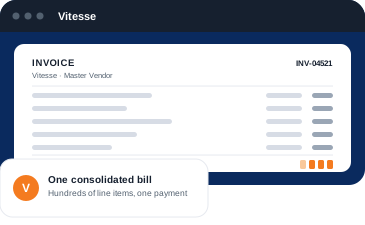
- Tail spend management addresses the long tail of small, high-frequency purchases that no sourcing team has the bandwidth to manage one by one. A managed master-vendor service like Vitesse consolidates thousands of small purchases through a single managed vendor, handling supplier vetting, onboarding, and payment while giving finance a single invoice instead of hundreds.
These are complementary layers. Spend analytics gives you visibility across all indirect categories. eSourcing gives you execution rigor for strategic indirect events. Tail spend management handles the fragmented, low-value purchases that fall below the sourcing threshold.
Indirect Procurement Best Practices
Assign category ownership. Every indirect category needs an owner, even if that owner manages multiple categories. Unowned spend is unmanaged spend.
Classify spend continuously. Annual spend analysis is too slow. AI-driven classification that runs continuously and flags anomalies, maverick spend, and new suppliers in real time keeps visibility current. Strategic Spend Hub provides this kind of real-time, cross-category visibility in a single environment.
Build preferred supplier programs. For repeat indirect categories, curated supplier lists with pre-negotiated terms reduce both cost and compliance risk. Compliance controls that vet vendors and purchases before payment, rather than after, prevent problems at the source.
Separate strategic indirect from tail. High-value indirect categories (large SaaS contracts, consulting engagements, major facilities agreements) deserve full strategic sourcing treatment. The fragmented tail, typically 80% of your supplier base, needs a different approach: consolidation, automation, and managed services rather than individual sourcing events.
Track savings from identification through realization. Negotiated savings that never hit the P&L are not savings. Closed-loop tracking, from identified opportunity through sourcing execution to realized impact, is the only way to demonstrate procurement’s value to finance.
Putting the Framework Into Practice
The direct vs. indirect procurement distinction is more than a taxonomy exercise. It determines how you staff your team, which technology you deploy, where you set compliance controls, and how you measure success. Getting it right means treating indirect procurement as a strategic function with its own operating model, rather than an afterthought managed through departmental budgets and ad hoc purchasing.
The first step is visibility. Know what you spend, with whom, across every category. From there, match each category to the right strategy, whether that is full strategic sourcing, a preferred supplier program, or consolidated tail spend management. The organizations that do this well consistently find 10 to 20% in savings they did not know were available.