Most procurement and finance leaders already know they need to digitize. The harder question is where the efficiency actually comes from, and how to measure it beyond vague promises of “doing more with less.”
Operational efficiency in the source to pay process spans cycle time reduction, FTE reallocation from manual tasks to strategic work, error rate reduction, and compliance improvement. When these gains compound across sourcing, contracting, purchasing, and analytics, the cumulative impact reshapes how procurement and finance teams operate day to day.
This article breaks down exactly how procure to pay automation delivers measurable efficiency outcomes at each stage, and what to look for when evaluating source to pay services for your organization.
What Operational Efficiency Really Means in S2P
It is tempting to equate efficiency with cost savings. They overlap, but they are distinct. A procurement team can save 10% on a category and still burn hundreds of hours on manual data gathering, email-based bid collection, and spreadsheet reconciliation.
True operational efficiency shows up in four dimensions:
- Cycle time. How long does it take to move from identifying a sourcing opportunity to executing a contract and processing payment?
- FTE reallocation. How many hours per week do skilled professionals spend on low-value, repeatable tasks that software could handle?
- Error rates. How often do misclassified transactions, duplicate payments, or missed renewals create downstream rework?
- Compliance. How much spend flows through approved channels versus maverick or off-contract purchasing?
When source to pay software is implemented well, it moves the needle on all four simultaneously.
Efficiency Gains by Process Stage
Sourcing: Templated RFx and Automated Scoring
Traditional sourcing cycles are notoriously slow. Creating an RFP from scratch, manually distributing it, chasing supplier responses, and building comparison spreadsheets can stretch a single event across weeks or months.
Modern sourcing platforms compress this timeline with category templates, automated distribution, and structured bid evaluation. Objective question types (yes/no, multiple-choice, numeric) can be scored automatically. Section-level and question-level weighting lets teams rank offers without rebuilding scoring models each time. Multi-round bidding and reverse auctions create competitive pressure without multiplying the administrative burden.
Simfoni’s eSourcing platform, for example, delivers 10 to 15% savings per event while accelerating cycle times. A case study with Supply Tigers documented 40 to 60% faster sourcing events. The efficiency gain goes beyond speed. It is the reallocation of analyst hours from data assembly to strategic evaluation and supplier relationship management.
Importantly, the tool scores, ranks, and optimizes. The award decision stays with your team.
Contracting: OCR Extraction and Renewal Alerts
Contracts are where sourcing gains either lock in or leak away. When contracts live in shared drives and email attachments, teams lose visibility into expiration dates, auto-renewal clauses, and compliance obligations.
A centralized contract repository with OCR-based clause and metadata extraction changes the equation. Teams can search by term, supplier, or category instead of hunting through folders. Automated renewal and expiration alerts prevent costly lapses or unwanted auto-renewals. PO-to-contract linkage connects purchasing activity back to negotiated terms, making off-contract spend visible in real time.
This is a substantial improvement. For organizations managing hundreds or thousands of active contracts, the reduction in rework and missed deadlines is significant.
Purchasing: Consolidated Invoicing and Vendor Management
Tail spend, the high-volume, low-value purchases spread across hundreds or thousands of small vendors, is one of the most operationally expensive areas in procurement. Each transaction may be small, but the cumulative cost of onboarding vendors, processing invoices, managing compliance, and reconciling payments is enormous.
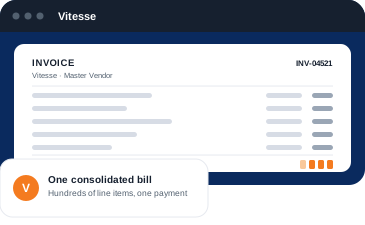
Vitesse, Simfoni’s managed master-vendor service for tail spend, consolidates thousands of small purchases into one invoice. The results are concrete: AP workload drops by an average of 70%, supplier onboarding is 80% faster (1 to 3 business days versus 6 to 8 weeks), and organizations save an average of $1.5M per year in vendor management costs alone. Every routed purchase is auto-classified across 200+ procurement categories, giving finance teams real-time visibility without manual data entry.
For CFOs evaluating procure to pay automation, this is where operational efficiency translates directly into P&L impact.
Analytics: Real-Time Dashboards That Replace Quarterly Reports
Perhaps the most underappreciated efficiency gain in the source to pay process is the shift from periodic, backward-looking reporting to real-time, actionable analytics.
When spend data is aggregated and classified continuously, teams stop spending days assembling quarterly reports and start acting on live insights. Maverick spend detection, price variance analysis, supplier consolidation opportunities, and tail spend patterns become visible without manual extraction.
Simfoni’s Strategic Spend Hub takes this further with Push-to-Source functionality, allowing teams to move directly from an identified opportunity to launching an eRFx event within the same platform. This eliminates the insight-to-action gap that plagues organizations where analytics and sourcing live in separate systems. The Virgil AI chat agent lets users ask natural-language questions across analytics, the sourcing pipeline, eSourcing, and contracts, turning data retrieval from a project into a conversation.
Quantifying the Efficiency Case
Industry benchmarks help frame the scale of opportunity:
- Manual spend classification can consume weeks of analyst time per quarter. AI-driven classification processes thousands of records per minute, freeing that capacity entirely.
- Invoice processing costs for tail spend transactions often exceed the value of the purchase itself when vendor onboarding, compliance checks, and reconciliation are factored in.
- RFx cycle times without automation routinely stretch to 8 to 12 weeks. Templated, automated sourcing can cut that by 40 to 60%.
The compounding effect matters. When sourcing cycles shorten, contracts execute faster. When contracts are visible, compliance improves. When tail spend is consolidated, AP capacity is freed for higher-value work. Each stage reinforces the next.
What to Look for in Source to Pay Services
Platforms vary in where they deliver efficiency. When evaluating source to pay services, procurement and finance leaders should ask:
- Does the platform connect insight to action? Analytics that do not feed directly into sourcing execution create a manual handoff, and manual handoffs are where efficiency dies.
- Is automation applied where it matters most? Automated scoring of objective criteria, consolidated invoicing, and AI-driven classification target the highest-volume manual tasks.
- Can it handle the tail? Many platforms optimize for high-value strategic categories but leave the long tail of small purchases, often 80% of transactions, completely manual.
- What is the time to value? Platforms that require 12-month implementations delay the efficiency gains they promise. Look for solutions that deliver initial insights in days or weeks.
The Bottom Line
Operational efficiency in the source to pay process is the cumulative result of eliminating manual handoffs, automating high-volume tasks, and connecting insight directly to execution. For procurement directors managing team productivity and CFOs focused on P&L impact, the question is where the highest-leverage efficiency gains are hiding in your current process, and how quickly you can unlock them.