You have budget approval, executive sponsorship, and a shortlist of vendors. Now comes the harder question: do you invest in a wall-to-wall procurement suite, or start with a focused module and build from there?
It sounds like an implementation question. It is actually a strategy question, and the answer depends less on the software market and more on your organization’s maturity, data readiness, and appetite for change.
What a Full Suite Promises, and What It Demands
Full-suite procurement solutions aim to cover every workflow under one roof: sourcing, contracts, purchase orders, invoicing, supplier management, analytics. The appeal is obvious. One vendor, one data model, one login.
The trade-offs are equally real. Enterprise suites typically require 12 to 24 months of implementation before the first dashboard goes live. Licensing is structured around committed seats or transaction volumes, which means you pay for breadth on day one, even if your team only uses a fraction of it in year one. Integration with your existing ERP and P2P systems can be extensive, since the suite often wants to replace adjacent tools rather than complement them.
For organizations with large, mature procurement functions and the internal bandwidth to manage a multi-year rollout, the suite model can work. For mid-market teams, or enterprises that already have a functioning P2P backbone and need to layer intelligence and sourcing capability on top, a suite can introduce cost and complexity that outpaces the value it delivers in the first 18 months.
The Modular Path: Start Where the Value Is Highest
A modular procurement platform lets you deploy one capability first, prove ROI, and expand when the organization is ready. The question is which module to start with.
In most organizations, the answer is spend analytics. Without clean, classified spend data, every other procurement activity is built on assumptions. You cannot prioritize sourcing events if you do not know where the money is going. You cannot track savings if you have no baseline. And you cannot make the case for additional investment without numbers the CFO trusts.
Once visibility is in place, the next logical step is sourcing execution. With classified data surfacing opportunities, you need a way to act on them: create events, collect bids, evaluate suppliers, and track the savings that result.
This sequence, visibility first and then execution, mirrors the way procurement teams actually mature. You diagnose before you treat.
Decision Factors: Five Questions That Clarify the Choice
Before evaluating any procurement technology platform, run your situation through these five questions.
1. What is your procurement maturity level? If your team still relies on spreadsheets for spend analysis and email for supplier negotiations, a full suite will overwhelm adoption. Start modular, build confidence, then expand.
2. How clean and accessible is your data? Suites assume you can feed them consolidated data from multiple source systems. If your ERP, P-card, and AP data live in silos, you need an analytics layer that can aggregate and classify first. Trying to go straight to end-to-end automation on fragmented data creates expensive rework.
3. What systems are already in place? Most mid-market and enterprise organizations already run a P2P or ERP system for purchase orders and invoicing. The right procurement platform should sit alongside those systems, not force you to rip and replace them. Look for solutions that complement your existing stack rather than compete with it.
4. How fast do you need to show value? If your CFO expects results within a quarter, a 14-month implementation is a non-starter. Time to first insight matters. Prioritize platforms that can deliver initial dashboards in days or weeks, not months.
5. What is your pricing tolerance? Committed seat licenses lock you into spend regardless of utilization. Consumption-based or pay-as-you-go models let you scale cost with actual usage, which reduces risk for teams that are still defining their roadmap.
How Simfoni’s Architecture Maps to This Decision
Simfoni is built for the modular path, with a unified architecture that prevents the fragmentation modular approaches sometimes create.
Strategic Spend Hub (SSH) is Simfoni’s Snowflake-native solution that unifies Spend Analytics, Sourcing Pipeline, eSourcing Execution, and Savings Tracking in a single environment. It is consumption-based via Snowflake credits, with no upfront license fee, so cost scales with usage. First dashboards can be live within approximately seven days. Customers do not need to already use Snowflake to adopt it.
Within SSH, Virgil AI serves as a conversational agent across modules, letting users ask natural-language questions about their spend, sourcing pipeline, contracts, and savings in one interface. Virgil works from the customer’s own connected data across analytics, the sourcing pipeline, eSourcing, and contracts.
Critically, Spend Analytics and eSourcing also stand alone. A team that needs classified spend data today and sourcing execution next quarter can start with analytics, prove value, and expand into sourcing without re-platforming. eSourcing includes a Contract Repository for centralized storage, clause extraction, and renewal alerts.
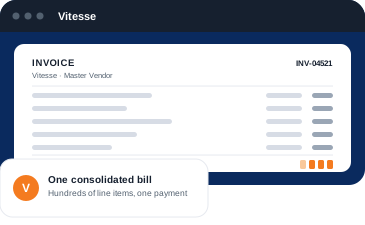
For the fragmented, high-volume tail of indirect spend, the thousands of small purchases that consume disproportionate AP time, Vitesse operates as a managed master-vendor service. It consolidates those purchases into a single invoice, vets vendors and transactions before payment, and reduces AP workload by an average of 70%. Vitesse is designed to work alongside your existing procurement solutions, handling the low-value transactions that strategic tools and P2P systems were never built to manage efficiently.
This architecture means Simfoni sits alongside your existing ERP and P2P systems rather than replacing them. Strategic spend gets visibility and sourcing execution through SSH. Tail spend gets consolidated through Vitesse. The systems you already have continue to handle purchase orders and invoicing.
Making the Call
The suite vs. modular debate is really about organizational readiness and speed to value.
If your procurement function is mature, your data is clean, and you have the bandwidth for a multi-year rollout, a comprehensive suite may serve you well. If you need to show results quickly, build the business case for further investment, and work within your current technology stack, a modular procurement platform that starts with your highest-value gap and expands from there is the lower-risk path.
The right procurement solutions meet your team where it is today and grow with it. Start with the problem that costs you the most, solve it, prove it, and then decide what comes next.