CPG procurement teams operate under a unique set of pressures. SKU proliferation keeps accelerating. Seasonal demand swings create sourcing urgency that doesn’t wait for headcount approvals. Margins are thin enough that every point of savings matters, yet most teams are stretched across direct categories (ingredients, packaging, co-manufacturing) and a sprawling indirect landscape (MRO, marketing services, facilities, logistics) with no realistic way to give both sides the attention they deserve.
That tension is exactly why CPG procurement managed services have gained traction. “Managed services” is a broad label, though, and signing the wrong contract can create as many problems as it solves. Here is what procurement and finance leaders in CPG and food & beverage should evaluate before committing.
What Managed Procurement Services Actually Look Like in CPG
Procurement as a service can mean very different things depending on the provider and the scope. In a CPG context, the most common models fall into three buckets:
- Managed sourcing events. An external team runs competitive bidding (RFQs, RFPs, eAuctions) for indirect categories your team doesn’t have bandwidth to cover. Think: packaging supplies, temporary labor, janitorial services, equipment maintenance.
- Tail spend consolidation. A master-vendor model where thousands of low-value, high-volume purchases are routed through a single provider that handles vendor vetting, onboarding, payment, and compliance. Instead of managing hundreds of small suppliers across multiple manufacturing or distribution sites, you manage one relationship and one invoice.
- Analytics as a service. A provider classifies and visualizes your spend data so your team can identify opportunities, track savings, and prioritize categories, without building an internal analytics function from scratch.
Some providers offer one of these. Others combine all three. The key question is whether the scope matches your actual gaps.
Five Questions to Answer Before You Sign
1. Which categories and processes are in scope?
This sounds obvious, but scope ambiguity is the most common source of frustration in managed procurement services. Be specific: are you outsourcing the full sourcing cycle for certain indirect categories, or just the transactional execution? Does the provider handle supplier onboarding and payment, or only the bidding process? If tail spend is in scope, define what “tail” means for your organization. A $5,000 threshold at one CPG company might be $25,000 at another.
2. How does the provider’s technology connect to your systems?
A managed service that operates in a silo creates a visibility gap. You need the provider’s platform to integrate with your ERP and AP systems so spend data flows back into your reporting. Ask whether the solution provides real-time dashboards or periodic reports, and whether you retain access to the underlying data. If you lose visibility into what’s being bought, from whom, and at what price, you’ve traded one problem for another.
3. What is the pricing model?
Fixed-fee arrangements give cost predictability but may not align the provider’s incentives with your outcomes. Outcome-based or pay-as-you-save models tie the provider’s compensation to measurable results, which can be compelling, but you need to agree on how savings are calculated and verified. Consumption-based pricing (pay for what you use) works well for analytics and technology layers. Understand which model applies to which component of the service.
4. What does the transition look like?
Switching from decentralized purchasing to a managed model affects internal workflows, employee behavior, and supplier relationships. Ask about onboarding timelines, change management support, and how quickly you can expect the first results. A provider that takes six months to stand up is consuming resources without delivering value during a critical window.
5. How do you measure success, and how do you exit?
Define KPIs upfront: invoice volume reduction, supplier consolidation ratios, savings per event, cycle time. And read the exit clauses carefully. If the relationship doesn’t work, you need to know how your data, supplier relationships, and in-flight processes transition back to your team or to a new provider.
Three Use Cases Where CPG Companies Benefit Most
Rapid indirect category coverage without hiring. Your team has five category managers and forty indirect categories that need attention. Managed sourcing events, like those available through Simfoni’s eSourcing platform, let you run competitive bidding across categories your team can’t reach, with structured templates, multi-round bidding, and Decision Optimization that accelerates awards. Typical results run 10 to 15% savings per event.
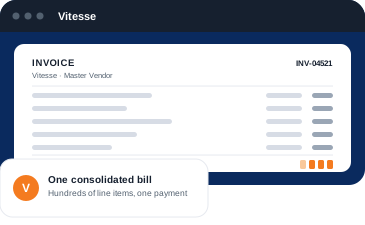
Tail spend consolidation across manufacturing and distribution sites. CPG companies with multiple facilities often have each site purchasing independently from hundreds of small vendors. The result is duplicated suppliers, inconsistent pricing, compliance gaps, and an AP team buried in invoices. Vitesse addresses this directly as a managed master-vendor service: employees route small purchases through a single point, vendors are vetted and onboarded (most within 1 to 3 business days), and everything consolidates into one invoice. The impact is measurable. Companies using Vitesse see an average 70% reduction in invoice processing workload and 30% fewer small vendors cluttering their tail spend.
Analytics-driven category prioritization. When the team can’t get to everything, you need data to decide what deserves internal focus and what to hand off. Strategic Spend Hub aggregates and classifies spend data with AI-driven classification, giving procurement leaders real-time visibility into where money is going, where maverick spend is hiding, and which categories offer the largest opportunity. That intelligence becomes the basis for a smarter managed services strategy: outsource the categories where external expertise delivers faster results, keep the strategic categories in-house.
A Decision Framework: In-House, Outsource, or Hybrid
Each category deserves its own evaluation. A practical framework for CPG procurement leaders:
- Keep in-house categories where deep supplier relationships and proprietary specifications create competitive advantage, typically core ingredients, primary packaging, and co-manufacturing.
- Outsource categories that are high volume, low complexity, and consume disproportionate administrative time. Tail spend is the clearest example. Routine indirect categories where competitive bidding delivers savings without strategic nuance are also strong candidates.
- Hybrid works well when you want your team to own the strategy and category decisions but need external capacity for execution, whether that’s running sourcing events, managing vendor payments, or maintaining spend analytics.
The best managed procurement services relationships in CPG extend your team’s reach so the categories that matter most get the attention they deserve, while the transactional work runs efficiently in the background. Define the scope clearly, align the pricing model to outcomes, insist on data visibility, and build in the flexibility to adjust as your business evolves.