Indirect spend typically accounts for 20 to 40% of total organizational spend. It spans hundreds of categories, touches every department, and involves thousands of suppliers. Yet most procurement platforms were built with direct materials in mind: stable supplier bases, predictable volumes, and well-defined specifications.
When procurement directors and CFOs go looking for indirect procurement software, they often find tools that handle the top of the spend pyramid well enough but fall apart where indirect gets messy. The fragmented, multi-category, multi-stakeholder reality of indirect procurement demands a different set of capabilities.
This guide covers what those capabilities actually are, how to evaluate your options, and when software alone falls short.
What Indirect Procurement Software Should Cover
A strong indirect procurement strategy starts with the right technology foundation. The problem is that “indirect procurement software” means different things to different vendors. Some offer analytics. Some offer sourcing. Few address the full lifecycle in a way that reflects how indirect categories actually behave.
Here is what a complete solution should cover:
- Spend visibility and classification. You cannot manage what you cannot see. The software should aggregate data from ERPs, P-cards, AP systems, and contract tools, then classify it accurately across categories. Manual classification does not scale when you are dealing with thousands of suppliers across hundreds of categories.
- Category-level analytics. Beyond knowing how much you spend, you need to understand where opportunities exist. Price variance analysis, supplier consolidation opportunities, maverick spend detection, and trend analysis should be standard.
- Sourcing execution for diverse categories. Indirect categories range from IT consulting to office supplies to facilities maintenance. The sourcing tool needs to handle that variety with flexible templates, multi-round bidding, and support for different event types.
- Compliance controls. Indirect spend is where policy violations hide. The software should surface off-contract spending and enforce approval workflows.
- Savings tracking. Projected savings mean nothing without a mechanism to track whether they were realized. The software should close the loop between sourcing decisions and financial outcomes.
Five Capabilities to Test During Evaluation
Indirect procurement best practices increasingly emphasize evaluation criteria that go beyond feature checklists. When you are comparing platforms, these five areas will separate tools that work in theory from tools that work in your organization.
1. Data aggregation across systems. Most enterprises run multiple ERPs, often by region or business unit. Ask vendors how they handle multi-source data ingestion, normalization, and deduplication. If the answer involves months of IT involvement, that is a red flag.
2. AI classification accuracy. Spend classification is the foundation of everything downstream. Look for AI-driven classification that improves over time, not rule-based mapping that breaks when suppliers or descriptions change. Ask about classification rates and how the system handles ambiguous records.
3. Sourcing flexibility for low-value, high-volume categories. Enterprise sourcing tools often assume high-value, low-frequency events. Indirect procurement includes a long tail of smaller, more frequent purchases. The platform should support templated, repeatable events that do not require a senior sourcing manager to run every one.
4. Stakeholder adoption. Indirect procurement touches marketing, IT, HR, facilities, and operations. If the tool requires procurement expertise to use, adoption will stall. Evaluate the user experience for non-procurement stakeholders. A conversational interface that lets users ask questions in plain language rather than navigating complex dashboards can make a meaningful difference.
5. Measurable savings tracking. Ask how the platform connects sourcing outcomes to realized savings. Can it track projected versus actual? Does it provide the data your CFO needs to see procurement’s P&L impact? This is often the weakest link in indirect procurement software, and it is the one your economic buyer cares about most.
When Software Alone Falls Short: The Build, Buy, or Outsource Question
Here is where the indirect procurement software conversation gets more nuanced. For concentrated indirect categories (large IT contracts, consulting engagements, facilities management), software-driven sourcing and analytics work well. These are categories with identifiable suppliers, defined specifications, and enough spend to justify a structured sourcing event.
Then there is tail spend. The hundreds or thousands of small, fragmented purchases that collectively represent significant cost but individually do not justify the overhead of a sourcing event, a supplier onboarding process, or even a PO. This is where many teams discover the limits of software alone.
Spend management outsourcing, specifically managed services for tail spend, addresses a fundamentally different problem. A managed service removes the operational burden entirely: vendor vetting, onboarding, payment consolidation, tax compliance, and reconciliation.
The most effective indirect procurement strategies use both. Software for visibility, analytics, and sourcing execution across your strategic and mid-tier indirect categories. A managed service for the tail, where the cost of managing the process often exceeds the cost of the purchase itself.
How the Pieces Fit Together
Consider how this plays out in practice. Strategic Spend Hub provides the analytics and sourcing execution layer: AI-driven spend classification, real-time dashboards, opportunity identification, and eSourcing tools that handle everything from RFx creation to bid evaluation to savings tracking. Virgil, its conversational AI agent, lets users across departments ask questions of their connected data in plain language, which directly addresses the stakeholder adoption challenge.
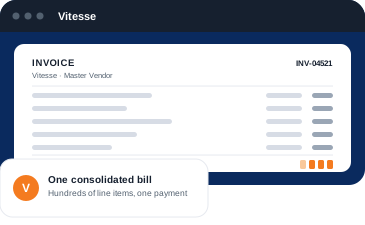
For the tail-spend slice, Vitesse operates as a managed master-vendor service. Employees route small purchases through Vitesse, which vets the vendor and purchase, handles onboarding (most suppliers are active within 1 to 3 business days), and consolidates everything into one invoice. The result: AP workload drops by an average of 70%, and organizations save an average of $1.5M per year in vendor management costs.
These are complementary layers, not competing ones. SSH addresses indirect categories where your team needs visibility and structured sourcing. Vitesse addresses the long tail where software alone creates more work than it eliminates.
A Decision Checklist for Active Buyers
If you are currently evaluating indirect procurement software, use this checklist to pressure-test your shortlist:
- Data readiness. Can the platform ingest and classify your spend data within weeks, or does implementation stretch into months?
- Classification depth. Does it classify across the full breadth of your indirect categories, or only the ones that fit neatly into predefined taxonomies?
- Sourcing versatility. Can it handle a $5M IT sourcing event and a $5K office supplies bid with equal efficiency?
- Tail-spend strategy. Does the vendor acknowledge the limits of software for fragmented, low-value purchases, or do they claim their platform handles everything?
- Savings accountability. Can you show your CFO a clear line from sourcing decision to realized savings, tracked over time?
- Time to value. First dashboards within days, measurable savings within months. Those are reasonable benchmarks. Anything significantly longer deserves scrutiny.
The indirect procurement software market is crowded with platforms that do one or two things well. The question is whether your chosen solution reflects how indirect procurement actually works: messy, fragmented, cross-functional, and spanning everything from strategic categories to one-off purchases. Evaluate accordingly.