Every procurement software vendor in 2026 claims AI-powered analytics, sourcing automation, and end-to-end coverage. Open any vendor’s website and you will find nearly identical language: intelligent classification, automated workflows, real-time dashboards, predictive insights. Feature lists have converged to the point where comparing platforms on capabilities alone feels like comparing identical resumes.
This is the real evaluation problem. Feature parity has made choosing the best procurement software for enterprise harder. If every platform checks the same boxes, the differentiators must lie somewhere else: in architecture, in how AI actually connects to action, in commercial structure, and in whether the vendor is willing to guarantee results.
Here are five criteria that cut through the marketing language.
Criterion 1: Data Architecture Matters More Than Feature Count
Most procurement platforms were built on legacy relational databases and later added AI as an overlay. The AI layer queries data, but it does not live where the data lives. This creates latency, integration complexity, and constraints on what the AI can actually do at scale.
The architectural question to ask: is the platform AI-native, or is it AI-added?
A Snowflake-native architecture, for example, means the application runs where the data already sits. There is no ETL pipeline moving procurement data into a separate analytics environment. Classification, dashboarding, opportunity identification, and sourcing workflows all operate on the same data layer. Strategic Spend Hub was built this way, positioned as the first native procurement app on the Snowflake Marketplace. The practical difference: faster queries, live data without batch refresh cycles, and AI that can work across modules without shuttling information between systems.
Ask any vendor: Is your AI running natively on the data platform, or is it a separate layer that ingests copies of your data?
Criterion 2: Cross-Module AI Connecting Insight to Action
Many platforms offer AI within individual modules. Spend analytics has its own AI. Sourcing has a separate one. Contract management may have another. The question is whether these are connected.
The best procurement software for enterprise should let you move from insight to action in one workflow. If the AI identifies a consolidation opportunity in spend data, can it push that directly into a sourcing event without manual handoff? If a contract is expiring and spend with that supplier is trending up, does the system surface that proactively?
Simfoni’s Virgil AI is a conversational agent that works across analytics, sourcing pipeline, eSourcing, and contracts from the customer’s own connected data. A user can ask a natural-language question like “What categories have the highest maverick spend?” and receive text and visual answers without leaving the interface. That cross-module conversational capability is the difference between AI as a feature and AI as a workflow.
Ask any vendor: Can your AI connect spend insights to sourcing actions in a single conversational workflow, or do users need to switch between modules?
Criterion 3: Time to Value, Measured in Days
Enterprise procurement implementations have historically taken six to twelve months. Some take longer. When evaluating procurement software, ask for specifics: not “rapid implementation” language, but actual timelines with milestones.
Strategic Spend Hub delivers first dashboards within approximately seven days. Full Spend Analytics implementations complete in four to six weeks, with initial insights available earlier. These timelines are possible because a Snowflake-native architecture eliminates much of the traditional data migration and integration overhead.
Ask any vendor: How many days until my team sees its first live dashboard with our own data? Get a number, not a range measured in quarters.
Criterion 4: Outcome Guarantees
Claims of ROI are easy. Guarantees are rare. If a vendor is confident in the outcomes their platform delivers, they should be willing to put ROI at risk.
Simfoni offers a guaranteed ROI for Strategic Spend Hub. This is a meaningful signal: the vendor’s commercial model is tied to your procurement outcomes, not just your software adoption.
Ask any vendor: Will you guarantee ROI in writing? If not, why not?
Criterion 5: Tail Spend Coverage
Most procurement platforms focus on strategic spend, the 20% of suppliers that account for 80% of your spending. That makes sense for high-value categories. But the remaining 80% of your supplier base, the tail, generates enormous hidden costs: onboarding complexity, invoice volume, compliance gaps, and unmanaged risk.
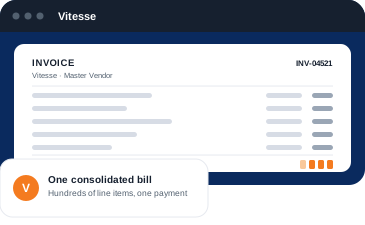
Evaluating the best procurement software enterprise-wide means asking whether the platform addresses this tail or leaves it unmanaged. Vitesse is Simfoni’s managed master-vendor service for tail spend. Employees route small purchases through Vitesse, which vets the vendor and purchase before payment, handles onboarding (most suppliers active within one to three business days), and consolidates everything into one invoice. The result: AP workload drops by an average of 70%, and organizations save an average of $1.5M per year in vendor management costs.
Ask any vendor: What is your strategy for the 80% of suppliers that sit in our tail spend? Is it a built-in solution or a gap you expect us to fill with a separate tool?
The Evaluation Framework That Actually Works
Feature checklists create the illusion of comparison. These five criteria, architecture, cross-module AI, time to value, pricing alignment, outcome guarantees, and tail spend coverage, reveal the structural differences that determine whether a platform delivers results or just demonstrates well.
When you are asking what is the best procurement software for enterprise, the answer depends less on what the software can do in a demo and more on how it is built, how it is priced, and whether the vendor stands behind its outcomes. Use these criteria in your next RFP. The vendors who can answer them confidently are the ones worth shortlisting.