Simfoni’s Chief Technology Officer Alan Buxton offers a pragmatic perspective on what agentic AI can realistically deliver today and what it truly means for the future of procurement.
It’s been the buzzword of the year. But what is it really, and how real is it?
An agent is a piece of software that you give a goal to, and it goes away and achieves that goal for you. To achieve this, it will likely interact with other agents and call various tools to get its job done.
The Reality Behind the Hype
A future agentic world could work like this: You tell your chatbot “Pls arrange a present for my cousin’s birthday”. The AI will know to look in your calendar to figure out which cousin you’re talking about, will know what that cousin likes, perhaps from reading your emails and looking at your family photos, will find something appropriate online, charge your card to pay for it and arrange shipping to your cousin.
Sounds pretty amazing, right? Will it happen? For sure. When? I’d guess this whole flow is closer to 10 years away than 2 years away, but there will be many steps along the way automating parts of the process one by one.
From AI Agents to Agentic AI
AI Agents aren’t a new idea. People have been working in this space for decades. But everything changed when ChatGPT burst onto the scene in November 2022. This brought huge amounts of hype and investment into Generative AI using Large Language Models and unleashed a whole lot of experimentation with how far you can use Large Language Models to build more effective agents.
It’s brought an important change in what is possible. But, as with any hyped technology, there’s a huge amount of noise too. It’s also brought a change in the language. Now we talk more about Agentic AI. Agentic means that your agents communicate with each other and plan how to achieve goals without having been explicitly programmed to do so.
Agentic AI is not about replacing human decision making overnight. It is about designing systems that know when to act, when to ask, and when traditional engineering delivers better outcomes than more AI.
Applying Agentic Thinking to Procurement
Let’s apply this concept to a procurement scenario.
For example, imagine giving this goal to your agent: “I need laptops for the marketing team.” To achieve this goal the agent needs to handle a whole range of different steps:
Firm up the requirements. How many laptops? Who for? What kind of specs? When are they needed?
Get any approvals required
Find appropriate suppliers
Run a negotiation
Choose a supplier
Issue a PO
Track delivery
Reconcile Invoice
And so on.
One day you could imagine some AI agents doing all of these, checking in with human beings as needed, for example to clarify requirements or to remind someone to approve something. It obviously won’t happen overnight. Equally obviously, it’s not science fiction. People are working on this right now. At Simfoni, we are on that journey too.
Simfoni’s Journey With Generative AI
We started with Large Language Models in late 2021. This gave us useful learnings both related to their awesome power and their frustrating drawbacks, sometimes being very confident and very wrong at the same time, what has come to be known as hallucinating.
We also learned that in a GenAI world it’s easier than ever to put together a quick demo of how something could work. But it’s no easier to turn that into something that delivers real value day after day, month after month in production.
We’ve learned that AI can surprise you in good ways, but there are also cases where just throwing more engineering effort at an AI approach won’t help, and you’re better off using more traditional software engineering.
We bring this knowledge to our AI projects. Start with no preconceptions and be prepared to be pleasantly surprised that the AI can do some things really well that you didn’t expect. But equally, come to the project knowing that in some areas it won’t make sense to rely on Gen AI.
Virgil and Practical Agentic Systems
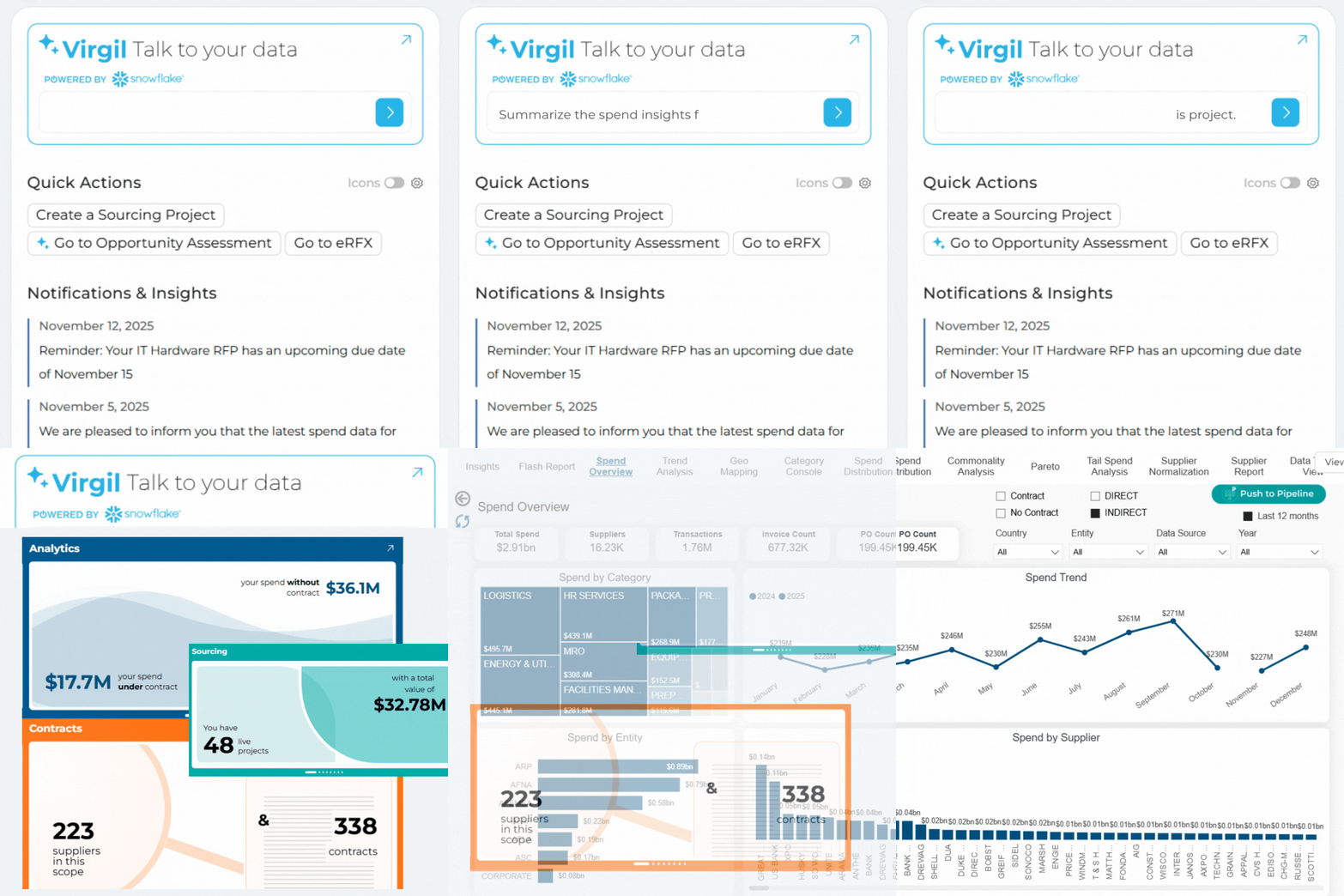
Most recently we took this approach with Virgil, our spend analytics AI assistant powered by Snowflake.
Virgil is an agentic system. A simple agentic system, but an agentic system nonetheless. The core agent takes what you’ve written in the chat window, looks at any recent context, and then determines which tool to use to satisfy a particular need.
These tools include things like:
Determining whether to analyze by supplier or category or payment terms, and then run an appropriate SQL query
Figure out the most relevant market price index for an item and compare changes in market price vs the change in unit prices you have been paying
Push a task to Slack, Teams, etc. to collaborate with your colleagues
Once it had called the tool, the agent would decide if it should make a recommendation. If it made a recommendation, for example there’s an opportunity to consolidate suppliers here, it would ask the user if they wanted to start a new sourcing project to address this opportunity.
Product Lessons From Real Usage
Technically this worked pretty well but it had some issues. What if a user wants to start a sourcing project even if the agent doesn’t think it’s made a recommendation? What if we keep asking the user if they want to start a sourcing project in one chat session? Will they get annoyed? Is it worth waiting the extra seconds while the agent figures out if it thinks it’s worth pushing to a sourcing event?
It turned out that a better user experience was to take this away from the agent’s responsibility and instead to have a button always available for the user to initiate a sourcing project whenever they wanted. Adding too much AI just for the sake of it doesn’t necessarily create a better user experience.
Blending AI With Traditional Engineering
Another area that needed improvement was how to show the results of a database query. Sometimes the raw data is good enough, other times a pivot table is more natural. In the end we used a combination of generative AI with some good old fashioned python coding to show the data in a more useful way.
You don’t have to make everything be agentic or generative or reliant on a large language model everywhere all the time.
What Comes Next for Agentic Procurement
All this together has given us a good grounding on which to explore further agentic approaches. Items that are high up on our priority list include:
How to turn a chat into a shareable dashboard. Once I’m done talking to Virgil about some data then I might want to turn this into several charts that I can share with interested parties.
A negotiation agent. Identify suppliers, negotiate with them and make a recommendation.
RFP builder. Take your existing RFP documentation and improve it based on what the AI knows.
These are just some examples of the items we are exploring as Simfoni builds out the agentic future for procurement. There is a lot more exploration to do on any of these, and it will take deliberate, thoughtful and long-term work to fully bed in the future.
But it’s not science fiction anymore. It is happening, and we will be a key part of making that future happen.
Discover how Simfoni applies AI and agentic thinking to help procurement teams gain clarity, move faster, and deliver measurable outcomes. Schedule a consultation today!

Alan Buxton
CTO at Simfoni

Simfoni
Follow Simfoni on LinkedIn