Accounts Payable Automation Guide: Streamline Your Finance
A Guide for Finance Teams
Accounts payable automation is the use of technology to streamline and accelerate the processes involved in receiving, validating, approving, and paying supplier invoices. This approach replaces time-consuming, error-prone manual tasks with intelligent workflows, enabling finance teams to process more invoices with fewer errors and a smaller administrative burden. For enterprise organizations managing thousands of invoices each month, accounts payable automation is a strategic capability that directly affects cost control, compliance, cash flow management, and the quality of financial data. Simfoni's guide highlights that modern AP automation platforms typically combine optical character recognition for data extraction and rules-based matching logic for purchase order validation.
Table of Contents
Accounts payable is one of the most process-intensive functions in enterprise finance. For organizations managing thousands of invoices each month across dozens of supplier categories, the manual cost of keeping pace with AP workflows is substantial. Accounts payable automation addresses this directly by replacing time-consuming, error-prone manual processes with technology-driven workflows that capture, validate, route, and reconcile invoices at scale. This guide explains what AP automation is, how it works, and how finance and procurement teams can build a business case and implementation plan that delivers measurable results.

What Is Accounts Payable Automation?
Accounts payable automation is the use of technology to streamline and accelerate the processes involved in receiving, validating, approving, and paying supplier invoices. In a manual AP environment, each invoice requires individual attention from finance staff: data is entered into the system by hand, purchase orders are matched manually, approvals are chased by email, and payment runs are compiled one transaction at a time. Automation replaces these steps with intelligent workflows that handle repetitive tasks consistently and at a fraction of the time and cost.
Modern AP automation platforms typically combine optical character recognition for invoice data extraction, rules-based matching logic for purchase order validation, configurable approval workflows for routing invoices to the correct decision-makers, and integrated payment processing for executing approved transactions. The end result is a finance function that processes more invoices, with fewer errors, in less time, and with a far smaller administrative burden on AP staff.
For enterprise organizations with high invoice volumes and complex supplier bases, AP automation is not simply a productivity tool. It is a strategic capability that directly affects cost control, compliance, cash flow management, and the quality of financial data available to leadership across the business.
How Traditional AP Processes Create Business Risk
Understanding why AP automation matters requires an honest look at what manual accounts payable processes cost the business, both in direct expense and in the ongoing risks they create across finance, compliance, and supplier relationships.
In a manual AP environment, invoice processing begins when a supplier submits an invoice, typically by email, post, or through a portal. A member of the AP team manually extracts the relevant data and enters it into the finance or ERP system. This step alone introduces significant error risk: miskeyed invoice numbers, incorrect amounts, wrong supplier codes, and duplicated entries are all common occurrences in high-volume manual operations.
Once data has been entered, the invoice must be matched against the relevant purchase order and goods receipt record. In organizations where purchasing data is fragmented across departments or systems, this matching process is slow and unreliable. Invoices sit in processing queues waiting for information that should be immediately available. Payment terms are missed. Early payment discounts are lost. Suppliers follow up with queries that consume additional staff time and generate further backlogs.
Approval workflows in manual environments typically rely on email chains, with invoices forwarded to approvers who may be traveling, working across time zones, or simply unaware of their outstanding obligations. The result is an approval process that is slow, difficult to audit, and highly dependent on individual responsiveness rather than systematic controls.
At the payment stage, manual AP teams compile payment runs from a combination of approved invoices, payment terms, and available cash positions. This process is vulnerable to human error, including duplicate payments to the same supplier, payments made against fraudulent invoices that were not adequately screened, and missed payments that damage supplier relationships and attract late payment penalties.
Industry benchmarks consistently place the cost of processing a single invoice manually at many times the cost of processing the same invoice through an automated system. For organizations processing thousands of invoices per month, the financial case for automation is compelling even before the compliance and risk management benefits are factored in.
The Business Case for AP Automation: Key Benefits
The benefits of accounts payable automation span cost reduction, risk management, compliance improvement, and strategic capability enhancement. Each dimension contributes to a business case that typically achieves full payback within 12 to 24 months for enterprise implementations.
How does AP automation enable faster invoice processing?
Automated invoice processing dramatically accelerates the time between invoice receipt and payment approval. Where a manual AP team might take five to fifteen days to process a standard invoice through receipt, matching, approval, and payment scheduling, a well-implemented automation platform handles the same workflow in a fraction of that time. Invoices that meet predefined matching rules and approval criteria can be processed in hours rather than days without any manual intervention at all.
Faster processing has direct commercial value. Organizations with strong AP automation are better positioned to capture early payment discount terms negotiated with preferred suppliers, which can represent meaningful savings at scale across a large invoice population. They also avoid the late payment penalties and supplier relationship damage that arise when manual processing delays push payments beyond agreed terms.
How does AP automation lead to lower processing costs?
The cost of processing each invoice drops significantly when manual steps are replaced by automated workflows. Data extraction, matching, routing, and reconciliation all consume AP staff time in a manual environment. Automation handles these steps at scale without proportional cost increases, which means the cost per invoice processed falls as volume grows rather than rising in line with it.
For organizations that have historically added AP headcount to manage invoice volume growth, automation fundamentally changes the operating model. The AP function can process significantly more invoices with the same team, or redirect existing capacity toward exception handling, supplier relationship management, and the higher-value analytical work that automation makes possible.
How does AP automation improve accuracy and reduce errors?
Manual data entry and matching processes introduce errors at multiple stages of the AP workflow. Automation eliminates the most common error sources by extracting invoice data directly from digital documents, matching it automatically against purchase order records, and flagging discrepancies for human review rather than allowing them to pass through undetected into the payment run.
The accuracy improvement compounds across the AP operation. Fewer errors mean fewer supplier queries to resolve, fewer payment corrections to process, and a cleaner audit trail that accurately reflects actual purchasing activity rather than a record distorted by keying mistakes and retrospective manual adjustments.
How does AP automation ensure stronger compliance and audit readiness?
Regulatory and audit requirements in accounts payable have become substantially more demanding across most industries and jurisdictions. Finance teams are expected to maintain complete, accurate records of all invoice approvals, demonstrate that purchases were made in accordance with procurement policy, and provide evidence that suppliers were appropriately screened before payment was released.
Automated AP workflows create a complete, timestamped audit trail for every invoice automatically. Approval decisions, supporting documents, matching results, and payment confirmations are captured and stored in a structured, searchable format. Compliance with e-invoicing mandates, tax documentation requirements, and supplier screening obligations can be built directly into the workflow as systematic checks rather than as periodic manual reviews that depend on individual diligence.
How does AP automation provide better cash flow visibility and control?
In a manual AP environment, the finance team’s view of outstanding payment obligations is typically a snapshot of what has been entered into the system at a given point in time, which rarely reflects the full picture of invoices in process, awaiting approval, or under query. This gap between actual liability and recorded position creates real uncertainty in cash flow forecasting and working capital management.
AP automation gives finance teams a real-time view of the full AP pipeline, including invoices at every stage of processing, their associated payment terms, and the expected cash outflow they represent. This visibility supports more accurate short-term cash flow forecasting, better decisions about early payment discount optimization, and more effective use of available credit facilities across the business.
How does AP automation reduce fraud risk?
Invoice fraud represents a growing risk for enterprise finance teams. Fraudulent invoices can enter the AP process disguised as legitimate supplier claims, particularly in organizations with large and unmanaged supplier bases where not every vendor relationship is well-known to the team processing the payment.
Automated AP systems reduce fraud risk through systematic controls that manual processes cannot reliably replicate. Supplier verification checks confirm that payment details match approved supplier records before any transaction is processed. Duplicate invoice detection identifies attempts to submit the same invoice twice under different reference numbers. Anomaly detection flags invoices with unusual amounts, unexpected frequencies, or unrecognized supplier details for human review before payment is released, providing a safety layer that operates consistently across the entire invoice population.
How Accounts Payable Automation Works
While the specific capabilities of AP automation platforms vary, the core workflow follows a consistent sequence that transforms the way invoices move from supplier submission through to payment confirmation and reconciliation.
How does AP automation handle invoice capture and data extraction?
The automation process begins when a supplier submits an invoice. Modern AP platforms accept invoices in multiple formats including PDF attachments, structured electronic data formats, EDI transmissions, and direct integration with supplier billing systems. Optical character recognition technology extracts the relevant data from unstructured invoice documents, including the supplier name, invoice number, date, line item details, and total amount, and maps it to the corresponding fields in the finance system.
For suppliers who submit invoices in structured electronic formats, this step is faster and more accurate because no character recognition interpretation is required. The data transfers directly into the AP system in a validated, structured form that is immediately ready for the next stage of processing without any manual verification of the extraction result.
How does AP automation perform matching and validation?
Once invoice data has been captured, the platform matches it automatically against the corresponding purchase order and, where applicable, the goods receipt record. This three-way match confirms that what was invoiced corresponds to what was ordered and what was actually delivered, which is the fundamental control mechanism in accounts payable that prevents payment for goods or services that were never received or properly authorized.
Invoices that match within defined tolerance parameters are automatically cleared for payment without requiring manual review. Invoices with discrepancies are flagged as exceptions and routed to the appropriate team member for investigation. This exception-based approach means that AP staff spend their time resolving genuine issues rather than manually reviewing every invoice regardless of whether any problem exists.
How does AP automation manage approval workflow routing?
For invoices that require human approval, whether because they exceed automated approval thresholds or because they relate to categories requiring additional oversight, the automation platform routes the invoice electronically to the correct approver based on predefined rules. Approvers receive notifications through email or mobile applications and can review and approve invoices directly without requiring desktop access to the finance system.
Approval workflows can be configured to reflect the organization’s actual authorization framework, including sequential approvals for invoices above certain value thresholds, parallel approval from multiple stakeholders for specific spend categories, and automatic escalation if an approver does not act within a defined timeframe. This configurability ensures that the platform enforces the organization’s actual controls rather than imposing a one-size-fits-all approval model that does not match operational requirements.
How does AP automation handle payment processing and reconciliation?
Once an invoice has been fully approved, the AP automation platform schedules the payment in accordance with the agreed supplier payment terms and the organization’s cash management priorities. Payment instructions are transmitted electronically to the banking system, reducing the risk of errors associated with manual payment file preparation and the re-keying of payment details that manual processes require.
After payment is executed, the platform automatically reconciles the transaction against the original invoice and purchase order records, updates the supplier ledger, and generates the documentation required for audit purposes. The full transaction lifecycle, from invoice receipt to payment confirmation, is captured in a structured, searchable audit trail that finance teams can access at any time without manual archive searches or retrospective reconstruction of the approval history.
Key Features to Look for in AP Automation Software
When evaluating AP automation solutions, finance teams should assess capability across several dimensions that determine whether the platform will genuinely address the organization’s specific challenges rather than simply digitizing existing manual processes without fundamentally improving them.
Invoice capture capability should handle the full range of formats used by the organization’s supplier base, including unstructured PDF documents, structured electronic formats, and portal-submitted invoices. A platform that processes only one invoice format will require manual handling for the remainder, which limits automation coverage and therefore the efficiency gains available from the investment.
Matching accuracy is critical to the overall effectiveness of the platform. The system’s ability to correctly match invoices against purchase orders and goods receipts without excessive exception rates determines how much AP staff time is genuinely freed up. High false-positive exception rates mean that staff are reviewing invoices that should have been automatically approved, while high false-negative rates mean that genuine discrepancies are passing through undetected into the payment run.
Integration depth with the organization’s existing ERP, procurement platform, and banking systems determines whether the AP automation platform operates as part of a connected financial workflow or as a standalone tool that requires manual data transfer at its boundaries. Deep, bidirectional integration is the foundation of a genuinely automated end-to-end process.
Approval workflow configurability allows the platform to mirror the organization’s actual authorization requirements rather than forcing the business to adapt its controls to the platform’s defaults. Configurable thresholds, sequential and parallel approval paths, mobile approval capability, and automatic escalation rules are all indicators of a platform built for enterprise-grade complexity.
Reporting and analytics capability determines the quality of the spend visibility and cash flow insight the platform provides to finance leadership. A platform that processes invoices efficiently but provides limited reporting on the AP pipeline, payment performance, and supplier activity does not deliver the full strategic value that AP automation can generate for the business.
AP Automation and Vendor Consolidation: The Connection
Accounts payable automation and vendor consolidation are mutually reinforcing strategies that deliver their greatest combined impact when implemented together rather than pursued in isolation from each other.
In an organization with a large, unconsolidated vendor base, even a highly capable AP automation platform has limited impact on total AP workload because the sheer number of active suppliers means that invoice volume remains high regardless of how efficiently each individual invoice is processed. Automation reduces the cost per invoice, but it does not address the underlying driver of invoice volume, which is the number of active vendor relationships generating invoices in the first place.
Vendor consolidation addresses the root cause directly by reducing the number of active supplier relationships and therefore the volume of invoices that need to be processed. When consolidation is applied to tail spend categories and the resulting volume is routed through a smaller number of preferred vendors or a single managed vendor, invoice volume drops sharply and the remaining invoices are processed through the automated platform at a fraction of the previous cost and effort.
The combination of AP automation and vendor consolidation creates a compounding efficiency effect. Automation drives the cost per invoice down. Consolidation reduces the invoice count. Together, they deliver a total AP processing cost reduction that neither strategy achieves independently, and the savings compound over time as preferred vendor relationships and automated matching rules mature together.
AP Automation in Tail Spend Management
Tail spend represents one of the most significant AP automation opportunities in enterprise organizations, precisely because it is the area where invoice complexity and vendor fragmentation are typically greatest and most resistant to conventional process improvement approaches.
In the tail spend category, a single enterprise might receive invoices from hundreds of small, infrequently used suppliers, each submitting invoices in different formats, with different payment terms, and requiring individual processing attention from AP staff. The volume of invoices is disproportionately large relative to the total spend involved, which means that tail spend generates a highly inefficient AP workload that consumes significant resources for relatively modest commercial value.
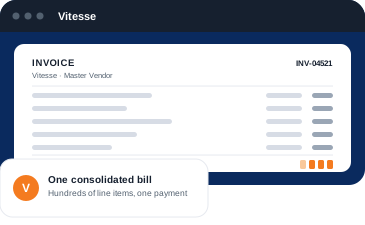
The most effective approach to AP automation in tail spend combines technology with a structural change to the vendor relationship model. Rather than attempting to automate individual invoice processing for hundreds of tail spend suppliers, leading organizations route all tail spend through a single managed vendor who handles onboarding, purchasing, and payment with underlying suppliers on their behalf. Finance receives a single consolidated invoice from the managed vendor covering all tail spend activity in a given period, which is then processed through the automated AP workflow as a single, high-quality, fully structured transaction.
This approach reduces tail spend AP workload far more dramatically than processing automation alone could achieve, because it addresses both the volume and the complexity of the invoice population rather than only the efficiency of each individual processing step. Organizations that combine consolidated tail spend management with AP automation consistently report accounts payable workload reductions of 70 percent or more in their tail spend categories, delivered sustainably without ongoing dependence on manual process workarounds.
How to Build the Business Case for AP Automation
Securing investment in AP automation requires a business case that translates operational benefits into financial terms that finance leadership and the executive team can evaluate alongside competing capital priorities. A rigorous business case is also the foundation for setting realistic implementation targets and measuring success once the platform is live.
The starting point is an accurate baseline of current AP performance. This means quantifying the number of invoices processed per month, the average fully loaded cost of processing each invoice including staff time, system costs, and error correction activity, the average processing time from receipt to payment approval, the current error and exception rate and its cost in rework and supplier query resolution, and the volume of invoices that result in late payment penalties or missed early payment discounts in a typical month.
With a credible baseline established, the business case can model the expected improvement in each dimension under an automated AP model, drawing on the documented performance benchmarks of comparable implementations. Processing cost per invoice should fall substantially. Processing time should compress from days to hours for invoices that meet matching criteria. Error rates should approach zero for automatically processed transactions. Late payment penalties should be eliminated and early payment discount capture should improve significantly.
The financial model should include the full implementation cost of the AP automation platform, including software licensing, integration work, data migration, and staff training, and compare that total investment against the projected annualized savings from efficiency improvement, error reduction, and payment optimization. Most enterprise AP automation implementations achieve payback within 12 to 24 months and deliver ongoing savings that significantly exceed the initial investment over a three to five year horizon.
Common Challenges in AP Automation Implementation
AP automation implementations regularly encounter obstacles that, if not anticipated and managed proactively, can delay deployment, limit adoption, or reduce the efficiency gains available from the technology investment.
What are the challenges of legacy system integration in AP automation?
Many enterprise finance environments include ERP and accounting systems that were not designed with modern API-based integration in mind. Connecting an AP automation platform to a legacy system may require custom integration work that extends the implementation timeline and adds to the total project cost in ways that are easy to underestimate during the initial scoping process.
Addressing this challenge requires early and detailed technical assessment of the integration requirements before implementation begins. Understanding exactly which data fields need to flow between systems, how frequently the data transfer needs to occur, and what the error handling and reconciliation requirements are allows the implementation team to scope the integration work accurately and include it in the project plan with realistic timelines and contingency provisions.
What are the challenges of supplier adoption and onboarding in AP automation?
AP automation delivers the greatest benefits when suppliers submit invoices in structured electronic formats that the platform can process without optical character recognition interpretation. However, transitioning suppliers to electronic invoice submission requires a dedicated supplier communication and onboarding program that many organizations underestimate in both scope and effort.
Smaller suppliers in particular may lack the technical capability to submit invoices in structured formats and may require extended support and accommodation during the transition period. A phased supplier onboarding approach that prioritizes high-volume suppliers first, where the efficiency gains from electronic submission are greatest, allows the organization to capture the majority of the available automation benefit while providing the time and support needed for smaller suppliers to adapt their invoicing processes.
What are the challenges of data quality and standardization in AP automation?
AP automation depends on clean, consistent data in the underlying finance and procurement systems. Inconsistent supplier naming conventions, duplicate vendor records, missing purchase order references, and incomplete goods receipt data all generate matching exceptions that must be resolved manually, which limits the straight-through processing rate and therefore the efficiency gain available from the platform.
Data quality improvement is best treated as a parallel workstream that runs alongside the AP automation implementation rather than a prerequisite that must be fully resolved in advance. Prioritizing the spend categories and supplier populations where data quality is strongest for the initial automation rollout allows the platform to demonstrate high straight-through processing rates quickly while the broader data quality improvement effort continues across the rest of the supplier base.
How to Measure the ROI of Accounts Payable Automation
Measuring the return on investment from AP automation requires tracking a defined set of financial and operational metrics before and after implementation, and comparing the post-implementation results against the baseline established during the business case development process.
The core financial metric is the total cost of AP operations, expressed both in absolute terms and as a cost per invoice processed. This measure captures the combined impact of staff efficiency improvement, technology replacement of manual processing steps, and the reduction in error-driven rework and supplier query resolution activity that automation delivers across the full invoice population.
Processing time metrics, particularly the average time from invoice receipt to payment approval and the proportion of invoices processed within agreed payment terms, capture the operational improvement delivered by automation and provide evidence of the supplier relationship and early payment discount benefits. Straight-through processing rate, which is the proportion of invoices processed automatically without any manual intervention, is the most direct indicator of automation effectiveness and should improve steadily as the platform’s matching rules are refined and supplier electronic invoice adoption increases over time.
Compliance metrics, including the completeness of the audit trail, the rate of compliance exceptions identified and resolved by the automated workflow, and the outcome of internal and external audits of the AP process, provide evidence that automation is delivering risk management value alongside the efficiency gains. A mature AP automation implementation should be able to produce complete, accurate documentation for any invoice at any point in its lifecycle within seconds, without requiring manual archive searches or retrospective approval history reconstruction.
Frequently Asked Questions About Accounts Payable Automation
What is accounts payable automation?
Accounts payable automation is the use of technology to replace manual steps in the supplier invoice processing workflow, including data capture, purchase order matching, approval routing, payment execution, and reconciliation. The goal is to process more invoices with greater accuracy, in less time, and at a lower cost per transaction, while maintaining a complete and searchable audit trail for compliance and reporting purposes.
What is the difference between AP automation and an ERP system?
An ERP system is a broad enterprise platform that manages financial transactions, general ledger accounting, procurement, inventory, and many other business processes. AP automation is a specialized discipline focused on optimizing the invoice-to-payment workflow within or alongside the ERP environment. Many organizations implement AP automation as a capability layer that enhances the invoice processing performance of their existing ERP rather than replacing it, with the automation platform handling data extraction, matching, and workflow routing while the ERP maintains the authoritative financial record.
How does AP automation reduce costs?
AP automation reduces costs in several ways simultaneously. It eliminates manual data entry, which is slow and introduces errors that create downstream correction costs. It accelerates approval cycles, which reduces late payment penalties and enables early payment discount capture. It reduces the staff time required to process each invoice, which allows the AP team to handle greater volume without adding headcount. It also reduces the cost of error resolution, supplier query handling, and compliance documentation that manual processes generate as a byproduct of their inherent inefficiency.
What types of invoices can be automated?
Modern AP automation platforms can process invoices in a wide range of formats, including PDF documents handled through optical character recognition, structured electronic invoice formats, EDI transmissions, and invoices submitted through integrated supplier portals. The proportion of invoices that can be processed with full straight-through automation depends on the consistency and quality of the invoice data submitted by suppliers and the completeness of the matching data available in the procurement system, which is why supplier onboarding programs and data quality improvement are important elements of a comprehensive AP automation strategy.
How long does AP automation implementation take?
Implementation timelines vary depending on the complexity of the integration requirements, the number of invoice formats to be supported, and the scale of the supplier base to be onboarded. A focused implementation targeting a specific set of high-volume invoice types with relatively straightforward ERP integration can go live within three to six months. A comprehensive enterprise implementation covering multiple entity types, geographies, and legacy system integrations typically takes six to eighteen months to reach full deployment, with ongoing refinement of matching rules and supplier onboarding continuing beyond the initial go-live milestone.
Does AP automation work for organizations with high supplier counts?
AP automation delivers efficiency improvements regardless of the supplier count, but the combination of AP automation with vendor consolidation delivers the greatest total impact for organizations with large, fragmented supplier bases. Automation reduces the cost and time required to process each individual invoice. Consolidation reduces the total number of invoices that need to be processed by concentrating spend with fewer, better-managed vendors. Together they produce a total AP workload reduction that is substantially larger than either approach achieves independently, and the efficiency gains compound over time as the consolidated vendor base and automated matching rules mature together.
How does AP automation support compliance?
AP automation creates a complete, timestamped audit trail for every invoice automatically, capturing the data extraction result, the matching outcome, each approval decision with the approver identity and timestamp, and the payment confirmation in a structured, searchable record. Systematic compliance checks including supplier sanctions screening, duplicate invoice detection, and policy exception flagging are built into the workflow and applied consistently to every invoice rather than selectively through periodic manual reviews. This systematic approach to compliance documentation significantly reduces the effort and risk associated with internal and external audit obligations.
What is the relationship between AP automation and tail spend management?
Tail spend generates a disproportionately large share of AP processing complexity because it involves a high volume of invoices from a large number of low-frequency suppliers, each with inconsistent invoice formats and varying levels of process maturity. AP automation reduces the per-invoice processing cost across this population, but the most dramatic workload reduction in tail spend comes from combining automation with a consolidated vendor model that routes all tail spend through a single managed vendor. Finance then receives a single, structured, consolidated invoice covering all tail spend activity in a given period, which is processed through the automated AP workflow as one clean transaction rather than hundreds of individual ones, delivering an AP workload reduction that processing technology alone could not achieve.