Spend analytics is no longer about visibility alone. Its true value lies in helping procurement leaders turn enterprise data into sourcing decisions and measurable outcomes.
Procurement organizations have spent years investing in spend analytics. Dashboards, reporting tools, and category analysis have become standard capabilities across many procurement environments. Yet despite these investments, a common frustration persists. Procurement teams often have more data than ever before but struggle to translate that information into action.
This gap between insight and execution is now shaping the evolution of modern spend analytics.
Today’s procurement leaders are not simply looking for visibility into spending patterns. They are seeking intelligence that connects directly to sourcing strategies, supplier engagement, and operational decision making. Modern spend analytics must therefore move beyond reporting and become an operational capability that drives procurement outcomes.
Why Traditional Spend Analytics Often Fall Short
Traditional spend analytics platforms were designed primarily to answer one question: where is the money going? While this visibility remains valuable, it rarely delivers procurement transformation on its own.
Several challenges often limit the effectiveness of traditional analytics environments.
- Delayed insights
Spend data often requires extensive manual classification and preparation before analysis can begin. - Fragmented procurement systems
Data frequently originates from multiple ERP systems and procurement tools that use inconsistent supplier and category definitions. - Limited connection to sourcing workflows
Even when analytics identify savings opportunities, acting on those insights may require switching to separate sourcing platforms or manual processes.
These challenges can turn analytics into a retrospective exercise rather than a forward-looking capability.
What “Modern Spend Analytics” Actually Means
Modern spend analytics represents a shift from static reporting to continuous procurement intelligence. Instead of simply describing historical spending, analytics environments are designed to help procurement teams identify opportunities and act on them more quickly.
Several capabilities define this evolution.
- AI classification of procurement data
Artificial intelligence helps organize transactions into consistent spend categories, enabling clearer visibility across suppliers, categories, and business units. - Real-time dashboards
Modern analytics environments provide continuously updated views of procurement performance, allowing teams to respond to changes in supplier behavior or spending trends more quickly. - Integrated workflows
Insights generated through analytics platforms connect directly to sourcing and supplier engagement processes, allowing procurement teams to move from analysis to execution without delay.
This shift transforms spend analytics from a reporting tool into a strategic decision support capability.
The Role of AI Classification in Spend Visibility
One of the most significant challenges in procurement analytics has always been the structure of procurement data. Supplier descriptions, transaction labels, and category definitions vary widely across organizations and systems.
AI classification helps address this problem by organizing procurement data into consistent category structures. Instead of relying solely on manual categorization, AI models can analyze transaction patterns and assign spending data to appropriate categories.
This capability improves spend visibility in several ways.
- Procurement teams gain a clearer view of enterprise spending patterns
- Category managers can identify consolidation opportunities more quickly
- Leadership teams receive more reliable procurement insights
When applied at scale, AI classification helps procurement organizations maintain consistent data governance across large and complex data environments.
Why Real-Time Dashboards Change Procurement Decision Speed
In traditional analytics environments, procurement insights often arrive after the fact. Teams analyze historical data, identify patterns, and then begin planning sourcing activities.
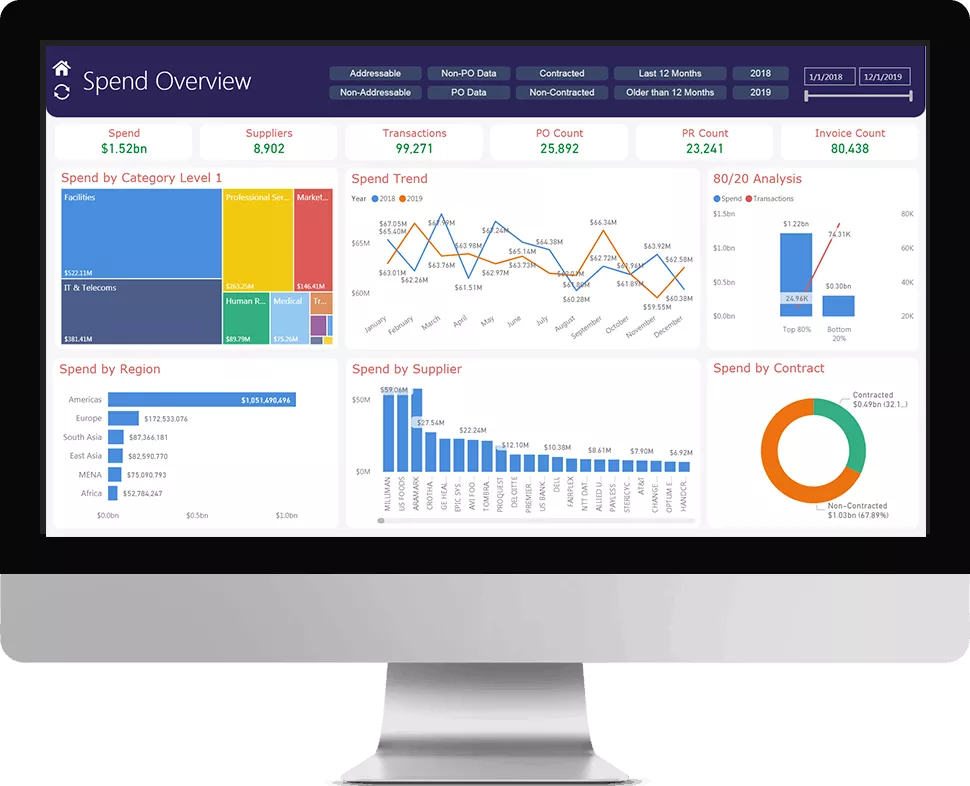
Real-time dashboards help shift procurement from retrospective analysis to ongoing intelligence. Procurement leaders can monitor supplier spending patterns, category trends, and procurement performance metrics continuously.
This visibility allows organizations to:
- Identify sourcing opportunities earlier
- Monitor supplier concentration and risk exposure
- Track procurement performance across categories and regions
When analytics environments update continuously, procurement teams can act on insights before opportunities disappear.
Closing the Gap Between Insight and Sourcing Action
The ultimate goal of spend analytics is not visibility. It is action.
Many procurement organizations still struggle with the transition from analytics to sourcing execution. Data insights may reveal consolidation opportunities or supplier inefficiencies, but those insights must translate into sourcing strategies, supplier negotiations, and category management initiatives.
Modern procurement platforms are increasingly designed to close this gap.
Simfoni’s Strategic Spend Hub (SSH) reflects this broader evolution in procurement technology. By combining spend intelligence, AI classification, and connected procurement workflows within a unified environment, platforms like SSH enable procurement teams to move from insight to execution more efficiently.
Within these environments, spend analytics is no longer a separate reporting capability. It becomes part of an operational system that supports sourcing decisions and supplier engagement.
Why Unified Procurement Data Matters
Modern spend analytics depends heavily on the quality and consistency of procurement data. Without strong data governance, analytics outputs become unreliable.
Unified procurement data environments help organizations maintain:
- Consistent supplier records
- Standardized category definitions
- Reliable enterprise-wide reporting
- Governance controls across procurement systems
When procurement data is centralized and governed, analytics insights become more trustworthy and easier to translate into action.
This is why many procurement leaders now view spend analytics not as a standalone tool but as a capability embedded within a broader procurement platform architecture.
What Procurement Leaders Should Prioritize
As procurement organizations modernize their analytics capabilities, several priorities are becoming increasingly clear.
- Invest in data governance
Reliable analytics depend on consistent supplier and category structures. - Connect analytics to execution
Insights should flow directly into sourcing workflows and supplier engagement processes. - Focus on decision speed
Real-time intelligence allows procurement teams to respond more quickly to supplier and market changes.
Procurement leaders who prioritize these capabilities will gain greater value from their analytics investments.
Conclusion
Spend analytics has evolved significantly over the past decade. What began as a reporting capability is now becoming a strategic intelligence function within procurement organizations.
Modern spend analytics enables procurement leaders to move beyond historical visibility and toward continuous intelligence that supports sourcing decisions, supplier engagement, and operational strategy.
Organizations that combine AI classification, real-time analytics environments, and integrated procurement workflows will be best positioned to turn procurement data into measurable enterprise outcomes.
What Is Spend Analytics in Procurement?
Spend analytics refers to the process of collecting, organizing, and analyzing procurement data in order to understand how an organization spends money across suppliers, categories, and business units.
Modern spend analytics platforms use technologies such as AI classification and real-time dashboards to provide procurement teams with clearer visibility into enterprise spending patterns.
This capability allows procurement leaders to identify sourcing opportunities, improve supplier management, and make more informed procurement decisions.
Why Spend Analytics Matters for Enterprise Procurement
Spend analytics plays a central role in modern procurement because it helps organizations understand where their procurement budget is being allocated and how suppliers contribute to enterprise operations.
With strong analytics capabilities, procurement teams can:
- Identify consolidation opportunities
- Improve supplier negotiations
- Monitor procurement performance
- Support sourcing strategies
As procurement becomes more strategic, the ability to generate reliable spend intelligence becomes increasingly important.
Key Takeaways: Modern Spend Analytics
- Spend analytics helps organizations understand enterprise procurement spending.
- AI classification improves the structure and accuracy of procurement data.
- Real-time dashboards allow procurement teams to respond more quickly to changes.
- Modern analytics platforms connect insights directly to sourcing workflows.
- Spend analytics is becoming a core capability for strategic procurement leadership.
Take an interactive tour of Simfoni's Strategic Spend Terminal!
Simfoni’s Strategic Spend Terminal combines Spend Analytics, eSourcing, and Pipeline Management into a single, unified platform designed to transform procurement operations.
Take an interactive tour and learn how our technology drives smarter decisions, faster results, and measurable value at every stage of the procurement process.