Vendor Consolidation
A Complete Guide for Enterprise Teams
Table of Contents
Vendor consolidation is one of the highest-impact programs available to enterprise procurement and finance teams. By deliberately reducing the number of active suppliers and routing more spend through a smaller, better-managed set of vendors, organizations gain control over costs, compliance, and the real-time visibility they need to make smarter purchasing decisions. This guide covers what vendor consolidation is, why it matters, how to build a strategy that works, and how to measure success once the program is running.

Vendor consolidation is one of the highest-impact programs available to enterprise procurement and finance teams. By deliberately reducing the number of active suppliers and routing more spend through a smaller, better-managed set of vendors, organizations gain control over costs, compliance, and the real-time visibility they need to make smarter purchasing decisions. This guide covers what vendor consolidation is, why it matters, how to build a strategy that works, and how to measure success once the program is running.
What Is Vendor Consolidation?
Vendor consolidation is the strategic process of reducing an organization’s active supplier base by concentrating purchasing volume with a smaller, more carefully selected group of preferred vendors. Rather than allowing departments to independently engage any supplier they choose, a consolidated approach routes spend through vendors who have been properly vetted, contracted, and integrated into the organization’s procurement and payment workflows.
The objective is not simply to reduce vendor count for its own sake. It is to replace an unmanaged, fragmented supplier landscape with a controlled one where every vendor relationship delivers measurable value, where compliance is enforced systematically, and where spend data is captured in a way that supports better business decisions. For enterprise organizations, vendor consolidation is one of the most reliable levers for reducing indirect procurement costs and improving financial control across the business.
How Vendor Sprawl Happens in Enterprise Organizations
Most organizations do not plan to have an unmanageable supplier base. Vendor sprawl develops gradually, driven by decentralized purchasing habits, organizational growth, and the absence of consistent procurement controls across departments and geographies.
When individual teams are free to select suppliers independently, each gravitates toward the vendors it finds most convenient. A marketing department uses one print supplier while a regional office uses a different one. An operations team onboards a specialist contractor without notifying central procurement. A facilities manager signs a local services agreement outside the approved vendor list. Over time, these individual decisions accumulate into a fragmented vendor base that no single team has a complete picture of.
Mergers and acquisitions amplify the problem substantially. When two organizations combine, they bring together separate vendor ecosystems, frequently with significant duplication across spend categories. A company operating across multiple geographies will often end up with separate regional vendors providing near-identical services, with no mechanism to consolidate those relationships at the enterprise level.
The result is a long tail of suppliers, many of whom were engaged for a single transaction and then forgotten, each representing a compliance risk, an outstanding invoice, and an administrative cost that exceeds the value of the original purchase many times over.
Why Vendor Consolidation Matters: The Business Case
The case for vendor consolidation extends well beyond reducing paperwork. When organizations bring their vendor base under control, the benefits compound across procurement, finance, compliance, and operations simultaneously.
Lower Procurement and Administration Costs
Every active vendor relationship carries an administrative cost. Setting up a new supplier in an ERP system, processing and reconciling invoices, managing payment runs, handling disputes, and maintaining compliance documentation all require staff time and system resources. When those activities are multiplied across hundreds of low-value suppliers, the total cost of maintaining the vendor base often exceeds the value of the spend it represents.
By reducing the active vendor count, organizations eliminate the overhead associated with suppliers who provide little strategic value. Procurement and accounts payable teams can redirect their capacity toward higher-value work, and the cost per transaction drops materially when volume is concentrated through fewer, better-managed relationships.
Greater Spend Visibility
Fragmented vendor relationships make it nearly impossible to maintain an accurate picture of organizational spend. When purchases are distributed across a large and shifting population of suppliers without consistent approval workflows or spend categorization, finance teams are left reconstructing purchasing patterns from incomplete data long after the transactions have taken place.
Vendor consolidation routes spend through a defined set of controlled channels, making it far easier to capture, classify, and analyze purchasing activity in real time. Organizations that consolidate their vendor base consistently report significant improvements in spend visibility, which in turn enables better category management, more accurate budget forecasting, and faster identification of cost reduction opportunities across the business.
Stronger Compliance and Risk Controls
A large, unmanaged vendor base creates meaningful compliance exposure. Suppliers who have not been properly vetted may present sanctions risk, modern slavery concerns, or data security vulnerabilities. Purchases made outside approved supplier lists breach procurement policy, generate audit findings, and can create serious legal liability in regulated industries.
When spend is routed through a controlled, consolidated vendor set, compliance checks can be applied systematically and consistently. Preferred vendors are screened at onboarding and reviewed on an ongoing basis. Purchasing controls govern which categories of spend can be approved at each level of the organization. The result is a procurement environment where compliance is built into the purchasing process rather than added as an afterthought.
Reduced Accounts Payable Workload
In an unconsolidated vendor environment, accounts payable teams routinely handle hundreds of separate invoices each month from a continuously changing roster of suppliers. Each invoice must be matched to a purchase order, checked for accuracy, approved, and paid. Discrepancies require resolution. New suppliers require bank detail verification and tax documentation before a first payment can be released.
Vendor consolidation simplifies this process considerably. When spend flows through fewer vendors, invoice volume drops proportionally and the remaining invoices are far easier to reconcile because they come from known, predictable sources with established workflows. Organizations that apply consolidation strategically in their indirect spend categories frequently report accounts payable workload reductions of 60 to 70 percent in those areas.
Leverage with Preferred Suppliers
A vendor receiving one or two small orders per year has no incentive to offer competitive pricing or prioritized service. By concentrating volume with a smaller set of preferred suppliers, organizations create the purchasing scale that earns better pricing, improved service levels, and stronger contractual terms.
This leverage compounds over time. As spend data accumulates and preferred vendor relationships mature, procurement teams are in a far stronger position to negotiate annual reductions and favorable payment terms than they would be managing equivalent spend across a fragmented vendor base where no individual relationship is large enough to attract meaningful commercial attention.
Vendor Consolidation vs. Vendor Rationalization: What Is the Difference?
Vendor consolidation and vendor rationalization are frequently used interchangeably, but they describe distinct activities. Understanding the difference helps organizations choose the appropriate approach and sequence their efforts correctly.
Vendor rationalization is the analytical process of evaluating an existing supplier base, assessing which vendors are delivering genuine value, and making strategic decisions about which relationships to retain, expand, or exit. It is primarily an assessment discipline. Organizations conduct vendor rationalization to develop a complete picture of their supplier landscape, identify unnecessary duplication, and determine where consolidation is warranted.
Vendor consolidation is what follows that assessment. It is the operational process of actively redirecting spend away from vendors identified as low-value or redundant and channeling that volume toward preferred alternatives. Rationalization defines the strategy; consolidation implements it.
In practice, the most effective programs combine both disciplines. A rationalization exercise establishes which vendors to retain and which to exit. A consolidation program then implements the transition with clear timelines, structured stakeholder communication, and ongoing performance measurement.
How to Build a Vendor Consolidation Strategy: A Step-by-Step Framework
Vendor consolidation achieves its full potential when it follows a structured methodology rather than an opportunistic approach. The framework below reflects best practices from enterprise consolidation programs across manufacturing, professional services, retail, and the public sector.
Step 1: Conduct a Full Vendor Audit
The foundation of any vendor consolidation program is a complete, accurate picture of the current vendor base. This means pulling all active vendor records from the ERP system, procurement platform, expense management tool, and accounts payable ledger, and consolidating them into a single, deduplicated dataset.
The audit should capture, for each vendor, the total spend over a defined period (typically 12 to 24 months), the number of individual transactions, the departments that initiated purchases, the categories in which spend is classified, and whether the vendor operates under a negotiated contract. This data provides the foundation for all subsequent consolidation decisions.
Organizations frequently discover significant surprises at this stage. Duplicate vendor records for the same supplier under different names, vendors who were paid once several years ago and remain active in the system, and unexpected concentrations of unmanaged spend in categories assumed to be under control are all common findings that shape the consolidation priorities that follow.
Step 2: Segment Your Vendor Base
Once a complete vendor picture is established, the next step is to segment suppliers by spend concentration and strategic value. A Pareto analysis is the standard starting point. In most enterprises, approximately 80 percent of total spend sits with roughly 20 percent of vendors. The remaining 80 percent of the supplier base accounts for the long tail of low-value, high-volume transactions that represent the primary consolidation opportunity.
Within this segmentation, further classification adds precision. Strategic vendors are those with high spend concentration and long-term contractual commitments. Preferred vendors are those who deliver strong value in specific categories and are candidates to absorb additional consolidated volume. Tail vendors are those with low spend frequency and no distinctive capability that a preferred alternative could not replicate at comparable or lower cost.
Step 3: Define Your Consolidation Criteria
Not every vendor is an appropriate candidate for exit or consolidation, and the criteria for prioritization should be defined explicitly before any transition decisions are made. This prevents the program from becoming an indiscriminate vendor reduction exercise that damages important relationships or eliminates genuine operational capability.
Consolidation criteria should address several dimensions. Spend threshold criteria identify the minimum annual spend level below which a vendor relationship is unlikely to justify its administrative overhead. Category criteria identify the spend types where consolidation is most practical, typically indirect and tail spend categories where like-for-like substitution is straightforward. Risk criteria flag vendors whose continuation presents compliance concerns. Capability criteria confirm that the vendors absorbing consolidated volume are genuinely equipped to meet the quality and service requirements of the spend being transferred.
Step 4: Identify and Qualify Preferred Vendors
For each category where consolidation is planned, procurement teams need to establish which vendors will receive the redirected volume. In some categories, an existing contracted vendor has the capacity and capability to absorb additional spend without further qualification. In others, a focused sourcing exercise is needed to identify the best available option.
Preferred vendor qualification should include financial stability review, compliance screening (including sanctions checks and insurance verification), capability and quality assessment, and reference validation where the volume involved is significant. Rushing this step creates the risk that the vendor inheriting consolidated spend is unable to deliver reliably, which rapidly undermines internal credibility for the broader program.
Step 5: Transition Spend and Communicate with Stakeholders
Moving spend from existing vendor relationships to preferred alternatives requires deliberate stakeholder management. Business units that have established relationships with vendors being exited will often resist change, particularly if they perceive the consolidation program as an infringement on their operational autonomy or a reduction in the quality of supplier options available to them.
Effective communication frames the program’s purpose in terms that resonate with each stakeholder group. Finance teams respond to the accounts payable efficiency argument. Operations teams respond to the simplified ordering and faster supplier access narrative. Leadership responds to cost reduction and compliance improvement data backed by concrete metrics.
Transition plans should define clear timelines for winding down existing vendor relationships, specify how employees should submit purchase requests in the new consolidated environment, and establish escalation routes for situations where a specific operational requirement falls outside the preferred vendor set.
Step 6: Monitor and Continuously Optimize
Vendor consolidation requires ongoing governance to remain effective. Vendor bases naturally drift toward complexity over time if controls are not in place to manage new supplier requests, and the benefits of consolidation erode quickly if departments are free to re-engage tail vendors without oversight or approval.
Successful programs establish monitoring through spend analytics dashboards, regular vendor base reviews, and defined controls governing new vendor onboarding. Procurement and finance teams should track active vendor count by category, the proportion of spend flowing through preferred suppliers, new vendor additions per period, and accounts payable cost per invoice. These metrics reveal whether the program is maintaining its discipline and where corrective action may be needed.
Vendor Consolidation in Tail Spend Management
Tail spend is the area of procurement where vendor consolidation delivers the most immediate and measurable results. Defined as the high-volume, low-value transactions that involve approximately 80 percent of an organization’s vendors while accounting for only around 20 percent of total spend, tail spend is precisely the environment where fragmentation is most damaging and consolidation most practical.
In a typical enterprise, tail spend covers a wide range of categories including office supplies, temporary services, facilities maintenance, print, couriering, and hundreds of other indirect needs. Each individual purchase may be modest in size, but the cumulative cost of managing the vendor relationships that serve these purchases is substantial and often invisible in total cost of ownership calculations.
The most effective approach to consolidating tail spend is to route all transactions through a single managed vendor or a tightly controlled set of preferred suppliers who act as intermediaries between the organization and the underlying market. This eliminates the need for individual vendor onboarding, contract negotiation, and payment administration for each tail spend category, replacing them with a single controlled workflow that captures spend data, enforces policy, and produces a consolidated invoice for finance teams.
Organizations that successfully apply consolidation to their tail spend typically report a 50 to 70 percent reduction in active small vendor relationships, a proportional reduction in accounts payable workload, and meaningful improvement in spend visibility across categories that were previously entirely unmanaged.
Common Challenges in Vendor Consolidation and How to Address Them
Vendor consolidation programs regularly encounter resistance and practical obstacles that, if not addressed proactively, can limit progress or undermine long-term results.
Internal Resistance from Business Units
The most common obstacle is pushback from departments whose existing vendor relationships are being exited. Employees often feel loyalty to suppliers they have worked with for years, or they are concerned that a preferred alternative will not meet their specific operational requirements as reliably as the incumbent.
Addressing this resistance requires early engagement rather than top-down mandates. Involving key business unit stakeholders in the vendor qualification and selection process builds genuine buy-in and ensures that preferred vendor choices reflect real operational needs. Demonstrating results from pilot categories with concrete data on cost savings and process improvement is consistently more persuasive than policy-level arguments presented without supporting evidence.
Data Quality Issues
Many organizations discover that their vendor master data is in poor condition at the start of a consolidation program. Duplicate records, inconsistent naming conventions, incomplete spend categorization, and gaps in transaction history all make it difficult to construct an accurate baseline from which consolidation decisions can be made with confidence.
Data quality remediation should be treated as a parallel workstream rather than a prerequisite that must be fully resolved before consolidation can begin. Starting with the spend categories where data quality is strongest allows the program to demonstrate early results and build momentum while broader data cleanup activities are in progress across the rest of the vendor base.
Supplier Capability Gaps
In some categories, there may not be an existing preferred vendor with the capacity or capability to absorb the full volume being consolidated. Forcing spend to a supplier who cannot reliably deliver creates operational disruption and quickly damages the program’s internal credibility, making subsequent consolidation phases much harder to implement.
Where genuine capability gaps exist, procurement teams have several practical options. A structured sourcing exercise can identify a new preferred vendor with the appropriate profile. In tail spend categories, a managed procurement solution can absorb consolidated volume across multiple underlying suppliers while presenting a single controlled interface to the organization. A phased consolidation timeline can also allow time for preferred vendors to build the capacity required before the full volume transfer occurs.
The Role of Technology in Vendor Consolidation
Technology plays an increasingly central role in enabling and sustaining vendor consolidation at enterprise scale, where the volume of vendors, transactions, and spend categories exceeds what can be effectively governed through manual processes alone.
Spend analytics platforms give procurement teams the data they need to understand their vendor base, identify consolidation opportunities, and track progress against defined targets. Without clear, real-time visibility into purchasing activity across the organization, consolidation decisions are based on incomplete information and the results cannot be accurately measured or reported to leadership.
Vendor management and onboarding technology reduces the time and effort required to qualify preferred suppliers and activate them within the organization’s procurement workflows. Automated compliance screening, digital documentation management, and integrated supplier portals compress onboarding timelines from weeks to days, which significantly reduces resistance from business units who would otherwise experience the preferred vendor model as a slowdown rather than an improvement.
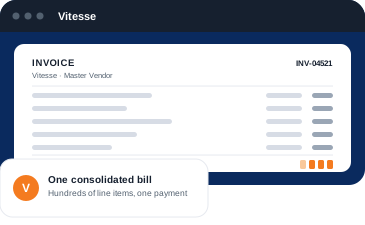
For tail spend categories specifically, managed procurement platforms that act as a single master vendor provide the most practical consolidation mechanism available at scale. Employees continue purchasing from the suppliers they need, but all transactions are routed through the managed platform, which handles onboarding, compliance, payment, and reconciliation on behalf of the organization and delivers a single consolidated invoice to finance. The integrated analytics layer then gives procurement and finance teams complete visibility into what was purchased, from which underlying supplier, in which category, and against which budget, creating the foundation for continuous optimization and compounding savings over time.
How to Measure the Success of a Vendor Consolidation Program
Measuring the outcomes of a vendor consolidation program requires a defined set of metrics established at the outset rather than applied retrospectively when the program is already underway. The most widely used performance indicators include the total count of active vendors tracked over time, the percentage of total spend flowing through preferred or contracted vendors (a metric known as spend under management), the monthly invoice volume processed by accounts payable and the average cost per invoice, supplier onboarding lead times, and the savings realized through improved pricing, reduced administration, and the elimination of duplicated or redundant contracts.
A well-run consolidation program should demonstrate measurable improvement across these indicators within the first six to twelve months of operation. Organizations that report results consistently and transparently are better positioned to sustain executive sponsorship for the program and extend its scope into new spend categories as the initial results establish confidence in the approach.
Frequently Asked Questions About Vendor Consolidation
What is vendor consolidation?
Vendor consolidation is the process of reducing the number of active suppliers an organization works with by directing more spend through a smaller, strategically selected set of preferred vendors. The goal is to simplify the supplier base, reduce administrative and compliance costs, and improve visibility and control over organizational spending across all categories.
What is the difference between vendor consolidation and vendor rationalization?
Vendor rationalization is the analytical exercise of assessing which vendors in an existing supplier base are delivering genuine value and which should be exited or replaced. Vendor consolidation is the operational process of redirecting spend to preferred suppliers following that assessment. Rationalization defines the strategy; consolidation implements it. Most successful programs involve both disciplines in sequence.
How many vendors should a company have?
There is no single correct answer, as the appropriate vendor count depends on the size of the organization, the complexity of its spend categories, and its geographic footprint. The governing principle is to concentrate as much spend as possible with vendors who have been properly qualified and contracted, while minimizing relationships with suppliers who consume administrative resources without delivering proportional value. For most enterprise organizations, the largest opportunity lies in dramatically reducing the tail of low-value, low-frequency supplier relationships.
What are the main benefits of vendor consolidation?
The primary benefits include lower procurement and accounts payable administration costs, improved real-time visibility into organizational spend, stronger compliance and risk controls, a materially reduced invoice processing workload for finance teams, and better pricing and contractual terms achieved through consolidated volume leverage with preferred suppliers.
What are the risks of consolidating too aggressively?
Consolidating too aggressively without adequate qualification of preferred vendors can create single-source dependency risk, where the failure of one supplier disrupts a wide range of purchasing activity simultaneously. It is also possible to exit specialist vendors who provide genuine and difficult-to-replicate capability, only to find that the preferred alternative cannot match the service level required. A well-structured consolidation program balances efficiency goals with supply chain resilience by maintaining appropriate supplier diversity in categories where it meaningfully reduces operational risk.
How long does a vendor consolidation project take?
A focused consolidation initiative targeting a specific spend category can show measurable results within 90 days. An enterprise-wide program covering multiple categories and geographies typically takes 12 to 24 months to reach full implementation, with ongoing governance and optimization continuing as a permanent function of the procurement and finance operation beyond that initial period.
How does vendor consolidation relate to tail spend management?
Tail spend is one of the highest-priority targets for vendor consolidation because it involves the greatest concentration of low-value vendor relationships with the lowest individual strategic return. Consolidating tail spend through a managed vendor or a tightly controlled preferred supplier set delivers rapid reductions in active vendor count, invoice volume, and compliance exposure, while improving visibility across categories that were previously unmanaged and invisible to both procurement and finance teams.
What technology supports vendor consolidation?
Spend analytics platforms, vendor management systems, and managed tail spend solutions are the primary technology enablers of vendor consolidation at enterprise scale. Spend analytics provides the visibility needed to identify consolidation opportunities and measure program results. Vendor management technology streamlines onboarding and compliance qualification for preferred suppliers. Managed tail spend platforms act as a single master vendor for all low-value purchases, eliminating the need to manage individual supplier relationships in the tail while maintaining full spend visibility and policy control for procurement and finance teams.