Procurement Compliance
A Complete Guide for Enterprise Teams
Table of Contents
Procurement compliance is one of the most critical and most complex responsibilities in enterprise procurement management. As organizations grow in size, geographic reach, and supply chain complexity, the number of policies, regulations, contractual obligations, and ethical standards that purchasing activity must conform to grows in parallel. Failures in procurement compliance carry serious consequences: financial losses, regulatory penalties, reputational damage, and supply chain disruption. This guide explains what procurement compliance is, why it matters, and how enterprise organizations can build the frameworks, controls, and technology infrastructure needed to manage compliance effectively across the full procurement portfolio.
What Is Procurement Compliance?
Procurement compliance refers to the practice of ensuring that all purchasing activity within an organization conforms to the policies, procedures, regulations, and contractual commitments that govern how goods and services should be procured. It covers everything from internal authorization and approval requirements to external regulatory obligations, supplier qualification standards, contract performance monitoring, and the ethical and sustainability standards that increasingly define the boundaries within which responsible procurement operates.
A compliant procurement process is one in which the right approvals are obtained before purchases are made, suppliers have been properly vetted and meet the required standards, purchases are executed through approved channels at contracted rates, and the full transaction lifecycle from requisition through payment is documented in a form that can withstand internal and external audit scrutiny without gaps or inconsistencies.
Procurement compliance is not a single control or a one-time review exercise. It is a continuous operational discipline that must be embedded into the processes, systems, and culture through which purchasing decisions are made and executed across the entire organization, from the largest strategic category contracts to the smallest tail spend transactions that occur outside the direct oversight of the central procurement function.
Why Procurement Compliance Matters
The business case for procurement compliance is grounded in four distinct risk dimensions, each of which carries serious consequences for organizations that allow compliance standards to lapse or fail to build adequate controls into their procurement processes from the outset.
Financial Risk and Cost Control
The most direct financial consequence of poor procurement compliance is the cost premium paid when purchases are made outside contracted arrangements. When employees bypass preferred supplier programs and authorized procurement channels, the organization pays spot prices or list rates rather than the negotiated rates its procurement team has secured. Across thousands of transactions in a typical enterprise spend portfolio, this compliance-related price premium accumulates into a material and largely invisible financial loss that erodes procurement savings before they can be realized.
Beyond the price premium on individual transactions, procurement compliance failures create downstream financial costs in the form of audit remediation, contract dispute resolution, duplicate or fraudulent payments that slip through without adequate controls, and regulatory fines that can dwarf the original transaction values that triggered the compliance failure in the first place.
Legal and Regulatory Exposure
Enterprise organizations are subject to a growing range of procurement-related legal and regulatory requirements that vary by industry, geography, and the nature of the goods and services being procured. Public sector and regulated industry organizations face particularly stringent obligations covering competitive sourcing requirements, contract award transparency, supplier qualification standards, and documentation of procurement decisions that can withstand regulatory scrutiny and challenge.
Even in the private sector, procurement activity intersects with regulatory frameworks covering anti-bribery and corruption, trade sanctions and export controls, data protection and supply chain security, environmental standards, and modern slavery and labor rights obligations. A single procurement decision that fails to account for these requirements can create legal liability entirely disproportionate to the commercial value of the purchase that triggered it.
Reputational Risk
Supply chain-related reputational crises have become one of the most significant risk categories for enterprise organizations. When a supplier is found to violate environmental standards, engage in forced labor, breach data security requirements, or circumvent trade sanctions, the reputational damage extends to every organization in its customer base, regardless of whether those customers had any direct knowledge of or involvement in the supplier’s conduct.
Procurement compliance programs that rigorously vet suppliers before engagement, monitor their ongoing conduct through the contract term, and maintain the documentation to demonstrate that due diligence was applied are the primary defense against this category of reputational risk. Organizations that can demonstrate a systematic and evidence-based approach to supplier compliance are significantly better positioned to manage public and regulatory scrutiny of supply chain conduct than those relying on ad hoc supplier selection and relationship-based trust without structured qualification evidence.
Operational Continuity
Procurement compliance failures create operational risk that can disrupt the continuity of supply for goods and services the organization depends on to operate effectively. Suppliers engaged without adequate financial stability checks may fail mid-contract. Suppliers that do not meet required technical or quality standards may deliver goods that cannot be used or services that fail to meet the performance levels the organization’s operations require. And purchases made without authorization or contract coverage may leave the organization without the legal protections needed to enforce performance or seek remedy when a supplier fails to deliver against the commitment for which they were engaged.
Types of Procurement Compliance
Procurement compliance covers several distinct categories, each of which requires specific controls, governance mechanisms, and monitoring approaches to manage effectively at enterprise scale across a complex and geographically distributed spend portfolio.
Internal Policy Compliance
Internal policy compliance refers to adherence to the organization’s own procurement policies, procedures, and authorization requirements. This includes compliance with purchase authorization thresholds that determine the level of approval required for different spend values, adherence to preferred supplier programs and approved vendor lists, use of the correct procurement channels for different spend types and categories, and compliance with the documentation and record-keeping standards that internal governance and audit requirements mandate.
Internal policy compliance is often where procurement compliance programs begin, because the organization has direct control over both the policies and the enforcement mechanisms simultaneously. The challenge is ensuring that internal policies are genuinely followed across a decentralized organization where purchasing decisions are made by a large number of employees who may not have procurement expertise or consistent awareness of the policies that apply to the specific purchases they make in their day-to-day operational roles.
Regulatory and Legal Compliance
Regulatory and legal compliance covers the external obligations that procurement activity must meet, including sector-specific regulatory requirements, trade and customs compliance, anti-bribery and corruption legislation, environmental and sustainability regulations, data protection obligations, and labor rights standards that apply across the supply chain. These requirements vary significantly by industry and geography, and they change over time as regulatory frameworks evolve in response to political, economic, and societal pressures that reshape what is legally required of organizations and their suppliers.
Managing regulatory compliance in procurement requires teams to maintain current awareness of applicable requirements, embed the relevant checks and documentation requirements into the sourcing and supplier management process, and work closely with legal, compliance, and risk functions to ensure that procurement practice keeps pace with regulatory change in each of the jurisdictions and sectors in which the organization operates.
Supplier Compliance
Supplier compliance refers to the ongoing conformance of the organization’s active suppliers with the qualification standards, contractual requirements, and behavioral expectations that governed their selection and initial engagement. It covers both the initial qualification of suppliers before they are engaged and the continuous monitoring of their compliance with those standards throughout the full duration of the contract term.
Supplier compliance monitoring is a continuous requirement rather than a one-time check at the point of onboarding. Suppliers’ financial positions, certification statuses, sanctions screening results, and operational capabilities can all change materially during a contract term in ways that would affect the organization’s willingness to continue the relationship if it were aware of the change. Systematic ongoing monitoring is the only reliable mechanism for maintaining visibility of these changes as they occur rather than discovering them after a compliance incident has already materialized.
Contract Compliance
Contract compliance refers to the monitoring of purchasing activity against the terms of executed supplier contracts to ensure that the commercial and operational commitments made during the sourcing and negotiation process are being honored in practice. It involves confirming that purchases are being made at contracted rates, from contracted suppliers, and in compliance with the volume and other commercial commitments that underpin the contract’s pricing structure.
Contract compliance failures, sometimes called contract leakage, represent one of the most common and costly procurement compliance breakdowns in enterprise organizations. Research consistently shows that a significant proportion of the savings negotiated through formal sourcing events are never realized because purchasing activity after contract execution does not conform to the contracted terms, either because employees are unaware of them or because the systems through which purchases are made do not enforce them automatically at the point of transaction.
ESG and Ethical Compliance
Environmental, social, and governance compliance in procurement covers the growing range of ethical, environmental, and social standards that organizations are expected and increasingly required to apply to their supply chains. Modern slavery and forced labor obligations require organizations to assess and mitigate the risk of exploitative labor practices across their supplier networks. Environmental standards require evidence that suppliers meet the organization’s commitments on carbon emissions, waste management, and resource use. Anti-bribery and corruption requirements prohibit the use of procurement processes to facilitate improper payments or undisclosed commercial inducements at any stage of the sourcing or contracting process.
ESG compliance requirements are evolving rapidly in most jurisdictions, driven by regulatory developments and by the expectations of investors, customers, and civil society. Organizations that build systematic ESG compliance assessment into their supplier qualification and ongoing monitoring processes are better positioned to meet current requirements and adapt efficiently as the regulatory and stakeholder expectations that define acceptable supply chain conduct continue to develop and tighten.
Key Procurement Compliance Risks
Understanding the specific risks that make procurement compliance challenging to maintain in enterprise environments is the starting point for designing controls that are targeted at actual sources of compliance failure rather than addressing procurement risk in generic and unfocused terms that do not match the behavioral and structural reality of how purchasing decisions are made.
Maverick Spend and Unauthorized Purchasing
Maverick spend, purchasing activity that bypasses the organization’s approved procurement channels and supplier programs, is one of the most pervasive and costly procurement compliance risks in enterprise organizations. Every maverick purchase is a compliance failure by definition: it bypasses the authorization controls, supplier qualification checks, and contract compliance monitoring that the procurement policy exists to enforce across the spending population.
At scale, maverick spending creates a shadow procurement ecosystem that operates entirely outside the organization’s visibility and control, accumulating cost, risk, and data quality failures that are only fully understood when a compliance incident or audit forces a retrospective analysis of what has actually been purchased and from whom in the period under review.
Supplier Due Diligence Failures
Inadequate supplier due diligence before engagement is a significant and often underestimated procurement compliance risk. When suppliers are engaged without rigorous financial, quality, legal, and ethical screening, the organization is exposed to risks that can only be managed through prevention rather than remedy: a supplier’s financial failure mid-contract, a quality compliance failure that affects the organization’s own products or services, a sanctions breach that creates direct regulatory liability, or a labor rights violation that becomes public and damages the organization’s reputation in its end markets.
Supplier due diligence failures are particularly common in tail spend categories and under operational time pressure, when the urgency of a purchasing need leads teams to bypass the standard qualification process in favor of completing the purchase quickly. Building a streamlined qualification route that maintains the essential compliance checks while reducing elapsed time is the most practical response to this pattern of compliance failure in the organization’s lower-value purchasing categories.
Contract Leakage and Non-Compliance
Contract leakage represents the gap between the commercial terms negotiated through the sourcing and contracting process and the purchasing behavior that occurs after contract execution. It occurs when purchases are made at rates above the contracted price, from suppliers outside the preferred list, or in volumes that deviate from the contractual commitments that formed the basis of the agreed pricing structure and commercial terms.
The causes of contract leakage are varied: poor communication of contracted terms to the people responsible for making purchases, inadequate integration between the contract management system and the transactional procurement and payment platforms through which day-to-day purchasing activity flows, and the absence of real-time compliance monitoring that would identify non-conforming transactions and trigger corrective action before leakage accumulates into a material commercial and compliance issue that is difficult and expensive to remediate retroactively.
Fraud and Corruption Risk
Procurement fraud encompasses a wide range of dishonest conduct in the purchasing process, including the creation of fictitious suppliers, the submission of duplicate or inflated invoices, kickback arrangements between employees and suppliers, bid manipulation in competitive sourcing events, and the unauthorized diversion of purchased goods or funds. Corruption in procurement, whether through the offer or acceptance of improper inducements in exchange for favorable sourcing decisions, creates significant legal liability under anti-bribery legislation in most jurisdictions where enterprise organizations operate.
The conditions that enable procurement fraud are often the same conditions that drive other compliance failures: insufficient controls over supplier creation and payment authorization, inadequate segregation of duties between purchasing and payment approval functions, and a lack of spend analytics capability that would identify suspicious patterns in transaction data before they escalate into significant financial losses or serious legal exposure for the organization and its leadership.
Sanctions and Trade Compliance
Sanctions compliance has become an increasingly important dimension of procurement compliance as the range and complexity of international trade restrictions has expanded significantly in recent years. Organizations that purchase goods, services, or technology from suppliers subject to trade sanctions face serious legal consequences, including substantial financial penalties and in some jurisdictions criminal liability for the individuals responsible for the non-compliant transactions.
Sanctions compliance in procurement requires systematic screening of suppliers against current sanctions lists at the point of onboarding and on an ongoing basis throughout the contract term, because sanctions designations change frequently and a supplier that was fully compliant at the time of initial engagement may become the subject of a new designation at any point during the active period of the relationship, creating a compliance obligation that did not exist when the supplier was originally qualified and approved.
How to Build a Procurement Compliance Framework
A procurement compliance framework is the organizational structure of policies, controls, processes, and governance mechanisms that together define how procurement compliance is established, maintained, monitored, and continuously improved across the enterprise spend portfolio and the supply chain it supports.
Step 1: Define Clear Procurement Policies
The foundation of any procurement compliance framework is a set of clear, accessible, and proportionate policies that define how purchasing decisions should be made at every level of the organization. Policies should cover the authorization thresholds that determine when procurement involvement is required, the supplier qualification requirements that apply to new vendor engagements, the purchasing channels and contract requirements for different spend categories and values, and the documentation standards that purchases must meet to be considered compliant with the organization’s internal governance requirements.
Policies written in plain language, organized around the purchasing scenarios that employees actually encounter, and accessible through the platforms they use when making purchasing decisions are far more effective compliance tools than lengthy policy documents stored in locations that employees have no reason to consult at the moment a purchase decision needs to be made. Simplicity and accessibility are as important as comprehensiveness in driving the genuine behavioral compliance that procurement policies are designed to produce across a large and diverse employee population.
Step 2: Establish Supplier Qualification Standards
Supplier qualification standards define the minimum requirements that any supplier must meet before it can be engaged to provide goods or services to the organization. These standards should address financial stability through credit checks and financial statement review, technical and quality capability confirmation, compliance credentials including relevant certifications and regulatory licenses, insurance requirements appropriate to the risk profile of the supplied category, and ESG standards covering labor practices, environmental performance, and anti-corruption commitments that the organization requires its supply base to uphold.
Qualification standards should be tiered by risk: higher-risk categories, higher-value contracts, and suppliers with access to sensitive data or critical infrastructure should be subject to more rigorous requirements than routine low-value tail spend suppliers whose individual compliance risk profile is lower and whose commercial significance to the organization is more modest. A tiered approach ensures that qualification effort is proportionate to the risk being managed rather than uniformly applied at a level that is either insufficient for high-risk supplier relationships or disproportionately burdensome for low-risk ones.
Step 3: Implement Purchase Authorization Controls
Purchase authorization controls govern who within the organization has the authority to approve purchases of different types and values, and ensure that this approval is obtained before the purchase commitment is made rather than applied retrospectively after the spending has already occurred. Authorization controls should be embedded into the procurement systems through which purchasing requests flow, so that the approval requirement is enforced automatically rather than depending on individual employee awareness of and willingness to follow a policy that may not be front of mind when a purchasing decision is being made under operational pressure.
Well-designed authorization controls balance the governance requirement with operational efficiency. Controls that introduce excessive friction create the incentive for employees to seek workarounds that bypass the system entirely, which is worse from a compliance perspective than a somewhat faster but still controlled approval process that employees are willing to engage with for the vast majority of their purchasing activity rather than treating as an obstacle to be circumvented.
Step 4: Enforce Contract Compliance
Contract compliance enforcement requires that the terms of executed supplier contracts are actively monitored and that deviations are identified and corrected promptly rather than allowed to accumulate into a systematic pattern of non-conformance that erodes the commercial value of the contract and creates ongoing risk for the organization. This requires integration between the contract management system and the transactional procurement and accounts payable platforms through which purchasing activity occurs, so that non-conforming transactions are flagged for review at the point they occur rather than identified retrospectively through periodic audit exercises.
Contract compliance also requires active supplier performance management: regular structured reviews of supplier delivery against contractual service levels, documented performance discussions that create an evidence base for enforcement action when standards are not met, and clear contractual provisions for remedy and escalation that give the organization the leverage to address performance failures before they require termination as the only available response to persistent non-conformance.
Step 5: Monitor and Audit Continuously
Procurement compliance monitoring involves the ongoing analysis of purchasing activity, supplier behavior, and process adherence to identify compliance failures and emerging risks before they become significant incidents. Continuous monitoring through spend analytics, supplier performance dashboards, and accounts payable exception reporting provides a real-time view of compliance status that periodic audits alone cannot deliver across the full complexity of an enterprise spend portfolio.
Regular procurement audits provide a deeper and more systematic review of compliance across specific categories, business units, or process dimensions, and create the documented evidence that the organization’s compliance program is operating effectively as required by external regulators, auditors, and governance standards. Audits should be followed by structured remediation programs that address the root causes of identified compliance failures rather than simply correcting the specific transactions the audit found to be non-conforming, leaving the underlying process or behavioral issues that produced those failures unaddressed.
Step 6: Train and Communicate Across the Organization
Procurement compliance is ultimately a behavioral discipline, and the policies and controls that define the compliance standard are only effective to the extent that the people responsible for making purchasing decisions understand them, accept them as reasonable, and know how to apply them in the specific situations they encounter in their daily operational roles. Training and communication programs that give employees the knowledge and tools to make compliant purchasing decisions are as important to program effectiveness as the technical controls and policy documents that establish the compliance standard.
Training should be tailored to the purchasing role and risk profile of different employee populations rather than applying a single generic program across all levels of the organization. Procurement practitioners need deep knowledge of the full compliance framework and its application to complex sourcing and contracting scenarios. Business unit managers need practical guidance on the authorization and supplier requirements that apply to the purchasing decisions they make most frequently in their day-to-day operational management role. Finance teams need clear understanding of the payment approval and invoice compliance requirements that protect the organization against fraud and erroneous payments at the point where financial commitments are settled.
Procurement Compliance and Tail Spend
Tail spend is the area of the procurement portfolio where compliance risk is often greatest and compliance controls are typically weakest. The structural characteristics of the tail, high purchase frequency, low individual transaction values, a large and fragmented supplier base, and widespread decentralized purchasing behavior, create an environment in which the standard compliance controls designed for strategic spend categories are difficult to apply consistently and at the cost-effective scale needed to manage the full population of tail spend transactions without creating prohibitive process overhead.
The compliance risks concentrated in the tail include unauthorized supplier engagement without due diligence, maverick purchasing activity that bypasses approved channels, a high volume of invoices that are difficult to validate systematically against purchase orders and approved supplier records, and the accumulation of supplier relationships that have never been formally qualified or subject to ongoing compliance monitoring. Together these factors make tail spend one of the highest-priority targets for compliance improvement programs in organizations that are serious about managing procurement risk across the full portfolio rather than only in the strategic categories that attract the most formal procurement attention.
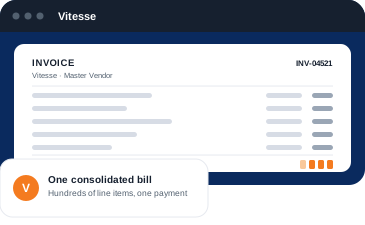
The most effective approach to managing compliance in the tail is to route all tail spend through a single managed vendor or a tightly controlled set of preferred suppliers who handle supplier qualification, sanctions screening, e-invoicing compliance, and downstream payment on behalf of the organization. This transforms the compliance profile of the tail from a fragmented and largely unmonitored purchasing population into a single controlled workflow that applies consistent qualification checks to every supplier engaged, captures complete spend data for every transaction, and delivers a single consolidated and audit-ready invoice to the accounts payable function. The compliance improvement achieved through this structural change is significantly greater than what can be accomplished by applying conventional procurement controls individually to each of the hundreds or thousands of tail spend supplier relationships that the unmanaged tail contains.
The Role of Technology in Procurement Compliance
Technology is the primary enabler of procurement compliance at enterprise scale, because the volume of transactions, suppliers, contracts, and regulatory requirements involved in a large organization’s procurement activity exceeds what any compliance program can manage effectively through manual processes and human oversight alone without significant gaps in coverage and consistency.
Spend Analytics
Spend analytics platforms provide the data visibility that makes procurement compliance measurable and manageable at the scale and speed that enterprise environments require. By consolidating transaction data from multiple source systems and classifying it consistently against the organization’s approved supplier register, preferred supplier programs, and contracted arrangements, spend analytics gives compliance teams the real-time view of purchasing activity they need to identify non-compliant transactions, maverick spending patterns, and unauthorized supplier engagements as they occur rather than discovering them through retrospective audits that are conducted weeks or months after the compliance failure has already taken place.
Spend analytics also supports proactive compliance management by identifying the categories and business units where compliance risk is most concentrated, allowing compliance programs to direct their monitoring and intervention efforts where they will have the greatest impact on the organization’s overall compliance posture across the full spend portfolio.
eProcurement and Workflow Controls
eProcurement platforms enforce compliance at the point of purchase by embedding authorization requirements, preferred supplier access, and policy checks into the digital purchasing workflow that employees use to make and approve purchasing decisions. When compliance controls are built into the purchasing system itself rather than existing as a separate policy document that employees may or may not consult, they are applied consistently to every transaction that flows through the system without depending on individual employee awareness of or willingness to follow the policy in each specific purchasing situation they encounter.
Electronic approval workflows capture a complete, timestamped record of every purchasing decision and the authorization that supported it, creating the audit trail that compliance programs and regulatory requirements demand. Integration between eProcurement platforms and ERP and accounts payable systems ensures that this compliance documentation flows through the full transaction lifecycle from purchase request through to payment confirmation, maintaining a connected and unbroken record of the compliance status of each transaction.
Supplier Management and Screening
Supplier management and screening technology automates the compliance checks that must be applied to every supplier before engagement and on an ongoing basis through the contract term. Automated sanctions list screening confirms that proposed suppliers are not subject to trade restrictions that would make the engagement legally prohibited. Automated financial stability monitoring identifies changes in a supplier’s financial position that might affect their ability to perform against the contract. Certification tracking ensures that the compliance credentials verified at onboarding remain current throughout the period in which the supplier is active in the organization’s supply base.
For tail spend categories where the volume and frequency of new supplier engagements makes manual screening impractical at the required scale and speed, automated supplier screening is the only mechanism that can maintain consistent compliance standards across the full population of supplier transactions without creating the process delays that drive maverick purchasing behavior in precisely the categories where compliance controls are most needed.
Contract Management Systems
Contract management systems provide the technology infrastructure for enforcing contract compliance through the active term of every supplier agreement in the organization’s contract portfolio. Centralized contract repositories ensure that contracted terms are accessible to everyone responsible for purchasing in the relevant category, rather than stored in individual email archives or shared drives that create information barriers between the commercial terms agreed and the operational teams responsible for purchasing against them. Automated compliance monitoring compares actual spending against contracted rates and supplier lists and flags deviations for review. Renewal alerts ensure that contracts approaching expiry are proactively reviewed rather than allowed to auto-renew on terms that may no longer reflect market best practice or the organization’s current requirements.
Procurement Compliance in Regulated Industries
While procurement compliance is a universal requirement for all enterprise organizations, the specific standards, documentation requirements, and enforcement mechanisms that apply vary significantly by industry, with regulated sectors facing particularly demanding and detailed compliance obligations that procurement programs must be specifically designed to address with the rigor those regulatory environments require.
In the financial services sector, procurement compliance programs must address vendor risk management requirements that mandate detailed due diligence on technology suppliers and outsourcing partners, concentration risk assessment to ensure that the organization is not critically dependent on a single supplier for services essential to its regulated operations, and data security and residency requirements that govern how suppliers can access and process sensitive customer and transaction data within the regulatory framework that applies to the jurisdiction in which the financial institution operates.
In the pharmaceutical and life sciences sector, supplier qualification and quality system compliance requirements under Good Manufacturing Practice and Good Distribution Practice standards impose rigorous documentation, audit, and qualification obligations on all suppliers of materials, services, and equipment that affect product quality or patient safety. Non-compliance with these standards can result in product recalls, regulatory enforcement action, and loss of operating licenses that are entirely disproportionate to the individual procurement decisions that triggered the compliance failure and can have serious consequences for patient welfare as well as for the organization’s commercial viability.
In the public sector, procurement compliance programs must address competitive procurement thresholds that require formal tendering processes for contracts above defined values, transparency and equal treatment obligations that govern how suppliers are evaluated and selected across the sourcing process, and public accountability requirements that make procurement decisions and their rationale subject to freedom of information requests and public scrutiny in ways that private sector organizations do not face and must design their procurement documentation standards to address.
Understanding the specific compliance obligations that apply to the organization’s industry and operating jurisdictions is the starting point for designing a procurement compliance framework that is appropriately calibrated to the actual regulatory and commercial risk environment rather than applying a generic approach that may be either insufficient for the compliance context or disproportionately burdensome relative to the specific risks being managed.
Common Challenges in Procurement Compliance
Procurement compliance programs consistently encounter a set of challenges that limit their effectiveness if not specifically addressed in the program design, governance framework, and ongoing management approach that sustains compliance discipline across a large and complex organization over time.
Decentralized Purchasing Behavior
The most fundamental compliance challenge in most enterprise organizations is that purchasing decisions are made by a large number of employees throughout the business who are focused on operational objectives rather than procurement compliance requirements. Designing compliance controls that work with the purchasing behavior of a decentralized organization, by making compliant purchasing the path of least resistance rather than an obstacle to operational efficiency, is consistently more effective than attempting to enforce compliance through policy mandates that employees have both the incentive and the ability to work around when operational pressure makes the compliant route feel impractical for the specific situation they face.
Supplier Data Quality
Procurement compliance monitoring depends on accurate and complete data about the suppliers with whom the organization is engaged and the transactions flowing to them across all purchasing channels. Supplier master data in most enterprise systems contains inaccuracies, duplicates, and gaps that make it difficult to maintain a complete and reliable picture of the active supplier base, let alone to run meaningful compliance monitoring against it with confidence that the coverage is genuinely comprehensive rather than systematically incomplete in ways that create invisible compliance blind spots.
Investing in supplier master data quality is a prerequisite for any compliance monitoring program that is intended to provide genuine assurance rather than a superficially compliant process with significant gaps in its actual coverage of the supplier relationships that generate the most compliance risk for the organization.
Keeping Policies Current
Procurement compliance policies must evolve in step with the regulatory environment, the organization’s strategic priorities, and the supply market conditions in which procurement activity takes place. Policies that were accurate and appropriate when they were written can become obsolete as regulations change, new risk categories emerge, and the organization’s procurement practices develop. Establishing a defined policy review cycle and assigning clear ownership for each policy element ensures that the compliance framework remains current rather than drifting out of alignment with the actual compliance requirements facing the organization in its current operating environment.
Balancing Control with Agility
The most persistent organizational tension in procurement compliance is between the control objectives of the compliance program and the operational agility that business units need to respond quickly to changing circumstances and urgent purchasing requirements. Compliance controls that are too rigid or time-consuming create the conditions for maverick purchasing by making compliant routes impractical for operational teams working under genuine time pressure. Designing compliance frameworks that are appropriately graduated by risk, with lighter controls for lower-risk purchases and full compliance requirements reserved for higher-value and higher-risk transactions, is the most effective way to manage this tension without sacrificing either compliance standards or the operational effectiveness that makes the organization competitive in its market.
How to Measure Procurement Compliance Performance
Measuring the effectiveness of a procurement compliance program requires metrics that capture performance across the full scope of the compliance framework, from policy adherence and supplier qualification through contract compliance monitoring and audit outcomes, providing compliance leadership with the evidence base needed to demonstrate program value and identify priority improvement areas.
Policy compliance rate, measured as the proportion of purchases made through approved channels with the required authorizations in place, is the primary indicator of whether the compliance framework is being followed across the organization. A declining policy compliance rate is an early warning signal that requires investigation of the underlying causes before the compliance failure escalates into a more serious regulatory or financial incident that is significantly more expensive to remediate than the behavioral issue that produced it.
Supplier qualification coverage, measured as the proportion of active and newly engaged suppliers who have completed the required qualification process, indicates whether the organization’s supplier due diligence obligations are being met in practice across the full scope of its supply base. Gaps in qualification coverage reveal supplier populations that are operating outside the compliance framework and require targeted intervention to bring within the standard qualification and monitoring processes.
Contract compliance rate, measured as the proportion of spend in managed categories flowing through contracted suppliers at contracted rates, captures the extent to which the commercial commitments made through the sourcing and contracting process are being honored in the day-to-day purchasing activity that follows contract execution. A declining contract compliance rate indicates poor communication of contracted terms, inadequate enforcement controls, or supplier behavior that is deviating from contractual commitments and requires active management response before the cumulative leakage becomes a material commercial issue.
Audit findings and remediation rates track the frequency and severity of compliance failures identified through internal and external audit, and the speed and completeness with which those findings are addressed through process and control improvements. A compliance program that consistently produces the same audit findings without achieving durable remediation of the underlying root causes is not improving the organization’s compliance posture regardless of the investment made in the audit process itself or the resources committed to the compliance function.
Frequently Asked Questions About Procurement Compliance
What is procurement compliance?
Procurement compliance is the practice of ensuring that all purchasing activity within an organization conforms to the policies, procedures, regulations, and contractual commitments that govern how goods and services should be procured. It covers internal policy adherence, regulatory and legal obligations, supplier qualification standards, contract performance monitoring, and the ethical and sustainability standards that define responsible procurement conduct across the full spend portfolio and supply chain.
What are the main types of procurement compliance?
The main types of procurement compliance are internal policy compliance covering adherence to the organization’s own procurement procedures and authorization requirements, regulatory and legal compliance addressing external legal obligations across anti-bribery, trade sanctions, data protection, and sector-specific regulatory frameworks, supplier compliance monitoring the ongoing conformance of suppliers with qualification standards and contractual requirements, contract compliance tracking purchasing activity against the commercial terms of executed agreements, and ESG compliance ensuring conformance with environmental, social, and governance standards across the supply chain.
What is a procurement compliance framework?
A procurement compliance framework is the structured set of policies, controls, processes, and governance mechanisms that together define how procurement compliance is established, maintained, monitored, and improved across an organization. It typically includes procurement policies and authorization controls, supplier qualification standards and screening processes, contract management and compliance monitoring capabilities, audit and assurance processes, and training and communication programs that ensure compliance requirements are understood and followed by all employees involved in making purchasing decisions at any level of the organization.
Why is supplier compliance important?
Supplier compliance is important because the risks associated with non-compliant suppliers extend well beyond the individual transaction. A supplier that fails a financial stability check may be unable to fulfill a critical contract mid-term. A supplier that violates sanctions requirements creates direct legal liability for the organizations that purchase from it. A supplier that breaches labor or environmental standards creates reputational risk that can affect the organization’s relationships with its own customers, investors, and employees. Systematic supplier compliance monitoring is the only reliable mechanism for identifying and managing these risks before they create incidents that are expensive or impossible to remediate after the fact.
What is contract compliance in procurement?
Contract compliance in procurement refers to the monitoring of actual purchasing activity against the terms of executed supplier contracts to ensure that purchases are being made from contracted suppliers, at contracted rates, and in conformance with the volume and other commercial commitments that form the basis of the contract’s pricing structure. Contract compliance failures, also known as contract leakage, represent one of the most common procurement compliance breakdowns in enterprise organizations, resulting in the erosion of savings negotiated through the sourcing process before they can be fully realized in operational spending and delivered as verified savings to the business.
How does technology support procurement compliance?
Technology supports procurement compliance through four primary capability areas. Spend analytics platforms make purchasing activity visible and measurable against compliance standards in real time. eProcurement platforms enforce compliance at the point of purchase through built-in authorization controls, preferred supplier access, and policy-driven approval workflows. Supplier management and screening systems automate qualification checks and ongoing compliance monitoring across the supplier base at the scale enterprise environments require. Contract management systems centralize contracted terms, automate spend compliance monitoring, and trigger alerts when contracts approach renewal or when purchasing activity deviates from contracted commitments in ways that require corrective action.
What is the relationship between procurement compliance and maverick spend?
Maverick spend is both a symptom and a cause of procurement compliance failure. Every maverick purchase is a compliance failure because it bypasses the authorization controls, supplier qualification requirements, and contract compliance monitoring that the procurement policy exists to enforce across the spending population. At scale, maverick spending creates a shadow procurement environment that operates outside the organization’s compliance framework, accumulating financial cost, regulatory risk, and data quality failures that compound over time into a compliance problem significantly larger than the sum of the individual transactions that produced it. Reducing maverick spend is therefore a compliance improvement imperative as well as a cost reduction objective for organizations serious about managing procurement risk effectively.
How does procurement compliance relate to tail spend management?
Tail spend is the area of the procurement portfolio where compliance controls are most commonly weakest and compliance risks most concentrated. The high volume, low individual value, and decentralized nature of tail spend transactions make it impractical to apply the same compliance controls used for strategic categories to each individual tail spend purchase without creating prohibitive process overhead. The most effective approach routes all tail spend through a single managed vendor that applies consistent supplier qualification checks, sanctions screening, and e-invoicing compliance to every transaction, consolidates payment into a single auditable invoice, and provides complete spend data to the compliance monitoring function. This transforms the compliance profile of the tail from an unmanaged risk area into a controlled and fully auditable purchasing channel.