Maverick Spend
A Complete Guide for Enterprise Procurement Teams
Table of Contents
Maverick spend is one of the most persistent and costly challenges in enterprise procurement. When employees make purchases outside the organization’s approved processes, preferred supplier programs, or contracted arrangements, the results are higher costs, greater compliance exposure, and spend data that finance and procurement teams cannot see or act on. This guide explains what maverick spend is, why it happens, and how enterprise organizations can build strategies to bring it under control without creating the process friction that drives more of it in the first place.

What Is Maverick Spend?
Maverick spend, sometimes called rogue spend or out-of-policy purchasing, refers to any purchase made outside an organization’s defined procurement processes, approved supplier lists, or contracted arrangements. It occurs when an employee or department makes a buying decision independently, bypassing the procurement controls that exist to ensure spend is compliant, competitively priced, and visible to finance and procurement teams.
Maverick spend can take many forms. It might be a department manager signing a new software subscription without checking whether a centrally negotiated contract already covers the same capability. It might be a regional office engaging a local supplier rather than the organization’s contracted provider for the same service category. It could be an employee booking travel directly rather than through the managed travel program, or a team procuring marketing services from an agency outside the approved roster without any competitive process.
What defines maverick spend in each case is not the nature of the purchase itself, but the fact that it bypasses the procurement process. The goods or services procured may represent entirely legitimate business needs. The problem is how they are procured: without the controls, competitive pricing, compliance checks, and spend visibility that a properly managed procurement workflow provides.
For enterprise organizations, the cumulative impact of maverick purchasing across hundreds of departments and thousands of employees is substantial. Research consistently estimates that maverick spend accounts for between 20 and 80 percent of total indirect spend in organizations without effective procurement controls, representing a significant and largely invisible source of cost and risk that compounds over time.
Maverick Spend vs. Tail Spend: Understanding the Difference
Maverick spend and tail spend are two concepts that are closely related in procurement practice but refer to distinct phenomena. Understanding the difference is important for designing targeted strategies that address each problem effectively rather than conflating two issues that require different interventions.
Tail spend is defined by the size and frequency of transactions. It refers to the high-volume, low-value purchases at the bottom of the spending curve, where a large number of suppliers each account for only a small fraction of total spend. Tail spend is a structural feature of any large organization’s procurement profile; it exists because the diversity of operational needs generates a long list of low-value supplier relationships that are difficult to manage through the same processes used for strategic categories.
Maverick spend is defined by the process through which a purchase is made, not its size. A maverick purchase is one that bypasses the organization’s procurement policies and controls, regardless of the value involved. A large consulting engagement commissioned by a business unit without a formal sourcing process and without procurement involvement is maverick spend, even though its value places it well above the tail spend threshold. A small office supply purchase made through an approved preferred supplier catalog is not maverick spend, even if it is low in value, because it follows the correct process.
The two concepts overlap significantly in practice because many tail spend purchases do happen outside controlled processes. Low-value purchases frequently fall below the thresholds that trigger formal procurement involvement, and the absence of procurement oversight in the tail creates the conditions in which maverick purchasing behavior flourishes. But addressing maverick spend requires a focus on process compliance and behavioral change that goes beyond simply managing the size distribution of transactions in the spend portfolio.
Why Maverick Spend Happens in Enterprise Organizations
Maverick spend is not simply the result of employees ignoring procurement policy. It is a behavioral response to real or perceived obstacles in the procurement process that lead individuals to conclude that working around the system is faster, easier, or more effective than working through it. Understanding why maverick purchasing happens is essential for designing interventions that address the root causes rather than attempting to enforce compliance on behavior that is driven by legitimate operational frustrations.
Overly Complex Procurement Processes
The most common driver of maverick spend is a procurement process that is perceived as too slow, too bureaucratic, or too disconnected from operational realities. When the approved process for engaging a new supplier requires weeks of paperwork, multiple approval layers, and involvement from a procurement team that operates at a different pace from the business, employees facing an urgent operational need will naturally seek a faster route to get what they require.
Procurement processes designed primarily to enforce control rather than to serve the needs of the business create the conditions in which maverick purchasing thrives. The more friction the approved process introduces, the greater the incentive to bypass it, and the more deeply embedded maverick purchasing becomes in the organization’s culture over time as each workaround reinforces the perception that the official route is not worth attempting.
Lack of Preferred Supplier Awareness
Many employees who make maverick purchases are not aware that a preferred supplier or contracted arrangement already exists for the category they are purchasing in. If the organization’s preferred supplier program is not actively communicated, easily accessible, and practically convenient to use, employees who need to make a purchase will default to a supplier they already know or find through their own research rather than consulting a list they may not know exists.
The responsibility for ensuring that preferred supplier information is visible and accessible sits firmly with procurement. If the program exists only in a document filed in a shared drive that employees have no reason to consult at the moment of purchase, its effectiveness will be severely limited regardless of the quality of the supplier negotiations it represents or the savings it was designed to deliver.
Urgency and Operational Pressure
Many maverick purchases occur under operational pressure when a department needs something quickly and does not have the time to go through the standard procurement process. A project team with a firm deadline, a facility that needs an urgent repair, or a manager who requires a specialist resource for an immediate engagement will often make the pragmatic decision to procure directly rather than wait for a process that was not designed with urgency in mind.
Urgency-driven maverick spend is particularly difficult to address through policy enforcement alone because the underlying need is genuine and immediate. The most effective responses are process redesign that makes rapid compliant procurement possible and emergency procurement pathways that allow urgent needs to be addressed quickly while still capturing the spend data and supplier compliance information that uncontrolled purchasing loses.
Cultural and Behavioral Factors
In some organizations, maverick purchasing is simply a cultural norm that has developed over time in the absence of consistent enforcement or meaningful consequences for non-compliance. Managers who have always engaged their own service providers, departments that view their supplier relationships as a form of operational autonomy, and organizations where procurement is seen as a back-office function rather than a strategic partner all create environments in which maverick purchasing is the default behavior rather than the exception to be managed.
Cultural factors are among the most difficult drivers of maverick spend to address because they cannot be resolved through process changes or technology implementations alone. Changing procurement culture requires sustained leadership commitment, consistent application of compliance expectations, and a procurement function that actively demonstrates its value to the business in terms that resonate with operational managers rather than only with finance leadership.
The True Cost of Maverick Spend
The financial and operational costs of maverick spend are consistently underestimated by organizations that have not conducted a detailed analysis of what out-of-policy purchasing actually costs across all its dimensions. The true cost extends well beyond the price premium paid on individual maverick purchases and accumulates across multiple dimensions simultaneously.
Direct Financial Cost
The most immediately visible cost of maverick spend is the price premium typically paid when purchases are made outside contracted arrangements. Preferred supplier contracts are negotiated on the basis of committed volume, and the pricing they deliver reflects the commercial leverage that consolidated spend provides. Maverick purchases made at spot rates or list prices rather than contracted rates pay a premium for the same goods or services, and this premium accumulates across thousands of transactions into a material financial loss at the organizational level.
Research on maverick spend pricing consistently finds that organizations pay 10 to 25 percent more on maverick purchases compared to contracted rates for equivalent goods and services. For organizations with significant levels of maverick purchasing in their indirect spend portfolio, closing this gap through improved compliance represents one of the most accessible and high-return procurement improvement opportunities available without any additional capital investment.
Compliance and Legal Risk
Every purchase made outside the approved supplier base and procurement process represents a potential compliance failure. Suppliers engaged without proper vetting may not meet the organization’s required standards for data security, financial stability, environmental practices, or labor conditions. In regulated industries, purchases made without the required documentation and authorization trail can create direct regulatory exposure and audit findings that have consequences well beyond the original transaction value.
Fraud risk is also significantly elevated in environments with high levels of maverick purchasing. When spending flows through many uncontrolled channels without systematic oversight, fraudulent invoices and unauthorized supplier arrangements are harder to detect, and the organization has fewer controls in place to prevent payments from being made against illegitimate claims that enter the AP process through the same uncontrolled channels as legitimate maverick purchases.
Supplier Relationship Damage
Maverick spend undermines the commercial relationships that procurement teams have worked to establish with preferred suppliers. When spend committed to a preferred supplier as part of a volume-based negotiation actually flows to alternative vendors because departments are purchasing independently, the organization fails to deliver on the volume commitments that formed the basis of the contracted pricing. This damages the credibility of future negotiations and may result in preferred suppliers revising the commercial terms that were contingent on spend commitment being honored.
The reverse relationship issue also occurs when maverick purchasing results in a proliferation of supplier relationships that have no strategic foundation and no one actively managing them. Suppliers engaged through maverick purchasing receive no meaningful relationship management and have no incentive to invest in the relationship or provide prioritized service, creating a purchasing experience that is consistently worse than the preferred supplier alternative would have delivered.
Data and Visibility Loss
Perhaps the most strategically significant cost of maverick spend is the loss of spend data and visibility it causes across the organization. When purchases flow through uncontrolled channels, the transaction data is either not captured at all or recorded in a form that cannot be easily categorized, analyzed, or reconciled against the spend picture that finance and procurement teams are working from at the category and organizational level.
The cumulative effect of significant maverick spend is a spend dataset with systematic gaps, distortions, and inconsistencies that make accurate spend analysis and meaningful category management impossible. Procurement teams working from an incomplete spend picture make strategic decisions based on data that does not reflect actual purchasing activity, leading to savings targets that cannot be validated, supplier negotiations conducted without accurate volume information, and budget forecasts that consistently underestimate actual expenditure commitments.
How to Identify and Measure Maverick Spend
Before maverick spend can be managed, it must be measured accurately enough to understand its scale, its distribution across categories and business units, and the behavioral patterns that are driving it in different parts of the organization.
Conducting a Spend Analysis
The starting point for identifying maverick spend is a comprehensive spend analysis that compares actual purchasing activity against the organization’s approved supplier list and contracted arrangements. By mapping all transactions recorded in finance systems, expense management tools, corporate card programs, and procurement platforms against the register of preferred suppliers and negotiated contracts, procurement teams can identify the proportion of spend flowing outside approved channels in each category and business unit.
This analysis typically requires significant data cleansing and normalization before it can be used reliably, because indirect spend data in most enterprise finance systems is not consistently categorized or supplier-coded in a way that supports direct comparison against the preferred supplier register. However, even an imperfect initial analysis provides enough directional insight to prioritize the categories and business units where maverick spend is most concentrated and where intervention will deliver the greatest impact relative to the effort invested.
Calculating Your Maverick Spend Rate
Maverick spend rate is the most widely used metric for tracking out-of-policy purchasing across the organization. It is calculated by dividing the total value of spend made outside approved procurement channels by the total value of spend in the categories covered by the preferred supplier program, expressed as a percentage. A maverick spend rate of 30 percent indicates that 30 percent of indirect spend in managed categories is flowing outside contracted arrangements, providing a direct measure of the gap between stated policy and actual purchasing behavior.
Tracking this rate over time by category and by business unit provides a clear and continuously updated picture of where the maverick spend problem is most acute and whether the interventions being applied are having the desired effect on purchasing patterns. A declining maverick spend rate is the clearest evidence that the program is working. A rate that remains static or increases signals that the root causes driving maverick behavior have not been effectively addressed and that the program’s approach needs to be reconsidered.
How to Control and Reduce Maverick Spend: A Strategy Framework
Reducing maverick spend requires a coordinated strategy that addresses process, communication, technology, and behavior simultaneously. Organizations that focus on only one of these dimensions consistently find that the others continue to undermine their efforts, producing short-term compliance improvements that erode as soon as active enforcement attention is redirected elsewhere.
Step 1: Build Spend Visibility Across the Organization
The foundation of any maverick spend reduction program is a clear, current, and comprehensive picture of what the organization is actually buying, from whom, and through which channels. Without this baseline, it is impossible to prioritize categories for intervention, set realistic reduction targets, or measure the impact of the programs put in place against an evidence-based starting point.
Spend analytics platforms that consolidate transaction data from multiple source systems and apply consistent category classification provide the ongoing visibility needed to monitor maverick spend trends in real time rather than through periodic retrospective reviews that are too late to inform timely intervention. The more current and comprehensive the spend data available, the more precisely procurement teams can direct their attention toward the categories and business units where maverick spend is having the greatest commercial and compliance impact.
Step 2: Simplify the Purchasing Process
The most effective single action for reducing maverick spend is making the approved purchasing process faster, easier, and more convenient than going outside it. When employees can access a preferred supplier catalog, submit a purchase request, receive approval, and place an order through a single streamlined digital process in less time than it would take to find and engage an alternative supplier independently, the incentive for maverick purchasing largely disappears for the majority of routine procurement needs.
Process simplification requires procurement teams to genuinely understand how business units experience the current purchasing workflow, where the friction points are, and what prevents employees from following the approved route for the kinds of purchases they make most frequently. Designing the solution from the perspective of the employee making the purchase rather than the procurement team enforcing the policy produces dramatically better adoption outcomes and more durable behavioral change.
Step 3: Build and Communicate a Preferred Supplier Program
A preferred supplier program that employees are unaware of or cannot easily access will not reduce maverick spend regardless of how well its commercial terms have been negotiated. The program needs to be actively communicated across the organization in language that operational managers understand and find relevant, with clear guidance on which suppliers are preferred in which categories, how to access them, and what the process is for requesting the addition of a new preferred supplier in a category that is not yet covered by the program.
Communication should be continuous rather than a one-time policy announcement. Regular updates through internal communication channels, integration of preferred supplier information into the purchasing tools that employees use daily, and category-specific guidance distributed to the departments with the highest spend in each area all contribute to building the awareness and accessibility that translate preferred supplier programs from policy documents into practical procurement tools that employees actually use.
Step 4: Implement Technology-Driven Controls
Technology can enforce purchasing controls at the point of purchase in a way that policy documents and communication campaigns alone cannot sustain. eProcurement platforms that require employees to submit purchase requests through a structured workflow, with preferred supplier catalogs built in and approval routing configured to reflect the organization’s authorization framework, create a purchasing environment in which compliant purchasing is the default path rather than the exception that requires additional effort.
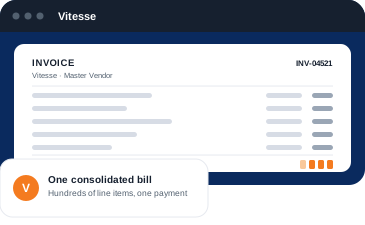
For tail spend categories, managed procurement solutions that route all low-value purchases through a single controlled channel provide an automated mechanism for eliminating maverick spend in the categories where it is typically most prevalent. These solutions give employees access to any supplier they genuinely need while capturing all spend data, enforcing compliance checks, and consolidating payment into a single managed invoice that dramatically reduces the AP processing burden associated with uncontrolled tail spend purchasing.
Step 5: Engage Stakeholders and Change Behavior
Behavioral change in procurement compliance requires sustained engagement with business unit stakeholders, not just policy enforcement directed at individual employees. Department leaders who understand the cost and risk implications of maverick purchasing in their areas, and who have been involved in the design of the preferred supplier programs that apply to their categories, are significantly more likely to actively support compliance within their teams than those who receive a policy mandate without context or genuine involvement in the solution.
Procurement teams that invest in category-specific stakeholder engagement, demonstrate the commercial value of the preferred supplier programs they manage, and provide business units with transparent reporting on their own maverick spend levels consistently achieve better and more durable compliance outcomes than those that rely on top-down enforcement without building organizational ownership of the procurement program across the business units responsible for the majority of the spend.
Step 6: Monitor, Report, and Continuously Improve
Maverick spend reduction is not a project with a defined end point. It requires continuous monitoring of purchasing behavior, regular reporting of maverick spend rates by category and business unit, and ongoing program adjustment as the organizational environment, purchasing patterns, and supplier market conditions evolve. Organizations that treat maverick spend reduction as a one-time initiative consistently find that the gains achieved during the active program phase gradually erode once enforcement attention moves elsewhere.
Regular reporting that shows maverick spend trends at a business unit level creates accountability for purchasing behavior in the parts of the organization most directly responsible for it. When operational leaders can see clearly that a significant proportion of their category spend is flowing outside contracted channels at a measurable cost, the conversation about compliance becomes grounded in specific commercial evidence rather than abstract policy principles, which makes it more productive and more likely to generate genuine and lasting behavioral change.
Maverick Spend in Tail Spend Categories
Tail spend categories are the area of the procurement portfolio where maverick spend is typically most prevalent and most difficult to control through conventional procurement processes. The reasons are structural: tail spend involves large numbers of individually small purchases across a wide range of categories, many of which fall below the value thresholds that trigger formal procurement involvement, and the operational urgency of many tail spend needs creates strong pressure to bypass any process that introduces meaningful delay.
In the tail, the combination of low individual transaction values, high purchase frequency, and decentralized purchasing behavior creates an environment where maverick spend is essentially the default unless specific mechanisms are in place to channel purchasing through controlled routes. Standard eProcurement tools and preferred supplier programs designed for higher-value categories typically do not translate effectively to the tail, because the volume and variety of tail spend purchases exceeds what catalog-based procurement can practically manage across all categories simultaneously without significant ongoing maintenance.
The most effective mechanism for controlling maverick spend in the tail is a managed vendor solution that acts as a single point of access for all tail spend purchasing. Rather than requiring employees to find and engage individual approved suppliers for each need in each category, a managed tail spend solution allows them to route any purchase request through a single controlled channel that handles supplier identification, vetting, purchasing, and payment on their behalf. Employees get the speed and flexibility they need to meet operational requirements. Procurement and finance get full visibility, policy enforcement, and a consolidated accounts payable process that replaces hundreds of individual invoices with one structured, auditable record of all tail spend activity.
The Role of Technology in Controlling Maverick Spend
Technology plays a central role in both identifying and controlling maverick spend, and the most effective reduction programs treat technology not as a monitoring tool applied after maverick spend has occurred, but as the primary mechanism through which compliant purchasing behavior is enabled, encouraged, and sustained across the organization.
Spend analytics platforms provide the visibility layer that makes maverick spend quantifiable and actionable. By pulling transaction data from multiple source systems and classifying it against the preferred supplier register and contract database, these platforms give procurement teams a real-time picture of maverick spend rates by category, business unit, and supplier. This is the essential foundation for directing intervention effort toward the areas of greatest impact and measuring program performance against an objective baseline.
eProcurement platforms shift purchasing behavior by making the compliant route more convenient than the alternative. When preferred suppliers are available through an integrated catalog, purchase requests flow through a digital approval workflow, and the entire process from need identification to order placement is faster and simpler than engaging an outside supplier independently, most employees will naturally follow the approved route without requiring active enforcement or repeated policy reminders.
Payment controls in accounts payable systems provide a final check on maverick purchasing by flagging invoices from non-preferred suppliers for review before payment is released. While catching maverick spend at the payment stage is less efficient than preventing it at the point of purchase, AP-level controls provide an important safety net that captures purchasing activity not routed through the procurement system and maintains a more complete picture of the organization’s actual supplier universe than self-reported compliance data alone would provide.
For the tail specifically, managed procurement platforms provide the mechanism that translates maverick spend control from a compliance exercise into an operational improvement. By replacing the friction of individual supplier engagement in hundreds of low-value categories with a single, responsive managed channel, these platforms address the root cause of tail spend maverick purchasing rather than imposing controls on behavior that the existing process was never designed to support efficiently.
Common Mistakes in Maverick Spend Reduction Programs
Organizations that have attempted to address maverick spend without achieving lasting results typically make a consistent set of mistakes that undermine program effectiveness regardless of the investment made in policy development, communication, or technology.
Focusing on Enforcement Rather Than Experience
The most common mistake in maverick spend programs is treating the problem as a compliance issue to be solved through stricter policy enforcement rather than a process experience problem to be solved through better design. When procurement teams respond to high maverick spend rates by adding approval steps, issuing policy reminders, and escalating non-compliance to senior management, they typically achieve short-term reductions that quickly erode as the underlying process frustrations reassert themselves and employees find new workarounds.
The programs that achieve durable reductions in maverick spend do so by making the approved process genuinely better than the alternative from the perspective of the employee making the purchase. Enforcement plays a supporting role in maintaining compliance once the experience has been improved, but it cannot substitute for a procurement process that employees actively choose to use because it is faster, more convenient, and more responsive than going outside the system.
Treating All Maverick Spend the Same
Not all maverick spend has the same drivers, the same cost implications, or the same feasibility of control through a given intervention approach. High-value maverick purchases in categories with mature preferred supplier programs and clear policy coverage are a different problem from low-value purchases in categories where no preferred supplier option currently exists. Applying the same intervention approach to both will either be disproportionately heavy-handed for the tail end of the spend curve or insufficiently rigorous for the strategic categories where maverick purchasing is causing the greatest commercial damage.
Effective maverick spend programs are segmented by category, value tier, and driver analysis, with different intervention approaches applied to each segment based on the specific behaviors and barriers generating out-of-policy purchasing in that part of the portfolio. This segmentation ensures that the program’s resources are directed toward the interventions most likely to work in each specific context rather than applying a generic approach uniformly across a highly varied spend landscape.
Underestimating Stakeholder Engagement
Procurement teams that design maverick spend reduction programs without meaningful involvement from the business units responsible for the majority of out-of-policy purchasing consistently find that their interventions fail to gain traction in practice. Policy documents issued without consultation, preferred supplier programs built without input from the operational managers who will use them, and compliance reporting that creates accountability without building understanding all generate resistance that undermines program adoption regardless of how well designed the technical solution may be.
The most effective programs invest heavily in stakeholder engagement before and during implementation, treating operational managers as partners in designing solutions that meet their genuine purchasing needs rather than as compliance subjects to be managed through policy enforcement. This investment in engagement pays dividends in adoption rates and in the durability of the behavioral change achieved, producing results that hold over time rather than deteriorating as soon as active program management attention moves elsewhere.
How to Measure Success in Maverick Spend Reduction
Measuring the success of a maverick spend reduction program requires clear metrics established at the outset, tracked consistently over time, and reported to leadership in a format that demonstrates the program’s commercial value rather than its administrative activity.
Maverick spend rate by category is the primary tracking metric, measuring the proportion of spend in managed categories flowing outside contracted arrangements over time and across business units. A consistently declining maverick spend rate demonstrates that compliance and process improvement interventions are working. A rate that remains static or increases is a clear signal that the root causes driving maverick behavior have not been effectively addressed and that the program approach requires review.
Spend under management is the complementary metric that tracks the proportion of total indirect spend flowing through approved channels and preferred supplier arrangements. As maverick spend is reduced, spend under management increases proportionally, and the commercial leverage and spend visibility associated with managed spend grows accordingly, creating compounding value as the program matures.
Savings capture from compliance improvement measures the financial value delivered by the reduction in maverick spend, calculated as the difference between the prices previously paid on out-of-policy purchases and the contracted rates now being achieved for the same goods and services. This metric provides the most direct demonstration of the commercial case for maverick spend management and the clearest evidence of the procurement function’s contribution to organizational financial performance that can be reported to leadership with confidence.
Frequently Asked Questions About Maverick Spend
What is maverick spend?
Maverick spend is any purchasing activity made outside an organization’s approved procurement processes, preferred supplier lists, or contracted arrangements. It occurs when employees or departments bypass procurement controls to engage suppliers independently, resulting in higher costs, compliance exposure, and spend data that finance and procurement teams cannot see, analyze, or act on to improve organizational purchasing performance.
What is the difference between maverick spend and tail spend?
Tail spend is defined by transaction size: it refers to high-volume, low-value purchases at the bottom of the spending curve involving a large number of small suppliers. Maverick spend is defined by the process through which a purchase is made: it refers to any purchase that bypasses approved procurement channels, regardless of value. A high-value consulting engagement commissioned without a sourcing process is maverick spend. A small purchase made through an approved preferred supplier catalog is not maverick spend, even if its value is low. The two concepts overlap in practice because tail spend categories are often where process controls are weakest and maverick purchasing is most common.
What is the difference between maverick spend and rogue spend?
Maverick spend and rogue spend are terms used interchangeably in procurement practice to describe the same phenomenon: purchasing activity that occurs outside approved procurement processes and controls. Neither term implies deliberate wrongdoing; both describe purchasing behavior that bypasses organizational controls designed to ensure compliant, visible, and competitively priced procurement. Some practitioners use the terms with slightly different emphasis, but in practice they are applied to the same category of out-of-policy purchasing behavior across the indirect spend portfolio.
How much does maverick spend cost organizations?
The cost of maverick spend varies significantly by organization and industry, but research consistently estimates that organizations pay 10 to 25 percent more on maverick purchases compared to what they would pay under contracted arrangements for equivalent goods and services. Beyond the direct price premium, the compliance, audit, data quality, and relationship costs associated with high levels of maverick purchasing add further to the total impact. For large enterprises with significant unmanaged indirect spend, the total annual cost of maverick purchasing can represent tens of millions of dollars in recoverable value that procurement programs can capture without requiring additional capital investment.
How do you calculate maverick spend rate?
Maverick spend rate is calculated by dividing the total value of spend made outside approved procurement channels by the total value of spend in the categories covered by the preferred supplier program, expressed as a percentage. A spend analysis comparing actual transaction data against the preferred supplier register is required to identify which spend is flowing outside controlled channels. The resulting rate provides a baseline against which the impact of maverick spend reduction programs can be measured and reported over time, giving procurement leadership a clear and consistent metric for demonstrating program progress to the business.
What are the main causes of maverick spend?
The main causes of maverick spend in enterprise organizations are procurement processes that are too slow or complex to meet genuine operational needs, poor awareness of preferred supplier programs among purchasing employees, urgency-driven purchasing decisions that prioritize speed over compliance, and organizational cultures in which departments have historically operated with full autonomy over their own supplier relationships. Addressing maverick spend effectively requires identifying which of these drivers is most significant in each category and business unit before designing specific interventions, rather than applying a generic compliance-focused approach that does not match the actual behavioral dynamics at work.
How can technology help reduce maverick spend?
Technology addresses maverick spend from multiple angles simultaneously. Spend analytics platforms make out-of-policy purchasing visible and measurable, which is the foundation for all subsequent intervention and program measurement. eProcurement platforms make compliant purchasing more convenient than the alternative by providing preferred supplier catalogs, streamlined purchase request workflows, and integrated approval routing that together reduce the process friction that drives maverick behavior. Managed tail spend solutions channel all low-value purchasing through a single controlled process, eliminating the most common source of maverick spend in the indirect portfolio. Accounts payable payment controls provide a final check by flagging invoices from non-preferred suppliers before payment is released.
How does maverick spend relate to vendor consolidation?
Maverick spend and vendor fragmentation are mutually reinforcing problems that compound each other over time. Maverick purchasing adds new supplier relationships to the vendor base with each out-of-policy transaction, increasing fragmentation and the administrative overhead of managing an already complex supplier landscape. A fragmented vendor base with no clear preferred supplier program makes maverick purchasing more likely because employees have no obvious approved alternative to turn to when they need to buy something and find it easier to source independently. Vendor consolidation addresses the structural conditions that enable maverick spend by establishing clear preferred supplier arrangements that make compliant purchasing the practical default, and by reducing the complexity of the supplier base that makes uncontrolled purchasing appear to be the simpler and more rational option.