Indirect Spend Management
A Guide for Enterprise Teams
Table of Contents
Indirect spend accounts for a significant share of total organizational expenditure, yet it remains one of the most complex and undermanaged areas in enterprise procurement. Unlike direct spend, which feeds directly into the products or services an organization delivers to its customers, indirect spend covers the goods and services required to keep the business running, from IT and professional services to facilities, marketing, and office supplies. This guide explains what indirect spend management is, why it matters, and how enterprise procurement and finance teams can build strategies that bring indirect purchasing under genuine control and deliver measurable results.

What Is Indirect Spend Management?
Indirect spend management is the practice of applying structured procurement discipline to all goods and services that support business operations rather than directly contributing to what the organization sells. It involves identifying what the organization buys across all indirect categories, establishing policies and controls that govern how those purchases are made, and continuously optimizing the supplier base, contract coverage, and compliance levels that determine whether indirect spend is working efficiently for the business.
Effective indirect spend management requires the same level of strategic attention that most organizations apply to direct procurement, including category strategy development, supplier relationship management, compliance monitoring, and spend analytics. In practice, however, indirect spend frequently receives less oversight because it is fragmented across business units, involves a larger number of smaller transactions, and sits outside the direct production process where procurement teams have historically focused their efforts.
The business impact of this neglect is substantial. Research consistently shows that organizations can recover 10 to 20 percent of indirect spend in savings when they apply structured management approaches to categories that were previously unmanaged or underperforming. For large enterprises, that represents tens or hundreds of millions of dollars in recoverable value across the indirect spend portfolio.
Indirect Spend vs. Direct Spend: Understanding the Difference
Understanding the distinction between indirect and direct spend is essential before building any spend management strategy, because the two categories require fundamentally different approaches to procurement, supplier management, and cost optimization.
Direct spend refers to all expenditure on goods and services that are directly incorporated into the product or service an organization delivers to its customers. For a manufacturer, direct spend covers raw materials, components, and the contract manufacturing services that produce finished goods. For a professional services firm, direct spend covers the personnel and resources deployed directly on client engagements. Direct spend is typically managed closely because its cost directly affects the margin on each unit sold or each project delivered.
Indirect spend covers everything else required to operate the business. Office supplies, IT hardware and software, professional services, travel and expenses, marketing services, facilities management, utilities, temporary labor, maintenance and repair, and logistics are all common examples of indirect spend. These categories share the characteristic that their cost does not vary directly with production volume in the way that direct spend does, which makes them easier to deprioritize during periods when the business is focused on operational delivery.
The practical consequence of this distinction is that indirect spend tends to be more decentralized, less standardized, and more difficult to bring under consistent procurement control than direct spend. Multiple departments make their own purchasing decisions without reference to centrally negotiated contracts or preferred supplier lists, which allows indirect spend to grow in complexity and cost far beyond what a well-managed approach would permit.
Common Indirect Spend Categories in Enterprise Organizations
Indirect spend covers a wide range of categories that vary by industry, geography, and organizational structure, but certain spend types appear consistently across enterprise organizations regardless of sector.
Information technology is one of the largest indirect spend categories in most organizations, encompassing hardware, software licensing, cloud services, telecommunications, and managed IT services. This category is frequently subject to significant maverick purchasing as departments independently procure software subscriptions and cloud resources without reference to centrally managed IT contracts or security requirements.
Facilities and real estate covers the cost of maintaining and operating the physical environments in which the business runs, including building maintenance, cleaning and janitorial services, utilities, security, and workspace management. In multi-site organizations, facilities spend is particularly prone to fragmentation across local vendors with no enterprise-level contract coverage or consistent performance standards.
Professional services covers advisory, consulting, legal, accounting, and specialist contractor engagements that organizations draw on for capabilities beyond their core competencies. This category is notable for high average transaction values and the frequency with which engagements are initiated at a departmental level without formal procurement involvement or competitive sourcing.
Marketing services encompasses creative agencies, digital marketing platforms, print and production, events management, and media buying. Marketing teams frequently maintain established vendor relationships and strong preferences that make centralizing procurement in this category particularly challenging without early stakeholder engagement.
Travel and expenses is a high-volume category involving both the procurement of travel services through managed programs and the reimbursement of employee expenses incurred outside those programs. Leakage from the managed travel program into uncontrolled direct bookings is a consistent source of cost and compliance risk in most enterprise environments.
Maintenance, repair, and operations covers the parts, equipment, and services required to maintain operational assets and keep production or service delivery running. This category is particularly prone to tail spend accumulation as individual maintenance requirements generate one-off supplier engagements that are never brought under contract or included in a preferred supplier program.
Why Indirect Spend Is Difficult to Manage
Indirect spend presents a distinct set of management challenges that do not apply in the same way to direct procurement. Understanding why indirect spend is difficult to control is the foundation for designing strategies that can realistically address the problem.
The first challenge is decentralization. Indirect purchasing decisions are made across every department in the organization by managers and employees who are focused on their operational objectives rather than procurement compliance. A departmental head approving a software subscription, an HR manager engaging a training provider, or a regional office signing a local services contract are all making indirect spend decisions without necessarily consulting or informing central procurement. The cumulative effect of thousands of such decisions is a vendor base and spend profile that procurement teams struggle to map, let alone actively manage.
The second challenge is the volume and low value of individual transactions. Many indirect spend categories involve large numbers of small purchases that are individually too minor to justify a formal procurement process. Requiring full procurement involvement for every office supply purchase or minor maintenance job is impractical, but the absence of any oversight means these small transactions accumulate into significant unmanaged spend that sits entirely outside any contract or preferred supplier arrangement.
The third challenge is the diversity of category requirements. Unlike direct spend, which can often be sourced from a relatively contained supplier market in each category, indirect spend spans an extremely wide range of categories with very different market structures, supply dynamics, and specification requirements. No single procurement team has the category expertise to actively manage every indirect spend category simultaneously, which means that many categories receive only periodic attention and operate on autopilot between sourcing events.
The fourth challenge is stakeholder resistance. Business units that have established their own supplier relationships and purchasing habits often resist procurement involvement in their indirect spend, viewing it as an administrative overhead that slows decision-making without delivering value they can see. Overcoming this resistance requires procurement teams to demonstrate tangible improvements in cost, service quality, and process efficiency rather than relying on policy mandates that generate compliance without cooperation.
The Business Case for Better Indirect Spend Management
The financial and operational case for improved indirect spend management is strong across all enterprise environments, but particularly compelling for organizations that have historically treated indirect procurement as a lower priority relative to direct spend management.
Cost Reduction and Savings Identification
The most immediate business case for indirect spend management is cost reduction. Categories that have operated without active procurement management typically contain significant savings opportunities: unconsolidated volume that could attract better pricing if directed to fewer preferred suppliers, maverick purchases being made at list price when contracted rates are available, contract renewal commitments allowed to lapse or auto-renew without renegotiation, and duplicate subscriptions or services maintained across different business units without awareness of the overlap.
Organizations conducting a structured indirect spend analysis for the first time consistently identify immediate savings opportunities of 10 to 20 percent across the unmanaged portion of their indirect spend portfolio. Over time, ongoing category management and supplier consolidation compound these initial savings as preferred supplier relationships mature and procurement teams develop deeper expertise in each category.
Improved Compliance and Risk Controls
Unmanaged indirect spend creates compliance risk that extends well beyond the procurement function. Suppliers engaged without proper vetting may present sanctions exposure, data security vulnerabilities, or environmental and labor standard concerns that create regulatory and reputational risk for the organization. Purchases made outside contracted supplier lists may violate procurement policy, generate audit findings, and create liabilities that are difficult to unwind retrospectively.
Structured indirect spend management reduces this exposure by ensuring that supplier qualification, contract coverage, and purchase authorization controls are applied consistently across all categories rather than only in the direct spend categories that receive regular procurement attention. Compliance improves not because individual employees change their behavior in isolation, but because the processes and systems through which they make purchases enforce the required standards automatically and consistently.
Greater Spend Visibility Across the Organization
One of the most consistent findings in indirect spend management programs is that organizations do not accurately know what they are spending in many indirect categories until they conduct a structured spend analysis. Purchases made on corporate credit cards, through expense reports, on departmental purchase orders, and through shadow procurement processes are often captured in finance systems in ways that make categorization and analysis extremely difficult.
Improved spend visibility is the foundation for everything else in indirect spend management. Without it, procurement teams cannot identify the categories where intervention would have the greatest impact, cannot measure the effectiveness of the programs they implement, and cannot provide finance leadership with the accurate picture of committed expenditure and payment obligations that sound financial management requires.
Stronger Supplier Relationships and Commercial Leverage
When indirect spend is fragmented across a large number of suppliers without centralized oversight, the organization has no meaningful commercial leverage with any individual vendor. Each supplier relationship is too small to attract competitive pricing or prioritized service, and there is no consolidated view of the total spend flowing to each supplier that could form the basis for a serious commercial negotiation.
Indirect spend management consolidates this fragmented picture into a coherent supplier landscape where preferred vendors can be identified, total spend with each supplier can be accurately quantified, and commercial negotiations can be grounded in the actual value the organization represents as a customer rather than in assumptions about individual transaction values that bear no relationship to the total commercial opportunity.
How to Build an Indirect Spend Management Strategy
An effective indirect spend management strategy requires a structured approach that moves from data gathering through analysis to action in a deliberate, measurable sequence. The framework below reflects the approach that consistently delivers results in enterprise environments across sectors.
Step 1: Map and Categorize All Indirect Spend
The starting point for any indirect spend management program is a complete map of what the organization actually buys across all indirect categories. This means extracting all indirect spend transactions from finance systems, expense management tools, corporate card programs, and procurement platforms, and organizing them into a consistent category taxonomy that allows meaningful analysis and comparison over time.
Categorization is often more challenging than it initially appears because indirect spend data in most ERP and finance systems uses inconsistent coding that reflects how transactions were entered rather than what was actually purchased. Investment in spend data cleansing and consistent category classification at this stage pays dividends throughout the program because every subsequent analysis and decision depends on the accuracy and reliability of the underlying spend data.
Step 2: Establish Spend Visibility Across the Business
Once indirect spend has been categorized, the next step is to establish ongoing visibility into how that spend is evolving across the organization. A one-time spend analysis provides a useful snapshot, but sustainable indirect spend management requires a continuous view that updates as new transactions occur, new suppliers are engaged, and new purchasing patterns emerge in different parts of the business.
Spend analytics platforms that consolidate transaction data from multiple source systems and apply consistent category classification automatically provide this ongoing visibility. The key output is a clear view of total indirect spend by category, by business unit, by supplier, and by geography, updated frequently enough to support timely management decisions rather than retrospective reviews of historical data that are too late to act on meaningfully.
Step 3: Segment by Category and Priority
Not all indirect spend categories offer equal management opportunity, and procurement teams with finite capacity must prioritize their effort toward the areas where active management will deliver the greatest return. Segmenting the indirect spend portfolio by size, strategic importance, and management maturity allows programs to be sequenced in a way that delivers early wins while building toward comprehensive coverage.
High-spend categories with significant maverick purchasing, expired contracts, or fragmented supplier bases typically offer the highest immediate savings potential and should be prioritized first. Categories with complex specification requirements or deeply embedded stakeholder relationships may require more preparation before a procurement program can be launched successfully. Lower-spend categories with minimal compliance risk can be addressed through lightweight management approaches, including preferred supplier lists and simplified purchasing processes, rather than full category management programs that would consume procurement capacity disproportionate to the available opportunity.
Step 4: Define Sourcing and Procurement Policies
Sustainable indirect spend management requires policies that govern how purchasing decisions are made across the organization, not just in the categories where procurement is actively involved in day-to-day transactions. Effective policies specify the purchase authorization thresholds that determine when procurement involvement is required, the approved supplier lists that employees should use for common indirect spend categories, the process for engaging a new supplier when no preferred option is available, and the documentation requirements for different spend types and values.
Policies that are clear, proportionate, and genuinely accessible are far more likely to be followed than complex rule sets that create more friction than the purchases they are designed to control. The goal is to make compliant purchasing the path of least resistance for employees rather than an obstacle that encourages workarounds and reinforces the maverick spending behavior that the policy exists to address.
Step 5: Consolidate the Supplier Base
Supplier consolidation is one of the most consistently impactful actions available in indirect spend management. By reducing the number of active suppliers in each category and concentrating spend with a smaller set of preferred vendors, organizations generate savings through volume leverage, reduce the administrative overhead of managing a large and fragmented supplier population, and improve spend visibility by limiting the number of channels through which indirect purchasing flows.
Consolidation is particularly impactful in tail spend categories, where the greatest number of suppliers are concentrated with the smallest individual spend values and the highest administrative cost per dollar of spend managed. Routing tail spend through a managed vendor solution that acts as a single point of contact for multiple underlying supplier relationships delivers efficiency benefits in both the purchasing and accounts payable processes simultaneously, addressing the two most resource-intensive aspects of unmanaged tail spend at once.
Step 6: Implement Controls and Monitor Compliance
The final step is to put in place the controls and monitoring mechanisms that ensure the indirect spend management strategy is genuinely being followed across the organization rather than simply documented and then ignored. Controls include procurement system configurations that enforce preferred supplier use, approval workflows that flag non-compliant purchases for review, and supplier onboarding processes that require new vendors to be vetted before they can receive payment.
Monitoring involves regular review of spend data against compliance targets, reporting of maverick spend levels by category and business unit, and consistent tracking of savings realized against the program’s stated objectives. Transparent reporting that shows business units and leadership how indirect spend performance is evolving creates accountability and builds the organizational support that sustains procurement programs through the periods when competing priorities would otherwise cause them to lose momentum.
Indirect Spend and Tail Spend: The Relationship
Tail spend is a subset of indirect spend, and understanding the relationship between the two is essential for building a coherent indirect spend management strategy that addresses the full complexity of the indirect spend portfolio rather than only its most visible portion.
All tail spend is indirect spend, but not all indirect spend is tail spend. Tail spend specifically refers to the high-volume, low-value transactions at the bottom of the procurement spend curve, where approximately 80 percent of an organization’s vendors account for only around 20 percent of total spend. These transactions are characterized by their small individual value, their high frequency, and the disproportionate administrative complexity they generate relative to the purchasing power they represent.
The practical consequence of this relationship is that indirect spend management programs that focus exclusively on high-value strategic categories will address only a portion of the total indirect spend portfolio. The tail, while modest in individual transaction value, collectively represents a meaningful share of total spend and an outsized share of procurement and finance administrative workload. A complete indirect spend management strategy addresses both the strategic categories where structured sourcing and category management deliver savings and the tail where consolidation and managed procurement solutions deliver efficiency, visibility, and compliance improvement together.
Organizations that bring both dimensions under management simultaneously typically achieve faster and more comprehensive improvements in their indirect spend performance than those that focus on strategic categories while leaving the tail to accumulate cost and complexity without oversight.
Category Management in Indirect Spend
Category management is the strategic approach to managing groups of related indirect spend in a coordinated way that delivers better outcomes than managing individual purchases or supplier contracts in isolation. It involves developing a deep understanding of the supply market for each category, the internal demand patterns and requirements that drive purchasing, and the strategic options available to the organization to improve cost, quality, compliance, and supply chain resilience.
In indirect spend, category management is typically applied to the largest and most complex spend areas where the investment in market analysis, supplier strategy development, and stakeholder engagement is justified by the scale of the available opportunity. IT, professional services, facilities, marketing, and travel are the categories most frequently managed through formal category management programs in enterprise organizations, and the savings and service improvements delivered in these categories typically represent the most visible evidence of procurement’s contribution to organizational performance.
Effective indirect category management requires procurement teams to move beyond transactional sourcing activity and develop a genuine strategic perspective on each category. This means understanding how the supply market is evolving, what innovations suppliers are developing that could add value to the organization’s operations, and how the organization’s demand for the category is likely to change over the planning horizon. Category strategies built on this level of market and demand intelligence consistently deliver better long-term outcomes than sourcing events driven by immediate price comparison alone, because they address the structural drivers of cost and risk rather than optimizing a single transaction at a time.
The Role of Technology in Indirect Spend Management
Technology is the enabler that makes indirect spend management practical at enterprise scale, where the volume of transactions, the diversity of categories, and the geographic spread of purchasing activity exceed what any team could monitor and manage through manual processes alone.
Spend analytics platforms are the foundation of the technology stack for indirect spend management. By consolidating transaction data from multiple source systems and applying consistent category classification automatically, these platforms give procurement and finance teams the visibility they need to understand where indirect spend is occurring, which categories and suppliers represent the greatest opportunity for improvement, and whether the programs implemented to manage spend are actually delivering the intended results against defined performance targets.
eProcurement platforms extend this visibility into the purchasing process itself by providing employees with a structured channel through which to make purchases, with preferred supplier catalogs, approval workflows, and budget controls built into the purchasing experience. When employees route purchases through a managed eProcurement environment, spend data is captured consistently and completely, compliance with preferred supplier programs is enforced at the point of purchase rather than reviewed after the fact, and the fragmented purchasing behavior that creates unmanaged indirect spend is significantly reduced across the organization.
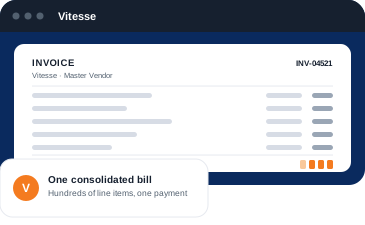
For tail spend specifically, managed procurement solutions that act as a single master vendor for all low-value indirect purchases represent a powerful complement to broader eProcurement and spend analytics capabilities. These solutions route tail spend through a controlled workflow, consolidate vendor onboarding and compliance screening, and deliver a single consolidated invoice that dramatically reduces the accounts payable processing burden associated with high-volume, low-value indirect spend. The spend data captured through the managed vendor is then available for analysis and optimization, giving procurement teams visibility into tail spend categories that were previously entirely invisible to both procurement and finance.
Contract management technology ensures that the agreements negotiated by procurement teams are actually used across the organization rather than filed and forgotten between renewal dates. Integrated contract repositories, renewal alerts, and spend-against-contract analysis allow procurement teams to monitor compliance with negotiated terms and identify where purchases are being made outside the contracted pricing structure without any visibility from the teams that negotiated the original agreement.
Common Challenges in Indirect Spend Management
Indirect spend management programs consistently encounter a set of challenges that procurement leaders should anticipate and plan for before beginning implementation, because each one has the potential to delay progress, limit adoption, or reduce the achievable savings below the level identified during the initial spend analysis.
Decentralized Purchasing Behavior
The most fundamental challenge in indirect spend management is that purchasing decisions are made by individuals throughout the organization who have no direct accountability to the procurement function and who are primarily motivated by their operational objectives rather than by procurement compliance. Changing deeply embedded purchasing habits requires a combination of policy clarity, process redesign, system enablement, and sustained communication that goes well beyond the scope of a typical procurement initiative.
Addressing decentralized purchasing behavior effectively requires procurement teams to focus on making compliant purchasing easier and faster than non-compliant purchasing, rather than simply mandating compliance and relying on enforcement. When preferred suppliers offer a better purchasing experience than going outside the approved list, and when the process for making a compliant purchase requires less time and effort than the alternative, most employees will naturally follow the path of least resistance toward the desired behavior without requiring active enforcement.
Lack of Spend Visibility
Many organizations begin an indirect spend management program without reliable data on what they are currently spending, with whom, and in which categories. Building spend visibility from fragmented source systems with inconsistent coding and categorization is a significant analytical undertaking that can consume considerable time and effort before the actual management work can begin with confidence in the underlying data.
Investing in spend analytics capability at the outset, including the data cleansing, classification, and reporting infrastructure needed to produce a reliable and consistent spend picture, should be treated as a foundation investment rather than an optional enhancement. Every program decision and priority downstream depends on the accuracy and completeness of the spend baseline established at this stage, and compromises in data quality at the beginning compound into compounding analytical errors that undermine the credibility of the program’s reported results.
Resistance from Business Units
Business units that have historically managed their own indirect purchasing relationships will often view procurement involvement as an imposition rather than a service. Category managers who approach these stakeholders with a mandate to take over supplier relationships and impose preferred vendor lists typically encounter significant resistance that can delay or fundamentally undermine program implementation without strong executive sponsorship.
Building productive relationships with business unit stakeholders requires procurement teams to demonstrate value from the outset rather than asserting authority over purchasing decisions. Bringing category market intelligence, supplier performance data, and concrete savings evidence to early stakeholder conversations positions procurement as a partner with useful expertise rather than a compliance function with a control agenda that prioritizes policy adherence over operational effectiveness.
Data Quality and Classification Issues
Indirect spend data in most enterprise finance systems reflects how transactions were coded at the point of entry rather than what was actually purchased. A consulting engagement might be coded as professional fees in one business unit, consulting services in another, and external support in a third, making it impossible to aggregate total organizational spend on consulting without significant manual reclassification work that is slow, expensive, and difficult to maintain as an ongoing process.
Addressing this challenge requires investment in spend taxonomy design, data cleansing processes, and the ongoing governance needed to maintain consistent coding discipline as new transactions are entered across the organization. AI-driven spend classification tools can significantly accelerate the cleansing of historical transaction data, but they still require human review and ongoing refinement to achieve the accuracy levels needed for reliable management decisions and credible savings reporting.
How to Measure Indirect Spend Management Performance
Measuring the performance of an indirect spend management program requires a framework of metrics that captures progress across the four dimensions that matter most: cost, compliance, efficiency, and visibility.
Cost metrics track the savings realized through category management, supplier consolidation, and contract coverage improvement relative to the baseline established at the program’s outset. Savings should be measured on a like-for-like basis that accounts for volume changes and market price movements, and reported against stated targets in a consistent format that allows meaningful comparison over time and builds credibility with finance leadership.
Compliance metrics measure the proportion of indirect spend flowing through preferred suppliers and approved channels. Maverick spend rate, which is the percentage of spend in managed categories made outside contracted supplier arrangements, is the most direct indicator of whether the program’s behavioral change objectives are being achieved across the organization and whether the controls put in place are functioning as intended.
Efficiency metrics capture the administrative cost of managing the indirect spend portfolio, including the procurement resource cost per dollar of spend under management, the accounts payable processing cost per indirect invoice, and the time required to onboard a new supplier or establish a new category contract. Improvement in these metrics reflects the efficiency gains from supplier consolidation, process standardization, and technology enablement that reduce the overhead cost of the procurement function relative to the spend it manages.
Visibility metrics track the completeness and accuracy of the spend data available to procurement and finance teams at any given point in time. The proportion of total indirect spend that has been categorized and analyzed, the frequency with which spend reporting is refreshed, and the coverage of spend analytics across business units and geographies all indicate how comprehensively the organization understands its indirect spend profile and how confidently decisions can be made based on the available data.
Frequently Asked Questions About Indirect Spend Management
What is indirect spend management?
Indirect spend management is the practice of applying structured procurement discipline to all goods and services that support business operations rather than directly contributing to what the organization sells. It involves identifying, categorizing, and actively managing indirect purchasing activity across all departments and categories to reduce costs, improve compliance, and build the spend visibility that enables better business decisions.
What is the difference between indirect and direct spend?
Direct spend covers goods and services that are directly incorporated into the product or service the organization delivers to its customers, such as raw materials, components, and contract manufacturing. Indirect spend covers everything required to operate the business itself, including IT, facilities, professional services, marketing, travel, and office supplies. Direct spend typically varies with production volume; indirect spend is driven by operational activity across the whole organization and tends to be more decentralized and more difficult to bring under consistent procurement control.
What are examples of indirect spend categories?
Common indirect spend categories include information technology, facilities management, professional and consulting services, marketing and creative services, travel and expenses, maintenance and repair, office and workplace supplies, temporary and contract labor, and logistics and distribution. The specific mix and relative importance of these categories varies by industry and organizational model, but most enterprise organizations have significant spend in several of these areas that is not being actively managed at a category level.
Why is indirect spend hard to control?
Indirect spend is difficult to control because it is decentralized across all departments rather than managed through a central procurement function, involves a very large number of individually small transactions that do not each justify formal procurement process involvement, spans an enormous diversity of categories with different market structures and supplier landscapes, and is subject to resistance from business units that have established their own purchasing relationships and perceive procurement involvement as an obstacle to operational agility rather than a service that adds value.
How do you reduce indirect spend?
Reducing indirect spend requires a combination of improved spend visibility, supplier consolidation, structured category management, and purchasing controls applied consistently across the organization. The starting point is always a comprehensive spend analysis that identifies where the greatest savings opportunities lie and which categories should be prioritized first. From that foundation, supplier consolidation reduces the cost and administrative overhead of a fragmented vendor base, category management programs drive savings through competitive sourcing and contract coverage improvement, and procurement policy enforcement reduces maverick purchasing that bypasses contracted supplier arrangements and realizes cost at list price rather than negotiated rates.
What is maverick spend in indirect procurement?
Maverick spend, sometimes called rogue spend, is purchasing activity made outside the organization’s approved procurement processes and preferred supplier arrangements. In indirect spend, maverick purchasing typically occurs when employees buy from suppliers of their own choosing rather than from the preferred vendor list, often because the compliant process is perceived as too slow or complex relative to the urgency of the operational need. Maverick spend results in higher costs, compliance exposure, and spend data that is difficult to capture and analyze accurately because it flows through channels that sit outside the standard procurement and finance workflow.
How does tail spend relate to indirect spend?
Tail spend is a subset of indirect spend that specifically refers to the high-volume, low-value transactions at the bottom of the spend curve, where a large number of vendors each account for only a small fraction of total purchasing activity. All tail spend is indirect spend, but indirect spend also includes the larger, strategically managed categories such as IT, professional services, and facilities that sit above the tail in the spend distribution. A complete indirect spend management strategy addresses both the strategic categories through category management programs and the tail through consolidation and managed procurement solutions that route low-value purchases through a controlled, visible process.
What technology supports indirect spend management?
The primary technology enablers of indirect spend management are spend analytics platforms for categorizing and continuously analyzing purchasing activity across source systems, eProcurement platforms for guiding employees toward compliant purchasing through preferred supplier catalogs and integrated approval workflows, contract management systems for maintaining visibility over negotiated agreements and their actual utilization across the business, and managed tail spend solutions for consolidating low-value indirect purchases through a single controlled vendor relationship that provides full spend visibility and a consolidated invoice for finance teams. Together these technologies provide the visibility, control, and efficiency infrastructure that makes enterprise-scale indirect spend management practically achievable across large and complex organizations.